
Live in 2 days: a manufacturer replaces 40 hours a week of MRP spreadsheets
Connected to its ERP in two days, an industrial manufacturer with four business units replaced a weekly MRP spreadsheet that took four people 10 hours each, and found where its real risk sat.
- From connecting the ERP to first answers
- 2 days
- Integration with the manufacturer's ERP, start to finish
- Of spreadsheet MRP work replaced
- 40 hrs/week
- Four people spent about 10 hours a week each, before CargoCore
- Of P&L work saved, including weekends
- 2 weeks/month
- As reported by the manufacturer's leadership
- Of receivables over 120 days were owed internally
- 84%
- External collections risk was 16% of the overdue balance
“The P&L feature saved two weeks of work every month, including weekends.”
The challenge
The company is an industrial manufacturer with four business units and several plants, making engineered components for HVAC, power generation, industrial OEM and military markets. It runs one ERP across all four units.
Every week, four people spent about 10 hours each building a material requirements planning (MRP) spreadsheet by hand: pulling open orders, material status and job data out of the ERP and stitching them together. Forty hours a week went into producing the picture, which left little time to act on it, and the picture was already a week old by the time anyone read it. Closing the books was its own grind: producing the P&L took about two weeks every month, often including weekends.
Leadership also had questions the spreadsheets couldn't answer quickly: which unit's backlog was actually going to ship, where late work was piling up on the shop floor, and how much of the overdue receivables balance was a real collections problem.
The approach
The manufacturer connected its ERP to CargoCore, and the integration took two days. CargoCore reads the material planning, sales outlook, shop-floor, bookings, invoicing and financial data the company already had, live, so the weekly spreadsheet was no longer needed.
The team now works from a handful of views:
Material Planning Command Center: every sales order at risk from a supply shortage or material gating, ranked by risk, with units short, the need-by date, what's critical inside 14 days, and an owner and status on each.
Monthly Sales Outlook: open backlog, what ships this month and what's blocked by material shortage, capacity or other holds, plus where late-shipping work is stuck, by work center.
Sales, backlog, bookings and invoices: performance by business unit, end market and customer, compared year over year.
Financial reports: trial balance, balance sheet, income statement and P&L across all four units, without the monthly manual build.
Workflows and an Intelligence Center: insights and anomalies turned into tracked work, and plain-language questions answered from the company's own data.
Data quality: completeness checks on the ERP tables behind every view, so gaps are found and fixed at the source.
In the first 90 days, that answered six operating questions end to end: revenue pulse, end-market mix and customer concentration, backlog and ship risk, shop-floor late jobs, receivables aging, and payables. Each finding came with an owner and a next step.
The results
Measured over the 90 days to October 13, 2026, from the manufacturer's own ERP data. Four of the six questions surfaced something worth acting on.
Time back. The manual MRP spreadsheet that took four people about 10 hours a week is gone, and leadership reports the P&L feature saves two weeks of work every month, including weekends.
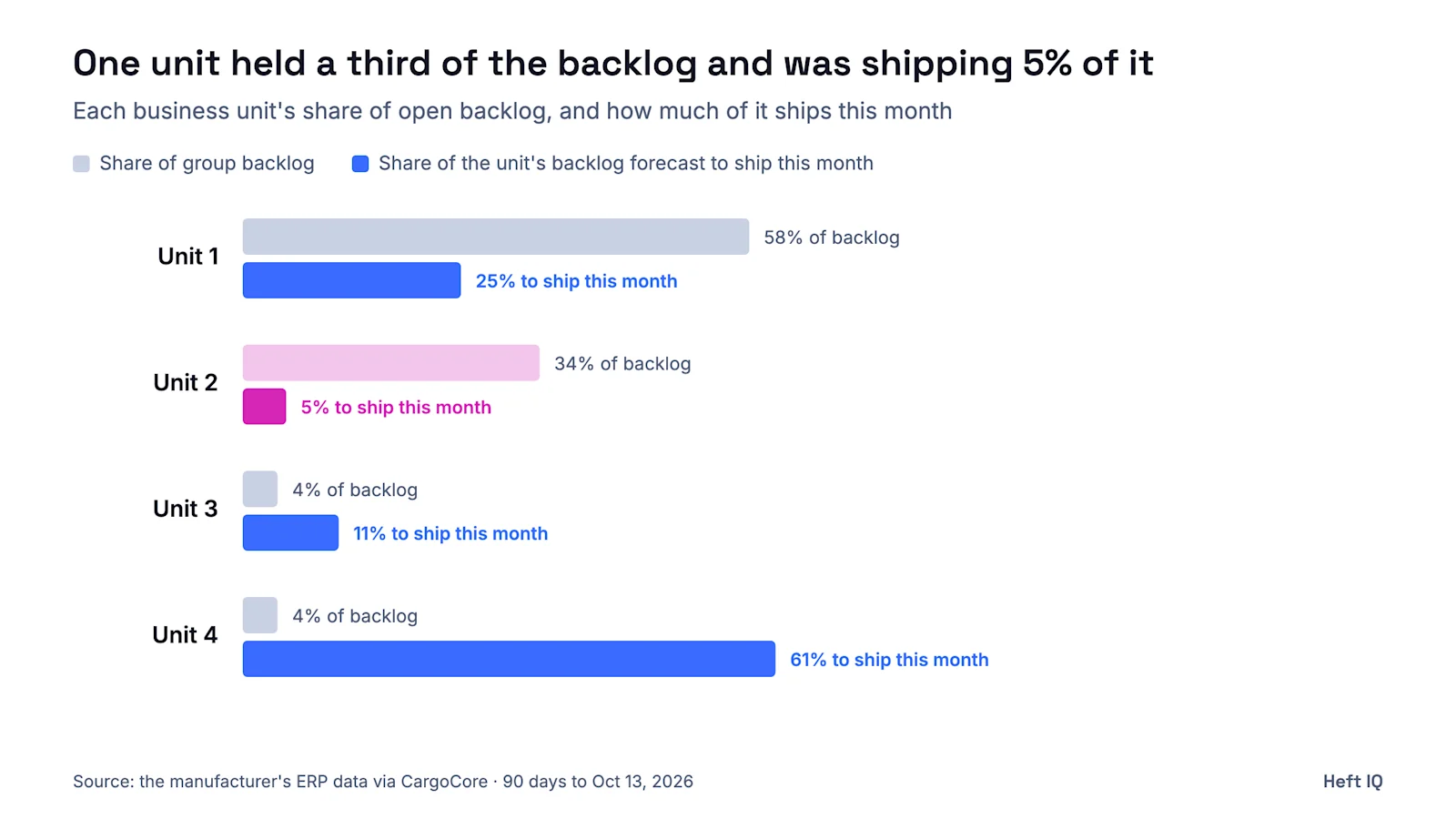
A stalled backlog, made visible. One business unit held about a third of the group's open backlog but was forecast to ship only 5% of it this month, which explained its revenue drop. Another unit had 76% of its backlog blocked by material shortages, flagged for expediting starting with the largest shortage parts.
Shop-floor risk, located. About 15% of active job releases were late, and one plant held 72% of them, with more due in the next three days. CargoCore also showed that 77% of late releases had no resource group recorded, which is why the bottleneck couldn't be pinned down. Requiring one became part of the fix.
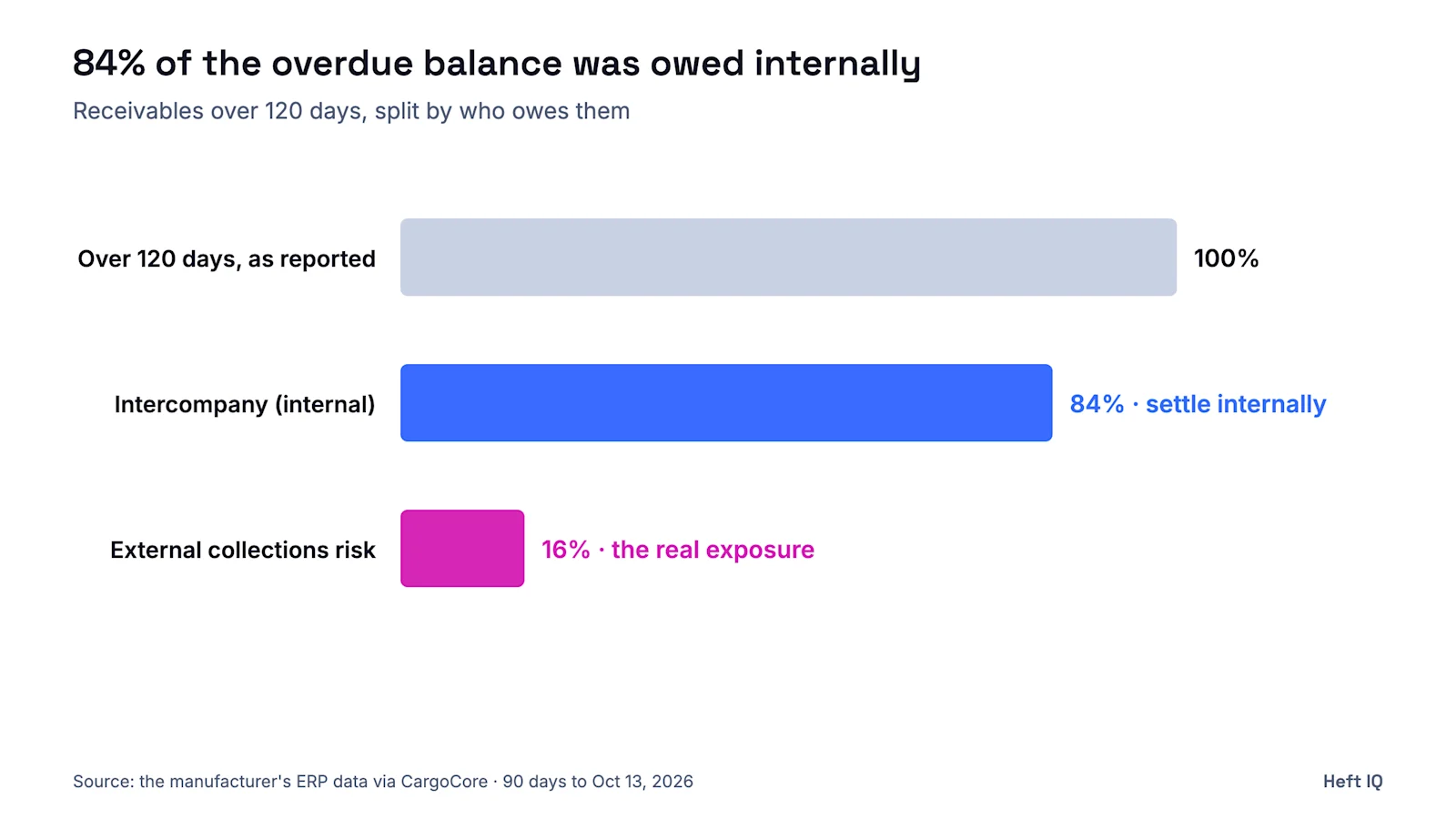
The real collections risk. Of receivables more than 120 days overdue, 84% was intercompany, owed between the company's own business units, which can be netted or settled internally. Only 16% was external collections risk, about 5% of external receivables, with one customer account making up a large share of it.
A question for payables. Payments in the window recorded no early-payment discounts. That's either a missed opportunity or a sign discounts are booked elsewhere, and the team is checking which vendors offer discount terms.
What's next. The team is working through a prioritized list: review the stalled backlog line by line, expedite the material-blocked orders, run a daily late-jobs review at the busiest plant, and settle intercompany balances. The same study will be re-run in January 2027 against these baselines.