
Closing the peak planning gap between brands and their 3PL
When a promotion reaches the 3PL as an order spike instead of a forecast, everyone pays: in temp labor, in a shared building's cutoffs, and in January returns.
On this page
At 9:15 on a Thursday morning in early December, the order queue for a home goods brand jumps to six times its usual rate. The brand's growth team had planned a 35%-off flash sale for weeks, and the email went out at 9 a.m. The 3PL's account manager learns about it from the site manager, who learns about it from the WMS. The building is already running two other brands' holiday promotions on the same pack lines.
Neither side did anything unusual. The brand's marketing calendar and the 3PL's labor plan simply never met. This article traces what that gap costs both sides, for brand operators and 3PL leaders alike. It is one of the chains in our guide to where peak season drains 3PL margin. All figures are illustrative.
The chain of impact
A promotion is planned without the 3PL (the brand's marketing team). The sale is built around an inventory position the brand believes is ready. The forecast lives in a marketing deck and a spreadsheet, not anywhere the 3PL can see it.
Notice arrives late or not at all (the 3PL account manager). At best, the account manager gets an email two days out. At worst, the first notice is the order spike itself. There is no time to plan waves, pre-kit, or move stock to the right building.
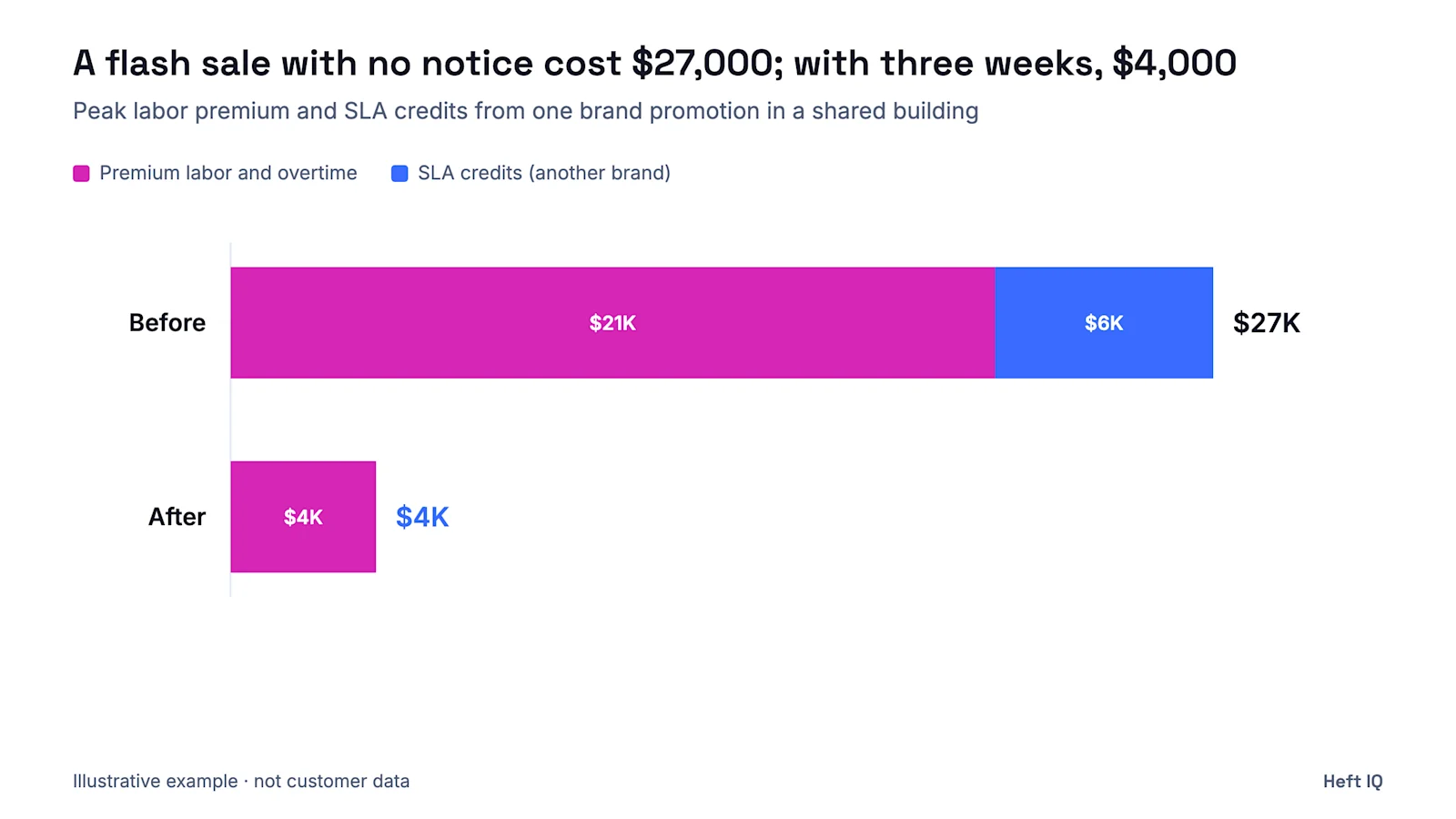
A staffing gap opens (labor planning and the temp agency). The building needs 30 extra pickers and packers for four days. The temp agency needs a week's notice for its standard rate, so the site fills the gap with overtime and same-week temps at a premium. Illustratively, that is $21,000 more than the same labor planned two weeks out.
Brands collide in a shared building (the floor and every brand's SLA). The flash sale competes with two other brands for the same pack stations and the same carrier pickup. Something has to give: one brand's orders slip past cutoff, and that brand's SLA credits, about $6,000 in this example, land on a customer that did nothing wrong.
Returns arrive in January with no plan (the returns team). Promo orders return at a higher rate. About 4,500 returns hit the returns area in the first two weeks of January, when temp labor has been released. Returns processing falls behind, and refunds and restocking slow down for the brand.
Follow-up questions get buried (two inboxes). After the sale, the brand finds an inventory mismatch on two SKUs and needs a corrected BOL for a transfer. Both requests sit in an account manager's inbox among hundreds of peak emails. Weeks later, neither side is sure who owes the next step.
The brand thinks it gave notice. The 3PL thinks it got none. Both are looking at different systems.
How teams catch it today
On the 3PL side, peak planning runs on whatever brands send: a forecast attached to an email, a note in a quarterly review, a call the week before. Account managers copy those numbers into a labor model by hand, and anything that arrives late or never arrives shows up as a surprise on the floor. Cross-brand conflicts are found by a site manager who notices three promotions on the same week's calendar, if a calendar exists.
On the brand side, operators chase answers from the 3PL by email and phone. Is the building staffed? Did the transfer land? Was the mismatch resolved? Each question starts a new thread. When something goes wrong, both sides rebuild the timeline from sent mail to work out who knew what, and when.
How CargoCore catches it
CargoCore gives the brand and the 3PL one shared path for peak plans and the requests that follow them.
Campaign forecasts the 3PL can confirm
The brand uploads a campaign forecast in the CargoCore brand portal, which also forecasts demand per SKU and warehouse. The assigned 3PL account managers are emailed. The 3PL assigns warehouses and either confirms or requests changes, so both sides know the plan has been seen and accepted.
CargoCore then checks each forecast against the network. Its detectors flag a staffing gap, SLA at risk with overtime and SLA credit dollars, cross-brand conflict in a shared building, capacity risk, late notice, and the expected returns load. After the campaign, it shows what a forecast miss cost, so next year's plan starts from real numbers.
Requests tracked to resolution
3PL Messaging replaces the inbox for the follow-up. Each request has a type (inventory discrepancy, document request, or general operational), a priority, a due date and overdue tracking. The "Needs your reply" and "Waiting on you" views show who owes the next step. A Documents area holds files such as a corrected BOL, and an Audit Trail records what happened and when. A brand's request is tracked to resolution instead of getting buried.
Owned actions on both sides
Findings on either side land in an Action Queue as owned, dated actions tracked to done. On the brand side, the queue shows value at stake and value captured, and replenishment shows a projected stockout date with the option to expedite an inbound, reallocate or transfer before the sale. On the 3PL side, warehouse managers act on their tasks in Mobile Ops.
Illustrative example
Picture a composite 3PL running six buildings, with the home goods brand sharing its Southeast site with two other brands. These figures are illustrative.
Before. The flash sale arrived as an order spike. Premium temps and overtime cost $21,000 above plan. Another brand missed cutoff on 2,400 orders, costing about $6,000 in SLA credits. In January, 4,500 returns took three weeks to clear. The inventory mismatch stayed open for 26 days, and the corrected BOL was sent twice.
After. The brand uploads its campaign forecast three weeks out. The account manager is emailed the same day, assigns the Southeast building and requests a one-day shift to avoid a conflict that CargoCore has flagged with another brand's promotion. The staffing gap and returns load detectors give the site manager time to book temps at the standard rate and plan January returns labor. After the sale, the mismatch and BOL go through 3PL Messaging with due dates. In this illustration, premium labor falls to $4,000, no brand misses cutoff, and both requests close within four days.
Peak plans work when both sides see them early. To see how CargoCore connects campaign forecasts, the 3PL's network and the requests in between, visit the CargoCore product page.