
Where peak season quietly drains 3PL margin
Peak shifts cost to serve brand by brand. Unbilled work, DIM-weight overcharges, labor variance and misplaced inventory add up long before the month-end P&L shows it.
On this page
It is the Monday after Cyber Week. Every building shipped record volume and the floor managers are proud of the numbers. Then the controller pulls the first cut of the November P&L by customer: revenue is up 40%, but contribution margin on three of the five largest brands has fallen by more than a third. Nobody can say exactly where it went, and December is already half planned.
Peak rarely breaks a 3PL in one dramatic failure. It leaks margin through small shifts that each look reasonable on the floor: a different order mix, a gift insert requested by email, a temp packer reaching for a bigger carton, a best seller sitting in the wrong building. Each lands in a different team and a different system. Together they decide whether the busiest quarter is also the most profitable one.
Below is how those shifts connect, why they surface weeks late, and how CargoCore puts the dollars and the owner in front of the right team in time. All figures are illustrative, built around a composite 3PL.
Why peak hides margin loss
Most 3PL contracts price peak work on rates set months earlier, using an order profile from a quieter period. Peak changes that profile overnight. Single-unit gift orders spike, promotions add special packing rules, and trained regulars are joined by temps in their second week. The rate card stays the same. The cost to serve each brand, and often each SKU, does not. And the evidence is split across the WMS, the timeclock, carrier invoices and supervisor email, so no single report shows the change while it is happening.
The chain of impact
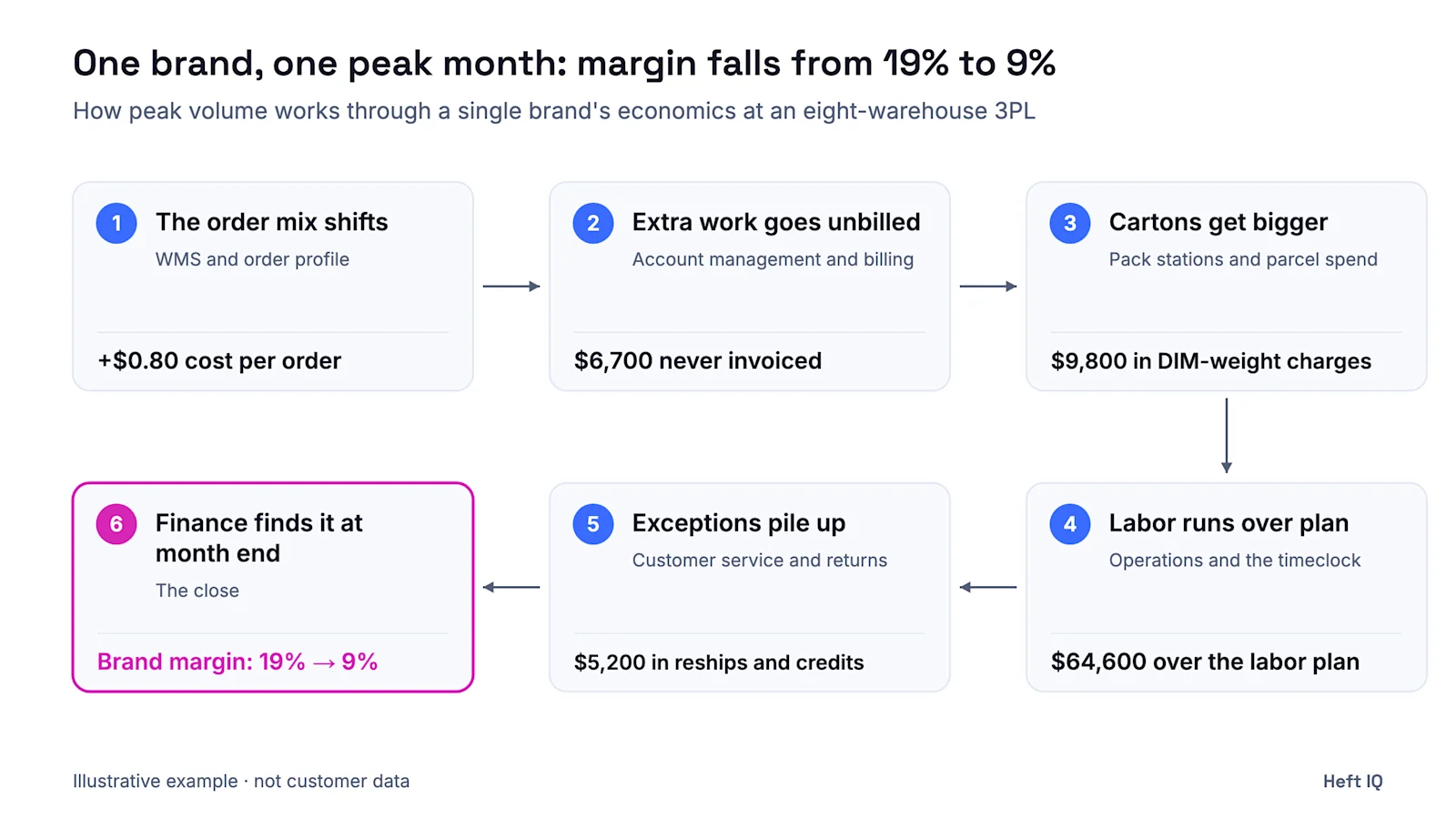
Here is how one trigger, peak volume, works through a single brand's economics at an illustrative eight-warehouse 3PL:
The order mix shifts (WMS and order profile). A beauty brand's units per order fall from 2.6 to 1.5 as gift sets and single-item promos take over. Picks, cartons and labels per unit all rise. Cost to serve climbs from $3.10 to $3.90 per order while the contracted pick and pack rate stays flat.
Extra work goes unbilled (account management and billing). The brand asks by email for a holiday insert in every order and a relabel on 4,000 units. The floor does the work, but nobody enters it as billable activity. Roughly $6,700 in fees never reaches the invoice.
Cartons get bigger (pack stations and parcel spend). The right-sized carton runs out on second shift and temp packers default to the next size up. Added DIM-weight charges on 7,500 parcels come to about $9,800 that the 3PL absorbs on a rate it already quoted.
Labor runs over plan (operations and the timeclock). New temps pick at about 70% of the planned rate, and the building covers the gap with 1,900 overtime hours. At $34 an hour, that is about $64,600 above the labor plan.
Exceptions pile up (customer service and returns). Mis-picks and short-ships rise with the new labor mix. Reships, credits and handling cost another $5,200 for this brand.
Finance finds it at month end (the close). The P&L by customer shows the brand's margin down from 19% to 9%. By the time the analysis lands in mid-December, the November loss is locked in and December is running on the same pattern.
A second chain: inventory in the wrong building
Multi-node 3PLs also leak margin through inventory placement:
Inventory sits in the wrong building (replenishment and inventory control). A brand's best seller is replenished heavily into the East building while the West building runs low ahead of a promo.
Orders ship two or more zones farther (fulfillment). About 24% of the brand's West Coast orders now ship from the East building, two to four zones beyond the nearest one.
Transit time stretches (carriers and end customers). Ground transit on those orders grows by about 1.5 days, just when shoppers watch delivery dates most closely.
Ship-by promises come under pressure (the East building's floor). The building carries another building's demand on top of its own, so more orders are due today and more slip past ship-by. Overtime rises again.
SLA pressure reaches the account (account management). The brand sees slower deliveries in its own data and asks for credits at the quarterly review.
Each step looks like a local problem to the team it lands on. The cost only becomes obvious when the steps are connected.
How teams catch it today
In most 3PLs, catching these leaks depends on a monthly analysis. A finance analyst exports order lines from the WMS, hours from the timeclock and charges from carrier invoices, then joins them in spreadsheets by customer. Shared costs such as overtime get spread across brands by volume, which makes an expensive brand look average. Extra activity shows up only if a supervisor remembered to log it.
Operations, meanwhile, watches waves, cutoffs and headcount in the WMS, but those screens show units, not dollars. A building manager can see that second shift is behind, but not that the delay is concentrated in one brand whose margin is already underwater. Account managers hear about routing problems from the brand, after it has built its own case. The loop runs weeks behind the floor.
How CargoCore catches it
CargoCore connects the steps in both chains and puts a dollar value and an owner on each one while the work is still happening.
Cost to serve, down to the SKU
The Executive Command Center shows cost to serve by region, warehouse, brand and SKU, with revenue, labor, freight, storage, exceptions and margin side by side. Costs that cannot be traced to a SKU are shown separately instead of being spread across every SKU, so shared costs do not blur any one brand's true margin. CargoCore flags margin erosion, labor variance, shipping variance, DIM-weight overcharges and the activity-fee revenue gap between work performed and work billed.
Floor alerts ranked by dollars
The Ops Command Center ranks alerts by urgency times dollars at stake, each with an owner role. It covers cutoff risk and past-cutoff orders, receiving pace against the ASN, inbound no-shows, SLA breaches, labor gaps, cutoff cascades and stale WMS syncs, which shows when the data itself has gone quiet.
Network routing in plain view
CargoCore's 3PL Live View shows each building's ship-by promise (shipped by the ship-by date, due today, past ship-by), fulfillable units and open purchase orders, including counts more than 90 days late. It shows the share of orders shipped from a building two or more zones farther than the nearest one, average zone and ground transit days compared with the nearest building, and a Watch or At risk status for each building.
Owned actions, tracked to done
Dollar-valued alerts flow into the Action Queue, where each finding becomes an owned, dated action tracked to completion. Warehouse managers work their tasks in Mobile Ops, and dismissing a task requires approval, so a hard problem cannot quietly disappear. Leaders get a morning brief from the Executive Advisor that they can read or listen to. When it is time to reprice, Deal Desk moves a quote from draft to ops review to approval with a margin preview, and flags deal drift.
Illustrative example
Consider a composite 3PL running eight warehouses for about 140 brands. These numbers are illustrative.
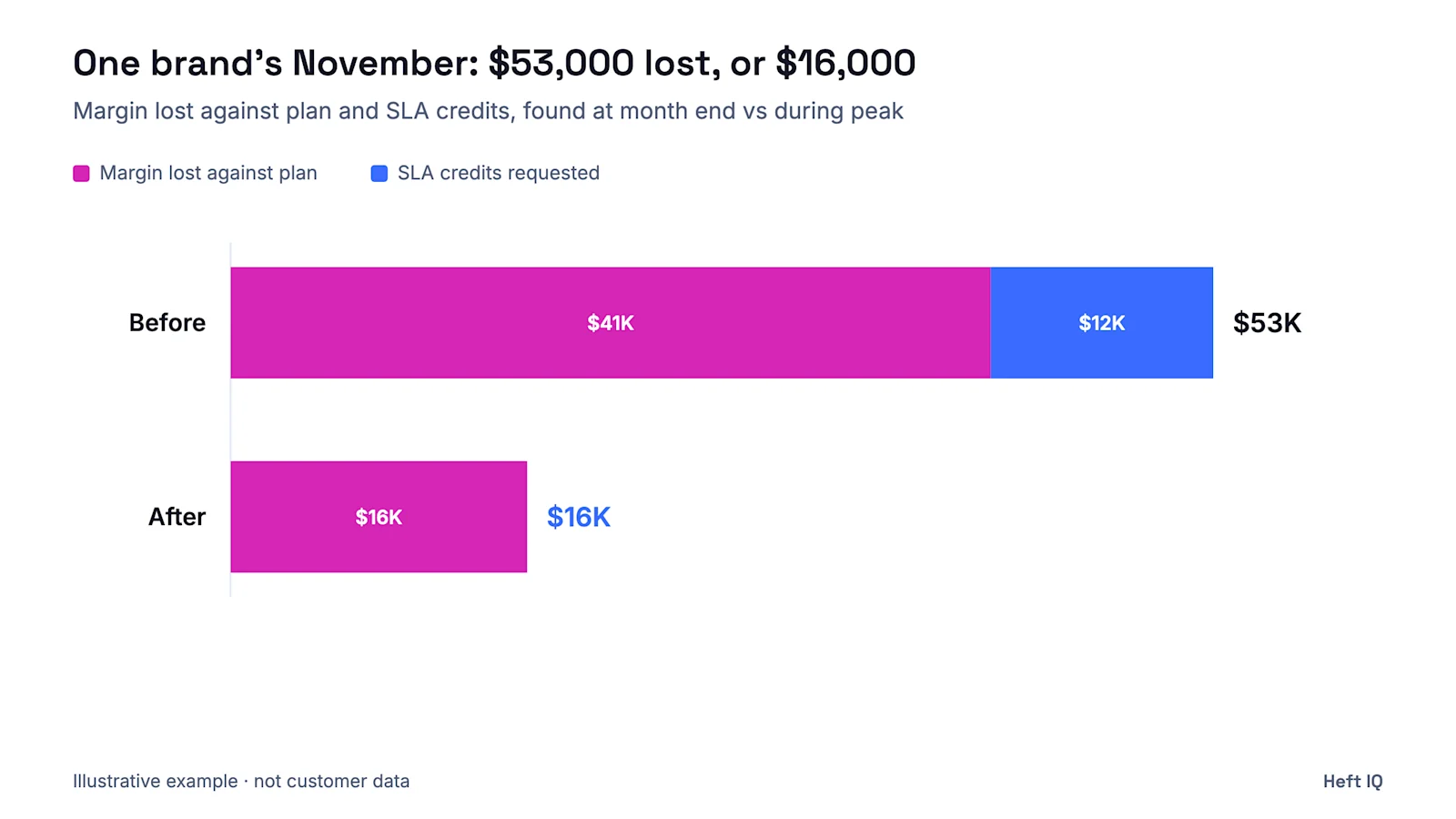
Before. In November, the beauty brand above generated $412,000 in revenue. Finance ran the customer P&L on December 14 and found margin had fallen from 19% to 9%, a gap of about $41,000. The unbilled inserts were never recovered because the brand disputed charges raised a month late. The routing problem came up in a January review, along with a request for $12,000 in SLA credits.
After. With CargoCore, the activity-fee gap appears in the first week of peak and becomes an action for the account manager, who bills the inserts and relabel while the brand still remembers asking for them. The DIM-weight alert goes to the building's operations manager, who restocks the right carton. The labor variance and the brand's falling margin sit side by side, giving the account team the facts for a peak surcharge conversation. 3PL Live View marks the West building At risk, and a transfer is assigned before the promo. In this illustration, the 3PL holds November margin at 15% instead of 9%, keeps about $25,000, and avoids the credit request.
Two chains worth a closer look
Two of the costliest peak chains start before an order is picked. One begins at the receiving door, where a late inbound cascades through cutoffs into SLA credits and overtime: how a late inbound becomes SLA credits. The other begins in a brand's marketing calendar, where an unannounced promotion becomes a staffing gap and a capacity conflict: how brands and 3PLs close the peak planning gap.
To see how CargoCore traces cost to serve, ranks floor alerts by dollars and tracks every fix to done, visit the CargoCore product page.