
What a peak-season carrier no-show really costs to recover
The re-cover premium is only the first bill. A no-show runs through chargebacks that rarely get collected, lost margin and the same carrier getting the next load. Here's the full chain.
On this page
It's 7:40 a.m. on the second Friday in December. The dry van that was due at a distribution center outside Columbus at 7:00 hasn't checked in, and the driver isn't answering. By 8:15 the dispatcher admits the truck is still in Indianapolis. The load has to deliver to a retailer's DC by Monday morning, and the shipper's logistics manager has already called twice. The rep re-posts it into the tightest market of the year.
Every broker knows a no-show costs a premium to re-cover. Fewer can say what it costs once the chargeback, the write-off and the next tender are counted. This piece follows that chain, one of the costliest covered in our overview of peak freight decisions you can defend.
The chain of impact
Carrier sales re-covers at a peak premium. The original rate was $1,850 on a $2,300 customer rate. With a few hours' notice on a Friday in December, the best truck available is $2,500. The $450 margin is now a $200 loss, before anything else happens.
Operations and the account team absorb the fallout. The new truck picks up mid-afternoon, so the shipper's dock has to reschedule and the delivery appointment gets pushed. Two coordinators and the account manager spend most of the morning on the phone. The customer starts asking whether this lane needs a different broker.
Carrier settlement issues a chargeback, and rarely collects it. The brokerage bills the carrier $650 for the re-cover cost. The carrier disputes it, or simply stops hauling for the brokerage. At peak, few teams have the time to chase it, and fewer want to burn a carrier they may need next week. Most of these chargebacks end up written off.
Finance books the loss on the lane, not on the decision. The re-cover premium, the unrecovered chargeback and the staff time appear as margin erosion on the lane. The month-end report shows the Columbus lane underwater, but not which tender caused it.
Carrier procurement tenders to the same carrier again. Nothing in the scorecard has changed yet, the carrier's rate is still the lowest, and the lane is thin. Two weeks later it falls off a second load. The pattern was visible after the first no-show, but nobody connected the dots in time.
The re-cover premium is the cost everyone sees. The repeat tender is the cost nobody planned for.
How teams catch it today
In most brokerages, a no-show is handled as an incident, not as a cost that keeps compounding.
The re-cover is a fire drill. Reps rebuild the load from scratch, post it, call through a carrier list and take what's available. The premium is noted, if at all, in a load note.
Chargebacks live in a separate workflow, usually a spreadsheet in carrier settlement. Whether one gets collected depends on who follows up, and that follow-up competes with paying hundreds of peak invoices.
The margin hit is reconciled at month end, when nobody remembers why the Columbus lane went negative.
Carrier performance reviews run monthly or quarterly. A carrier that no-shows in the first week of December is still getting tenders in the third week, because the review hasn't happened.
There's no record of why the carrier was chosen in the first place, so nobody can tell whether the no-show was a risk worth taking or a warning that was missed.
How Margo catches it
Margo treats a no-show as one chain from start to finish, and makes sure the next tender knows about it.
Margin Command shows the whole chain. The no-show, the re-cover premium, the chargeback to the carrier and the resulting margin loss sit in one view, tied to the load and the carrier.
A decision trace from the original tender. Margo captured the options, the all-in cost of each and a snapshot of the carrier when the load was tendered. The team can see whether the carrier's record called for caution.
Carrier trust updates with the outcome. The no-show feeds the carrier's trust and performance score, with confidence bounds that reflect how much history there is. One bad day from a carrier with 300 loads reads differently from one bad day out of four.
A trust gate on repeat patterns. Your team sets where Margo can act on its own and where a person signs off. A carrier whose trust has dropped doesn't get auto-tendered the next peak load because its rate is lowest. The decision goes to a person, with the history in front of them. Any autonomous action can be undone within an undo window.
Coverage depth now and in 30 days. If the no-show leaves a lane thin, carrier procurement can see how thin, and whether January looks worse, while there's still time to add carriers.
Decisions scored against outcomes. Past tenders are scored against what happened, so the team learns which carriers are worth the risk at peak.
Each no-show produces owned, dated actions in Margo's Action Queue: the chargeback for carrier settlement to pursue, the carrier review for the carrier sales lead, the coverage gap for procurement. The queue tracks each one to done, so a chargeback doesn't quietly age out in a spreadsheet.
Illustrative example
These figures are illustrative, based on a composite brokerage covering about 900 loads a week at peak, mostly dry van retail freight in the Midwest.
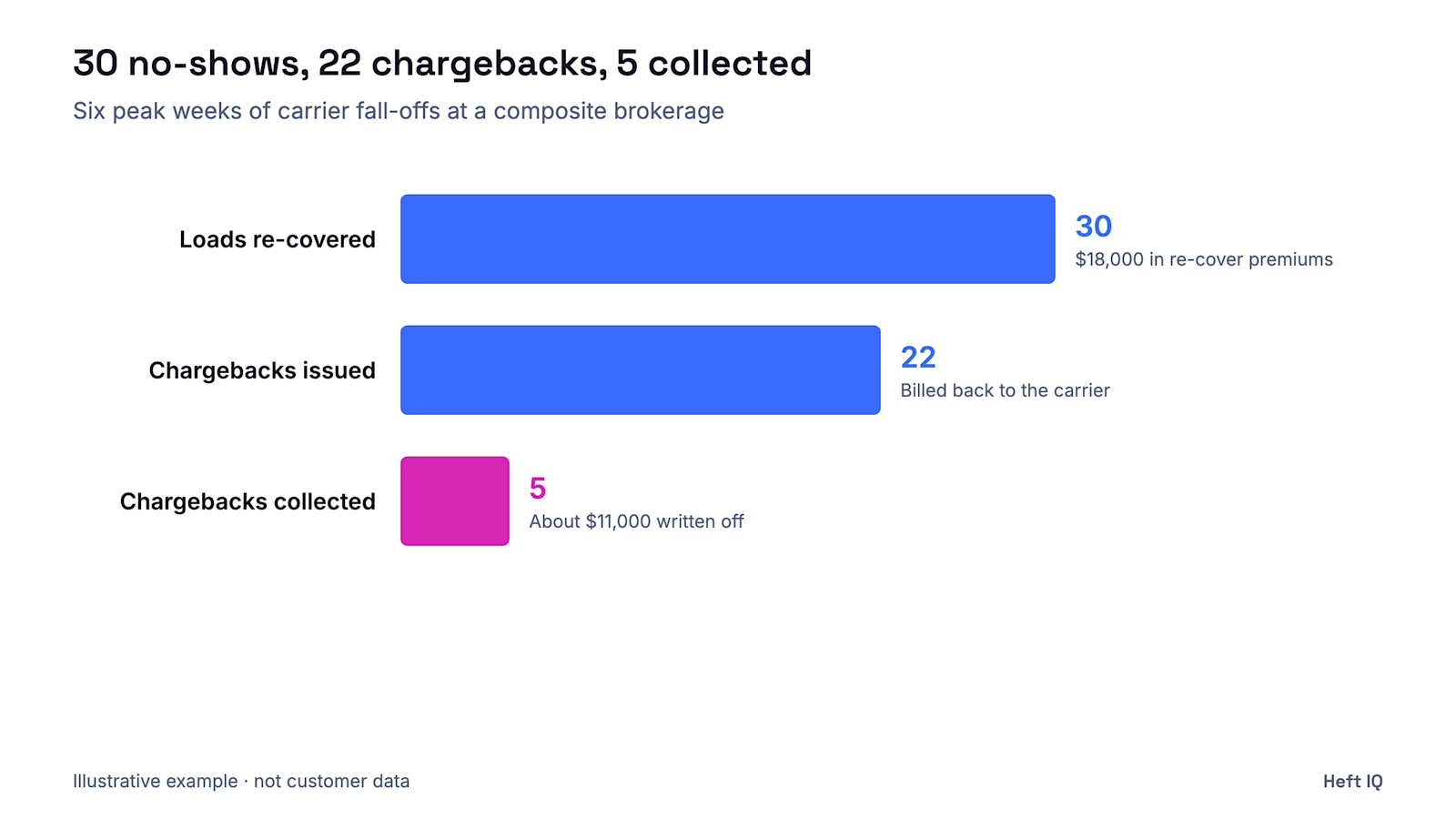
Before. Over six peak weeks, 30 loads fall off after tender. Each is re-covered at an average $600 premium, $18,000 in all. Chargebacks are issued on 22 of them, but only five are collected, leaving about $11,000 of chargebacks written off. Four of the no-shows come from two carriers that had already fallen off a load earlier in the season. Those repeats alone cost $2,600 in premiums, plus a strained relationship with one shipper.
After. Each no-show appears in Margin Command with its full cost. Chargebacks go into the Action Queue with an owner and a date, so collection is tracked instead of forgotten. After the first no-show, both repeat carriers lose trust, and their next tenders go to a person for approval. Those four repeat fall-offs don't happen, and procurement adds coverage on the two lanes that were thinning for January.
A no-show at peak is going to cost something. A second one from the same carrier doesn't have to. See how Margo connects the no-show, the chargeback and the next tender.