
Peak freight decisions you can defend, load by load
All-in cost, carrier trust, coverage depth and a decision trace: what a brokerage needs to make fast peak tender calls it can still explain when the invoice and the customer ask.
On this page
It's the Monday after Thanksgiving. A carrier sales rep has 38 open loads, the spot market moved twice before lunch, and an email lands from a shipper's transportation manager: why did last Tuesday's Dallas to Atlanta load bill $640 over the quote? The rep remembers booking the carrier. The rate was the lowest one offered, and the truck was available. What the rep can't reconstruct is everything else: what the market was paying that day, how that carrier had performed on the lane, and where the detention line and the lumper receipt on the invoice came from.
Peak doesn't create new problems for a brokerage. It compresses old ones. Tender decisions get made faster, with less information, by reps covering three times their normal load count. The cost rarely shows up on the load itself. It shows up weeks later in carrier settlement, a billing dispute, a carrier scorecard, and a month-end margin report nobody can trace back to the tender.
This article frames that problem space. Two companion pieces go deeper on the costliest chains: why the cheapest linehaul is so often the most expensive decision, and what a peak carrier no-show really costs to recover.
The four questions behind every peak tender
Every load covered in December answers four questions, whether or not anyone asks them out loud.
What will this load actually cost? Not the linehaul on the rate confirmation, but linehaul plus fuel plus the accessorials that come with it.
Will this carrier do what it said? Show up for the pickup appointment, deliver the load intact, and send an invoice that matches the rate confirmation. And how sure are you, given how many loads you've actually run with them?
How deep is coverage on this lane? How many carriers you trust can run it today, and how many will still be available in 30 days, when the post-holiday returns freight hits.
Can you defend the choice? When the customer, the carrier or your own finance team asks why this carrier at this rate, can anyone show the reasoning?
At peak, memory is the first thing to go.
The chain of impact
Here is how a single fast decision travels through a brokerage. The trigger: a rep covers a thin lane at peak by taking the lowest linehaul offered, from a carrier with little history on that lane.
Carrier sales books the load on linehaul alone. The new carrier offers $2,150 against $2,400 from a carrier the team knows: $250 of apparent extra margin on a $2,900 customer rate.
Track and trace inherits a missed appointment. The driver checks in two hours after the pickup window, the shipper's dock reworks the slot, and the truck sits for five hours. The carrier bills detention. The customer won't pay for it, because the late arrival caused the wait. The brokerage is now carrying $225 of detention it can't pass through, plus the time an operations coordinator spent on calls.
Carrier settlement receives a different invoice. Detention, a $160 lumper receipt at the consignee and a recalculated fuel surcharge arrive as a single total. The invoice is $455 over the rate confirmation. AP spends 40 minutes on it, then either short-pays and starts a dispute with the carrier, or pays in full to keep the carrier happy during peak.
Account management fields the customer's question. The shipper disputes the accessorials on their invoice. The account manager can't show what the market was or why this carrier was chosen, and some credibility in the next rate negotiation goes with it.
Carrier procurement loses a lane. The same carrier falls off its next two loads on the lane. Both are re-covered at a $500 premium, and a lane that looked covered for January is suddenly thin.
Finance closes the month on a number nobody can explain. The $250 'win' turned into a loss of more than $1,000 across three loads. It shows up as margin erosion on the lane, with no line connecting it back to the original tender.
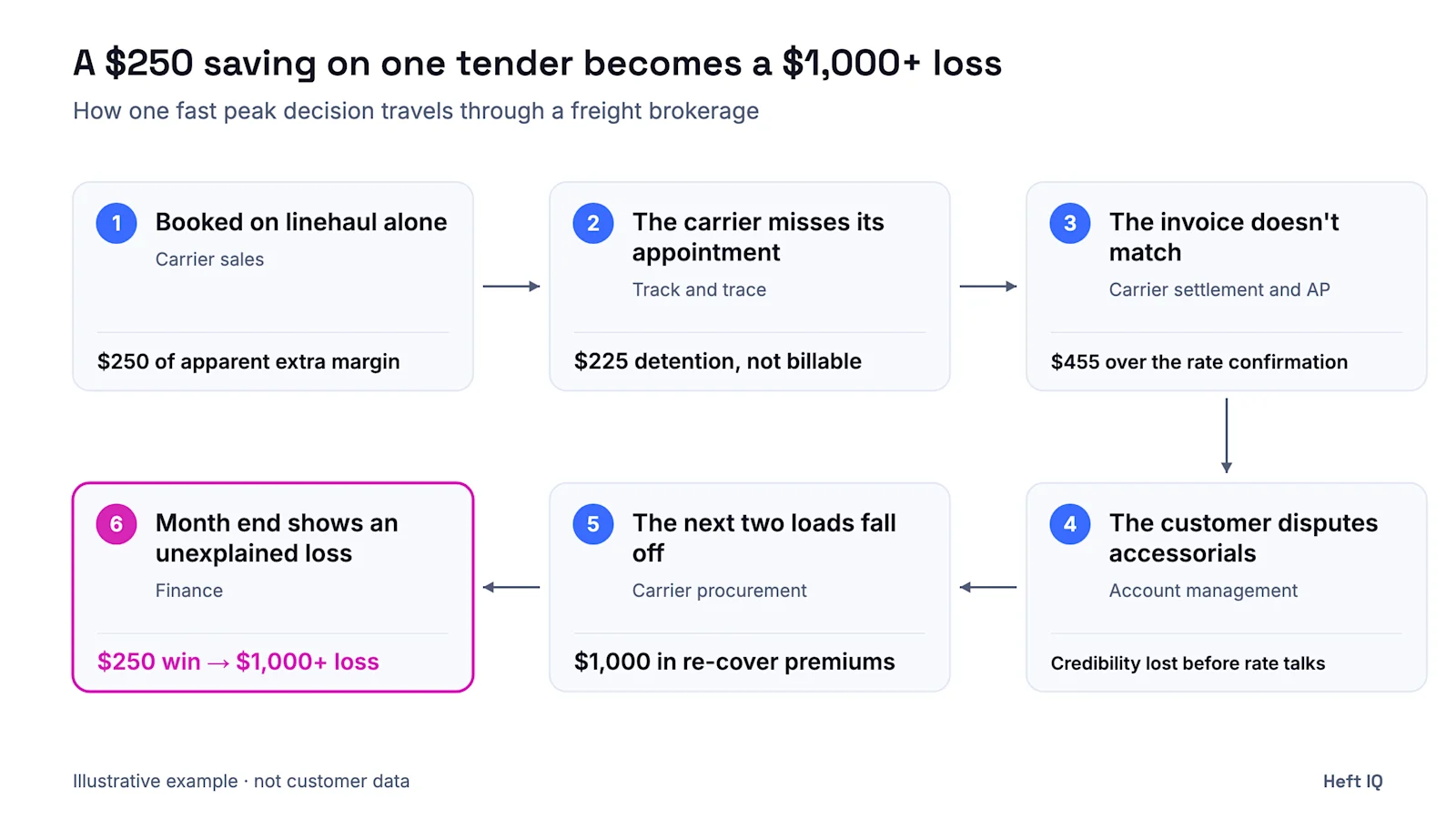
No team made a bad call. Each saw one symptom in its own system, and nobody saw the chain.
How teams catch it today
Most brokerages piece this together after the fact, and the work falls on the people stretched thinnest at peak.
Carrier scorecards get rebuilt monthly or quarterly from exports, so December behavior isn't visible until January.
Accessorial review happens in carrier settlement, one invoice at a time. AP can see the variance, but not whether the dwell was the facility's fault or the carrier's, or whether the TONU claim meets the terms on the rate confirmation.
Decision rationale lives in the rep's head or an email thread. By the time a customer disputes a charge, the rep has booked 200 more loads.
Lane coverage is judged by feel: how many carriers answered the last time the load was posted.
Margin by load is reconciled at month end, after the carrier is paid and the customer is billed, when nothing can be changed.
Together these find the problem four to six weeks late, and in pieces.
How Margo catches it
Margo puts the four questions in front of the decision instead of behind it, then follows the load through to the invoice.
Before the tender
All-in cost, not linehaul. Each option is shown as linehaul plus fuel plus accessorials, alongside how the rate compares with the market. A $250 cheaper linehaul stops looking cheaper once fuel and accessorials sit beside it.
Carrier trust with confidence bounds. Trust and performance are scored with how sure the score is. A carrier with four loads of history isn't treated as though it had four hundred.
Coverage depth now and in 30 days. Carrier procurement sees which lanes are thin today and which will thin next month, while there's time to build capacity.
Human approval, with limited autonomy and undo. Your team sets where Margo can act and where a person signs off. Anything Margo acts on can be undone within an undo window.
At the moment of tender
Margo captures a decision trace and a carrier snapshot when the load is tendered: the options considered, the all-in cost of each, the carrier's trust and performance at that moment, and why this carrier won. When the shipper asks why the load cost what it did, the answer is already written down.
After the load
Payability. Accessorial, detention and TONU charges are checked for whether they're payable. Facility dwell is charged to the facility, never to the carrier, so a carrier isn't penalized for a consignee's slow dock.
Invoice reconciliation by component. The $455 variance is split into linehaul, fuel, detention and lumper, so AP and account management are arguing about specific lines instead of a total.
Margin Command. When a no-show happens, the full chain is in one view: the no-show, the re-cover premium, the chargeback to the carrier, and the margin lost.
Decisions scored against outcomes. Past tender decisions are scored against what actually happened, so the team learns which trade-offs paid off.
Every finding lands in Margo's governed Action Queue as an owned, dated action: a disputed lumper receipt for carrier settlement, a thin January lane for carrier procurement, a carrier review for the carrier sales lead. The queue tracks each one through to done.
Illustrative example
The figures below are illustrative, built around a composite brokerage: about 1,100 loads a week at peak, a 22-person carrier sales team, and a book weighted toward retail and consumer goods freight out of the South Central region.
Before. Over six peak weeks, the team covers 240 thin-lane loads with the lowest linehaul offered, booking an apparent $230 of extra margin per load, about $55,000 in total. Behind that, 70 loads produce accessorials the brokerage can't pass through, averaging $310 each, or about $21,700. Eighteen loads fall off and are re-covered at an average $520 premium, about $9,400, and chargebacks recover only a fraction of it. AP loses 40 hours to invoice disputes, and two customer billing disputes stall January rate talks. The $55,000 'win' shrinks by more than half, and nobody can say which decisions caused it.
After. The same loads are tendered with all-in cost and carrier trust on screen. About a third go to carriers with stronger records at a slightly higher rate, with a lead's sign-off. Unpayable accessorials are caught at reconciliation instead of paid. Carrier procurement gets a dated action to add two carriers on the lanes that are thinning for January. When the shipper asks about the Dallas to Atlanta load, the account manager sends the decision trace the same afternoon.
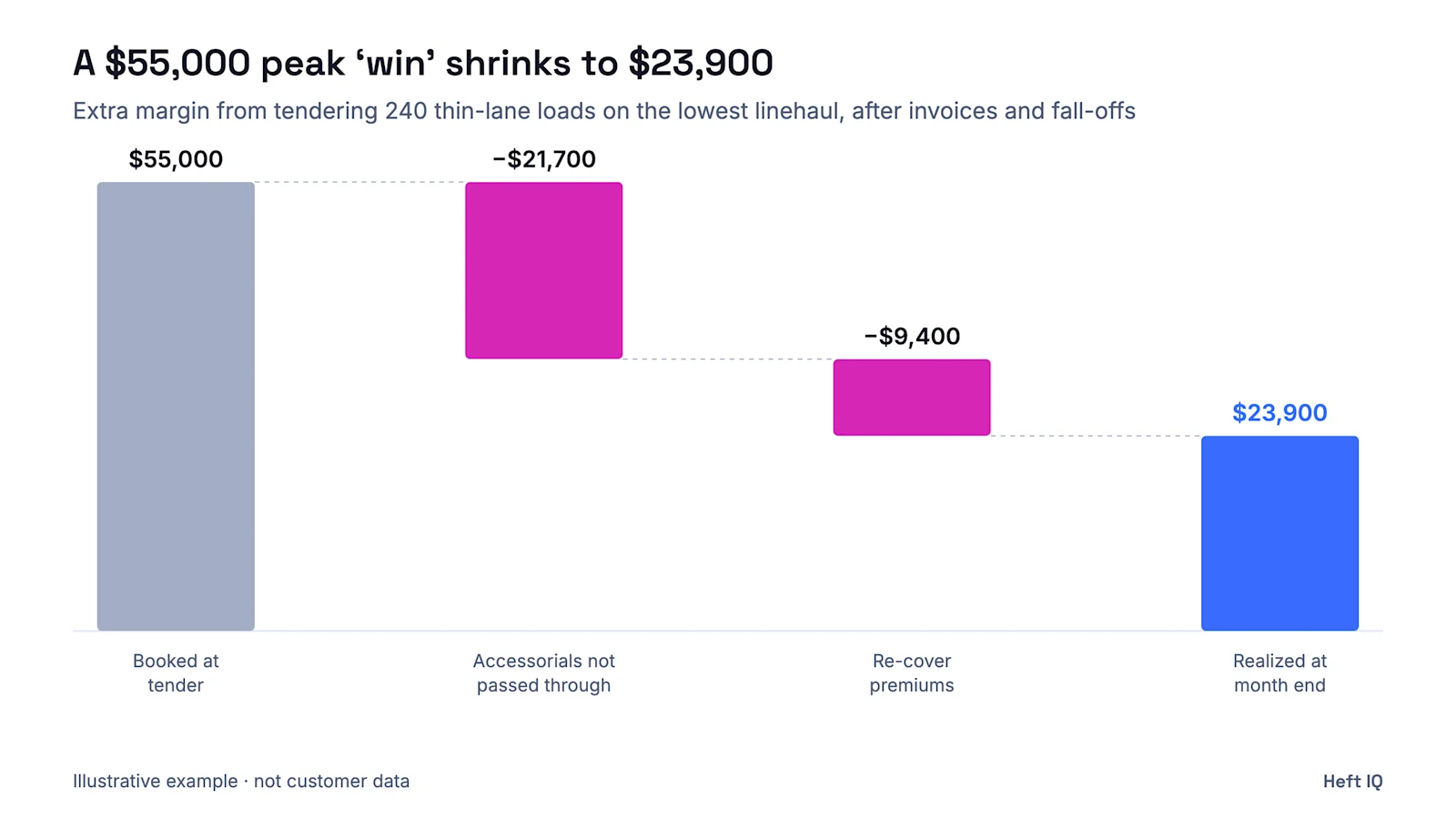
The fastest peak decision is the one you don't have to relitigate in January.
Peak will always force fast calls. What matters is whether they hold up when the invoice, the customer and the month-end close come back to them. See how Margo puts all-in cost, carrier trust and a decision trace behind every tender.