
A carrier vetting checklist for freight brokers
Twelve checks to run before you tender a load, what each one protects you from, and how to keep a record that shows you ran them.
Learie Hercules on LinkedIn (opens in a new tab), CEO, Heft IQ
4 min read
On this page
Most brokerages vet a carrier once, at onboarding, and then book it for months. The trouble is that carriers change. Insurance lapses, a safety rating gets downgraded, contact details are quietly swapped by someone impersonating the company. The carrier that passed in March is not necessarily the carrier you are tendering to in November.
Since the Supreme Court's decision in Montgomery v. Caribe Transport II, negligent-selection claims against brokers can proceed under state law. That makes two things matter: running the right checks at the moment you tender, and being able to show later that you ran them. This checklist covers both. It is general guidance, not legal advice.
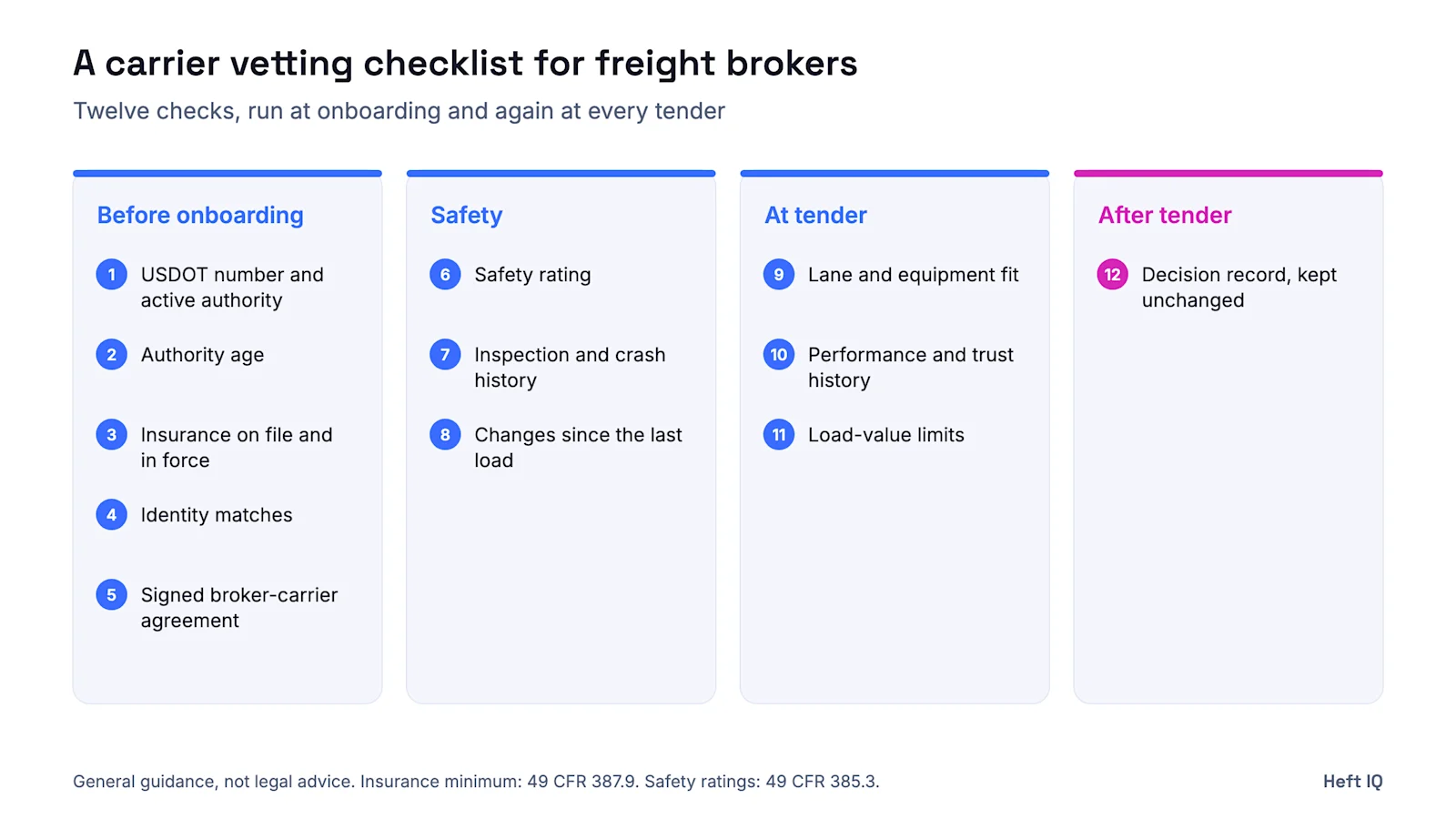
Before onboarding: is this a real, authorized carrier?
USDOT number and active for-hire authority. Look the carrier up in FMCSA's SAFER system or the QCMobile API and confirm it is authorized for for-hire property carriage, with authority active, not pending, revoked or inactive.
Authority age. Note when authority was granted. Very new authority isn't disqualifying, but it means less history to judge from, so it deserves extra checks and possibly a lower load-value limit.
Insurance on file and in force. Confirm the auto liability filing with FMCSA and get the certificate from the insurer or agent directly, not from the carrier. For general freight in interstate commerce, the federal minimum is $750,000 (49 CFR 387.9). Many shippers require more, and cargo coverage is a separate question.
Identity matches. The phone, email domain, address and remit-to details should match what FMCSA and the insurer have on file. Mismatches are how impersonation and double brokering get in.
A signed broker-carrier agreement. It should cover no re-brokering, insurance requirements and claims handling.
Safety: would a reasonable broker have concerns?
Safety rating. FMCSA rates carriers Satisfactory, Conditional or Unsatisfactory, and many carriers are unrated. Under 49 CFR 385.3, a Conditional rating means the carrier lacks adequate safety management controls. An Unsatisfactory rating should stop the tender. A Conditional one should trigger a documented decision, made by someone with the authority to make it.
Inspection and crash history. Review out-of-service rates and crash history relative to the carrier's size. A small carrier with a high out-of-service rate is a different risk from a large one with a few incidents.
Changes since the last load. Re-check rating, authority and insurance at tender, not just at onboarding. This is the check most often skipped during peak, and the one that matters most if something goes wrong.
At tender: is this the right carrier for this load?
Lane and equipment fit. Has the carrier actually run this lane and this equipment type, and how did it perform?
Performance and trust history. On-time pickup, claims, detention disputes and past no-shows on your own loads, weighted by how many loads the history is based on.
Load-value limits. Set a ceiling by carrier risk tier. A newer or lower-trust carrier can still haul freight, just not your highest-value load without a second approval.
After tender: can you prove what you did?
A decision record. Save which carriers were considered, what each check returned at that moment, why this carrier was chosen and who approved it. Keep it unchanged. A claim can arrive years later, and the carrier's record will have changed since.
The check you ran is only half the defense. The other half is a record of it, made at the time, that nobody has edited since.
Why checklists fail during peak
Every brokerage has some version of this list. The failures come from how it's run, not what's on it.
It runs once. Onboarding checks go stale. Rating downgrades and insurance cancellations happen between loads.
It runs by hand. When a rep has minutes to cover a load at 6 a.m., manual lookups are the first thing skipped.
The record is scattered. A TMS note, an onboarding PDF and a rep's memory don't add up to evidence. Reconstructing a selection months later takes days, if it can be done at all.
The carrier pool is too small. When the usual carriers are full, reps reach for whoever answers. A deeper bench of carriers that already pass your checks takes the pressure off.
How Margo runs the checklist on every load
Margo is built for freight brokers. It runs these checks at the moment of each tender and keeps the evidence.
Vetting before every tender. Operating authority, insurance, safety rating, trust score with its confidence, and lane fit are checked for each carrier option. Carriers that fail are excluded, and the reason is saved.
A deeper carrier bench. Margo's carrier database draws on FMCSA data, including QCMobile, and covers Canadian carriers, so reps can find vetted capacity they don't already know when the usual carriers are full.
A decision record at tender. The carriers considered, what was checked, why the chosen carrier won and who approved it, captured when the load is tendered and kept unchanged.
Human approval where you want it. You decide when a person must sign off, for example a lower-trust carrier on a high-value load. Every automatic action can be undone.
Recovery when a carrier falls off. If a carrier no-shows or a check fails after tender, Margo finds vetted replacement capacity and the follow-up becomes an owned, dated item in the Action Queue.
None of this makes a brokerage immune from claims, and Margo doesn't decide what your legal obligations are. It makes your process consistent and your evidence available. To see it on your lanes, visit the Margo product page. For more on what the ruling changed, read What Montgomery v. Caribe means for how brokers vet carriers.