
What Montgomery v. Caribe means for how brokers vet carriers
A unanimous 2026 Supreme Court ruling lets negligent-selection claims against freight brokers proceed. Here's what the Court decided, and why a decision record now matters.
Learie Hercules on LinkedIn (opens in a new tab), CEO, Heft IQ
5 min read
On this page
This article explains a court decision for a general business audience. It is not legal advice. Talk to your own counsel about how the ruling applies to your brokerage.
On May 14, 2026, the Supreme Court of the United States decided Montgomery v. Caribe Transport II, LLC. The vote was unanimous. The question was narrow and technical, but the effect for freight brokers is easy to state: a claim that a broker negligently selected an unsafe motor carrier is not wiped out by federal preemption. It can go forward under state law.
For years, many brokers could point to federal law as a shield in these cases, at least in some parts of the country. That shield is now gone everywhere. The question that matters in a claim is no longer whether the case can be brought, but whether the broker acted reasonably when it chose the carrier, and whether it can show what it did.
What happened in the case
According to the Court's opinion, Shawn Montgomery was injured when a tractor-trailer struck his vehicle, which was stopped on the side of the road. His leg had to be amputated. The truck's driver was driving for Caribe Transport II, a motor carrier. C.H. Robinson, a broker, had coordinated the shipment.
Montgomery sued the driver, the carrier and the broker. Against the broker, he alleged negligent hiring: that Caribe Transport had a "conditional" safety rating from the Federal Motor Carrier Safety Administration when C.H. Robinson hired it, with alleged deficiencies including driver qualification, hours of service, inspection and maintenance, and recordable crash rate. Based on that rating, he claimed the broker knew or should have known that choosing the carrier was reasonably likely to result in crashes.
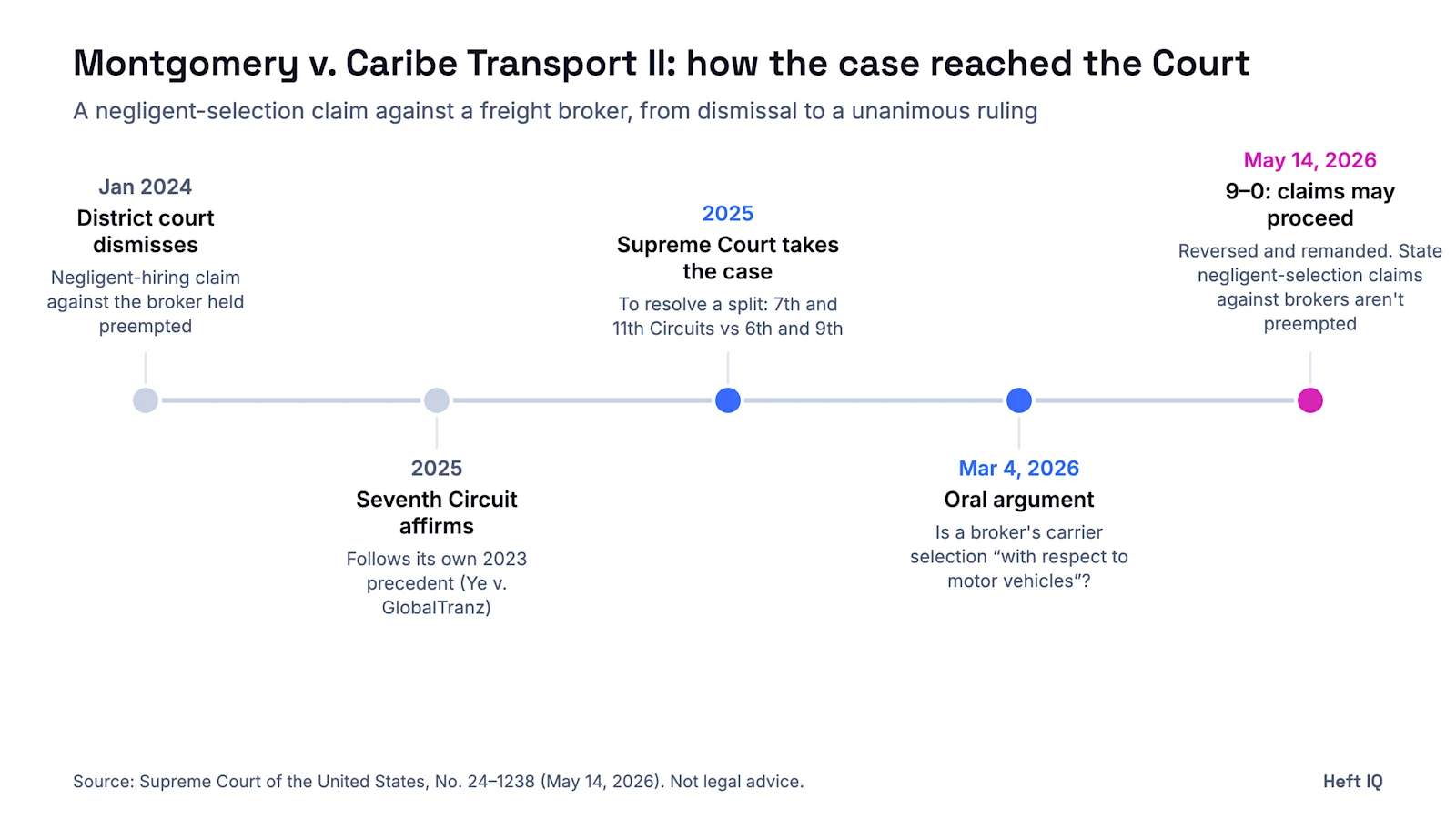
The district court dismissed the claim against the broker in January 2024, holding that the Federal Aviation Administration Authorization Act (FAAAA) preempted it. The Seventh Circuit affirmed in 2025. Other circuits had reached the opposite result, so the Supreme Court took the case to resolve the split.
What the Court decided
The FAAAA generally preempts state laws related to a broker's services, but it has a safety exception that preserves "the safety regulatory authority of a State with respect to motor vehicles." The question was whether a negligent-hiring claim against a broker falls inside that exception.
The Court, in an opinion by Justice Barrett, held that it does. A claim that a broker negligently selected an unsafe motor carrier is a claim "with respect to motor vehicles," so the safety exception saves it from preemption. The Court reversed the Seventh Circuit and sent the case back for further proceedings.
Justice Kavanaugh, joined by Justice Alito, concurred. He agreed with the result but wrote that the case was "closer than the Court's opinion perhaps might suggest," noting that two circuits had gone the other way.
The ruling decides whether these claims can be heard. It does not decide that any broker was negligent. That question turns on what the broker knew, what it checked, and what it can show.
What it changes for brokers
The decision does not create a new federal vetting standard, and it does not say what checks are enough. Those questions will be answered under state negligence law, case by case. What changes is exposure and evidence.
Preemption is no longer a reliable early exit. In parts of the country where brokers previously won dismissal on preemption grounds, negligent-selection claims can now proceed to the facts.
The selection decision becomes the evidence. Plaintiffs in these cases typically focus on what information was available about the carrier at the time of tender, such as its safety rating, and whether the broker looked.
Memory and email are weak records. A claim may arrive months or years after a load moved. Reconstructing why a particular carrier was chosen from inboxes and rate confirmations is slow and incomplete.
Speed still matters. Peak season compresses tender decisions. A vetting process that only works when there's time to do it by hand will be skipped exactly when risk is highest.
How brokers document carrier selection today
Most brokerages already have some form of carrier onboarding: authority and insurance checks, and sometimes a safety-rating review. The gap is usually what happens at the moment of each tender. Onboarding is done once; conditions change. A carrier that was fine in March may carry a conditional rating in November, and the rep booking a load at 6 a.m. on a peak Monday may not see it.
Even when the right checks happen, the record of them is scattered across a TMS note, an onboarding file and a rep's memory. Answering a simple question, such as which carriers were considered for a load and why this one was chosen, can take days.
How Margo helps
Margo is built for freight brokers, and it treats each carrier selection as a decision that should be explainable later.
Vetting before every tender. Operating authority, insurance, safety rating, trust score with its confidence, and lane fit are checked for each carrier option. Carriers that fail are excluded, and the reason is saved.
A decision record at tender. Margo captures the carriers considered, what was checked, why the chosen carrier won and who approved it, at the moment of tender, and keeps it unchanged.
Human approval where your team wants it. You decide where Margo can act on its own and where a person signs off, for example a low-trust carrier on a high-value load. Every automatic action can be undone.
Owned follow-up. When a carrier's trust drops or a check fails, the issue becomes an owned, dated item in Margo's Action Queue rather than a note nobody reads.
None of this makes a brokerage immune from claims, and Margo does not determine what your legal obligations are. What it does is make your process consistent and your evidence available, so that when someone asks why a carrier was used, the answer already exists.
To see carrier vetting and decision records in practice, visit the Margo product page. For the wider picture of peak-season tender decisions, read peak freight decisions you can defend.