
The follow-up that closes the deal before year-end
Late-stage deals rarely slip on price. They slip on a promised document that never went out. How one unlogged commitment becomes a cold buyer, a lost champion and a missed quarter.
On this page
Forty minutes into a strong call on November 12, the buyer's IT lead asks for your security documentation and a revised quote that splits the license across two budget years. Your account executive says, "I'll have both to you by Friday." Everyone nods. The call ends. Nobody writes it down.
That sentence is the most important thing said on the call, and nothing in the deal record knows it happened. At year-end, when buyers are racing to get approvals in before budgets lock, a promise like this is often the difference between a December signature and a January restart. This piece traces one unlogged promise through to a slipped quarter. For the wider set of year-end risks, see what stalls pipeline before year-end close.
The chain of impact
The figures in this chain and in the example below are illustrative, built around a composite company.
The promise isn't logged (account team). The commitment lives in the call recording and the rep's memory. In a week full of year-end calls, it falls behind newer requests.
The commitment goes overdue (deal record). Friday passes. The deal's next step still reads "proposal sent," so nothing looks late to anyone but the buyer.
The champion can't move the deal (buying committee). The buyer's operations director needed the split quote and security documents to get the deal onto the finance committee's December agenda. Without them, the deal misses the meeting.
The buyer goes cold (customer). After two weeks without the documents, the buyer stops replying. A vendor that can't send a document on time during the sale looks like a risk for the next three years.
The champion moves on (buying committee). In early December the operations director takes a job at another company. The new contact never saw your proposal and has no reason to hurry.
The quarter slips (revenue leadership). A $240,000 deal that was on track for December closes in March, after a re-evaluation and a 10% discount to restart it.
How teams catch it today
Commitments are the least tracked part of a deal. Reps write some of them in notes, flag some emails, and remember the rest. Call recordings capture everything, but nobody re-listens to last week's calls looking for promises, least of all in December.
Next steps are stage-shaped, not promise-shaped. The CRM tracks where a deal is, not what each side owes the other and by when.
Missed promises surface in deal reviews. By then the buyer has already noticed.
Call prep starts from scratch. Before the next call, the rep rebuilds what was said and promised from scattered notes, and an open commitment is easy to miss.
The business case comes late. The champion asks for something to take to finance, and the team builds it by hand, often after the budget meeting it was meant for.
Job changes surface by accident. The team learns a champion has left when an email bounces.
How Thread catches it
Thread makes the promises on a deal as visible as its stage.
Commitments pulled from email, voice, and transcripts. When a rep says "I'll send the revised quote by Friday" on a call or in an email, Thread captures it as a commitment, ties it to the deal, and records who owes it and when.
Overdue tracking and "Blocked on you." If Friday passes and the commitment isn't closed, it's marked overdue and shows up in the rep's Today feed under "Blocked on you." The manager can see it the day it slips.
Meeting prep briefs. Before the next call, the prep brief lays out the deal's status, the people involved, and every open commitment, so the rep walks in knowing what's owed.
Business case and value report. Thread produces a business case the champion can take to the finance committee, so the deal reaches its budget meeting with the document it needs.
Buyer map and champion job-change detection. The buyer map shows who is involved in the deal and in what role. If the champion changes jobs, Thread flags it, so the team can turn to the next person on the map before the deal stalls.
Smart Nudge. When a buyer has gone quiet, Smart Nudge drafts a follow-up grounded in the deal's history for the rep to review and send.
Every overdue commitment becomes an owned, dated action in Thread's Action Queue, tracked through to done. The record shows the promise, when it was due, and when it was kept.
Illustrative example
Picture a composite company selling through direct reps and 25 agency partners, with 60 late-stage deals heading into November. All figures are illustrative.
Before
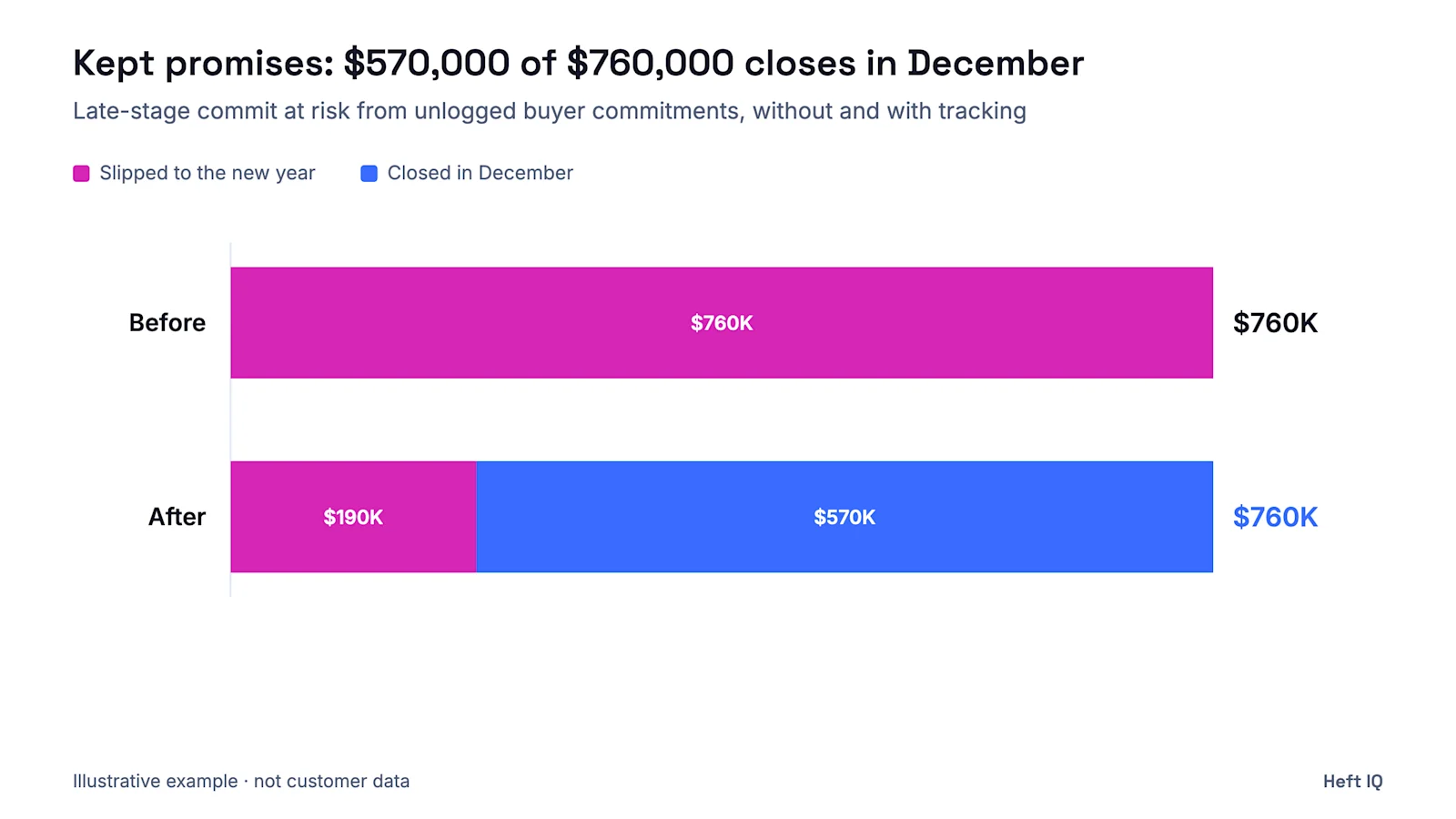
Between November 1 and December 15, reps make about 140 commitments to buyers on calls and in email. Around a third get logged. Twenty-two go overdue without anyone noticing, and seven of those deals miss a buyer's budget meeting. Four slip into the new year, taking $760,000 of commit with them.
After
With commitments captured from calls and email, each one has an owner and a due date on the deal. Overdue items land in "Blocked on you" the day they slip and are cleared within a day or two. Meeting prep briefs surface open promises before each call, and business cases reach champions ahead of their budget meetings. Two champion moves are flagged as soon as they're detected, and the buyer map points to the next contact. In this scenario, one deal still slips, and $570,000 of the $760,000 closes in December.
Deals close on the small promises kept between the big meetings. Thread catches each promise as it's made, tracks it to done, and keeps the champion equipped, so the follow-up happens before the year runs out.