
What stalls pipeline before year-end close
Quiet partners, unlogged promises, champion moves and channel conflict compound in the last ten weeks of the year. Thread catches each one while the deal can still close.
On this page
It's the first Tuesday in December and the forecast call is running long. Three partner-sourced deals marked commit haven't changed stage since before Thanksgiving. The reseller rep on the largest one stopped answering two weeks ago. The revised pricing your account executive promised on a mid-November call never went out. And the champion who was carrying the deal internally has started a new job at another company, which nobody on your side knows yet.
None of these problems is unusual on its own. What makes year-end hard is that they arrive together while the calendar shrinks: buyers leave for the holidays and budgets lock. A leader who sees these problems one at a time, in separate reports or a Friday pipeline review, sees them after the window to fix them has closed.
Below: how pipeline stalls in the last ten weeks of the year, why the usual review finds it late, and how Thread turns each signal into an owned action while there's still time to close.
The chain of impact
Take a single trigger: a partner goes quiet on a late-stage deal in mid-November. The figures here and throughout this article are illustrative, built around a composite company rather than a real customer.
The partner stops updating the deal (partner channel). A reseller working a $180,000 expansion deal hasn't logged anything in twelve days. The CRM still reads "Negotiate, commit, December 15."
The deal ages past its stage (pipeline). Negotiation should take about a week. By day fifteen the deal has sat there twice as long as expected, and the buyer's procurement team has moved on to other vendors' paperwork.
A promise goes unkept (account team). On the last call, your account executive told the buyer a revised order form with multi-year pricing would arrive by Friday. It never became a task. Friday passes, then another week, and the buyer reads the silence as a lack of interest.
The champion changes jobs (buying committee). The operations director who sponsored the deal accepts a role elsewhere. The new budget owner has never heard of you and wants to re-evaluate in the new year.
A second partner shows up on the account (channel program). Another agency in your program starts its own conversation with the same buyer. Two partners now quote different terms to one company, and the buyer pauses to sort it out.
The forecast is wrong in the QBR (revenue leadership). The deal is still in commit when the quarter closes. It slips to Q1, the partner misses its number, and the CRO explains a $180,000 miss that had five chances to be caught.
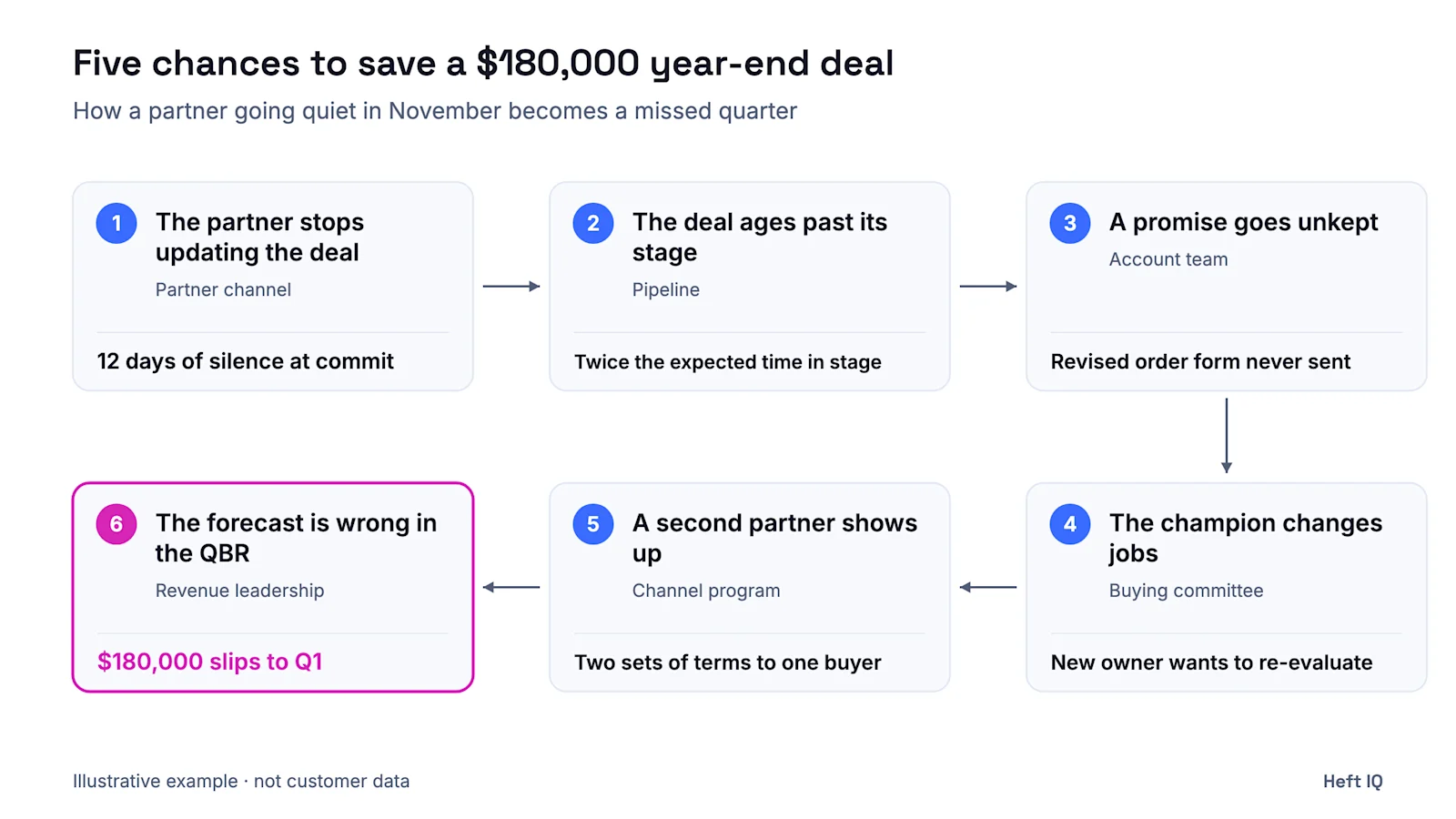
Each step on its own looks like ordinary friction. Together they turn a winnable December deal into a January re-evaluation.
Four ways year-end pipeline stalls
A partner goes quiet
When a broker, agency, producer, or reseller gets busy with its own year-end, deal updates stop first. Deal age climbs, the partner's whole book goes stale at once, and partner health falls before anyone notices. We trace this chain step by step in why partner deals slip quietly.
A promise nobody logged
"I'll send the security review by Thursday." "We'll get you a revised quote after the holiday." Commitments made on calls and in email threads hold a late-stage deal together, and most of them never become tasks. When one goes overdue, the buyer cools and the deal drifts into January. See the follow-up that closes before peak.
A champion changes jobs
The end of the year is a common time for people to move. When the person who carried your deal internally leaves, the deal loses its sponsor, its momentum, and often its budget. Finding out three weeks later means starting over.
Two partners chase the same account
Channel conflict gets worse when everyone is hunting for year-end numbers. Two partners pursuing one buyer confuse the customer and start a discount race.
How teams catch it today
Most leaders find these problems in the weekly pipeline review. Partner managers export the CRM, sort by close date, and start calling around. Reps scan their inboxes for anything they owe. Channel conflict surfaces when a buyer forwards two quotes and asks which one is real.
Deal age is invisible until someone looks. A stalled deal looks the same as a healthy one until a person compares today's date with the day it entered its stage.
Commitments live in notes, inboxes, and call recordings. Nobody owns the list of what the team promised buyers, so nobody sees what's overdue.
Partner updates depend on the partner. When the partner goes quiet, the data goes quiet too, and silence reads as "no news."
Every signal shows up somewhere different. The stalled deal, the missed promise, and the champion move are three separate discoveries, made by three people, often in different weeks.
So leaders learn about a slipping deal in the forecast call, when the only move left is to push it to next quarter.
How Thread catches it
Thread looks at the deal, the partner, the people, and the promises together, and routes what needs attention to the person who can act.
Deal and partner health. Every deal carries a health status, and so does every partner, based on recent deal activity, open pipeline, and deals that have gone idle. When a partner stops updating its deals, its health drops visibly instead of hiding behind a full pipeline.
Stalled-deal escalation tiers. Each stage has an expected duration. A deal that passes it gets a nudge. At twice the expected time it moves to a warning, and at three times it becomes critical and is flagged for a manager to step in.
Commitments with overdue tracking. Thread pulls the promises made in email, voice calls, and meeting transcripts, ties each one to its deal, and tracks it against its due date. An overdue commitment surfaces the day it slips, not at the next review.
Champion job-change detection and the buyer map. When a key contact moves to a new company, Thread flags it. The buyer map shows who else is involved in the deal, so the team knows who to engage before the deal goes cold.
Channel-conflict guard. Only one partner can hold an open deal on a given company at a time. When a second partner tries to open a deal on an account already in play, Thread stops it and shows who holds it, before the buyer sees two quotes.
Smart Nudge and meeting prep briefs. When a deal needs a follow-up, Smart Nudge drafts one from the deal's history for the rep to review and send. Before the next call, a meeting prep brief collects the deal's status, open commitments, and people.
Business case and value report. For deals waiting on internal approval, Thread produces a business case the champion can take to finance, so approval doesn't wait on a document.
Today feed with "Blocked on you." Each person starts the day with stalled deals, overdue commitments, and flagged contacts. The "Blocked on you" view shows exactly where a deal is waiting on that person.
Every finding becomes an owned, dated item in Thread's Action Queue, tracked through to done. Nobody has to ask whether the overdue pricing went out. The queue shows it.
The forecast call should confirm what the team already fixed, not reveal what it missed.
Illustrative example
Consider a composite company: a B2B software vendor selling through 40 reseller and agency partners, carrying $6.2 million of fourth-quarter commit pipeline across 85 open deals. All figures are illustrative.
Before
On December 1, the pipeline review finds 14 deals that haven't moved in three weeks. Six partners haven't updated anything since early November. Nine buyer commitments, including two revised quotes, are overdue, and they're found one at a time. One champion has changed jobs. Two partners are working the same manufacturing account. The quarter closes with $1.4 million of commit pushed to Q1 and a difficult QBR.
After
With Thread running from mid-October, stalled deals get a nudge within days of passing their stage threshold. Partner health flags the six quiet partners in November, while there's still time to call. Overdue commitments land in "Blocked on you" for the reps who made them, and each becomes an owned action. The champion move is flagged as soon as it's detected, and the buyer map shows who to engage next. The second partner is stopped when it tries to open the deal. In this scenario, $900,000 of the $1.4 million closes in the quarter, and the remaining slips are explained weeks before the QBR, not during it.
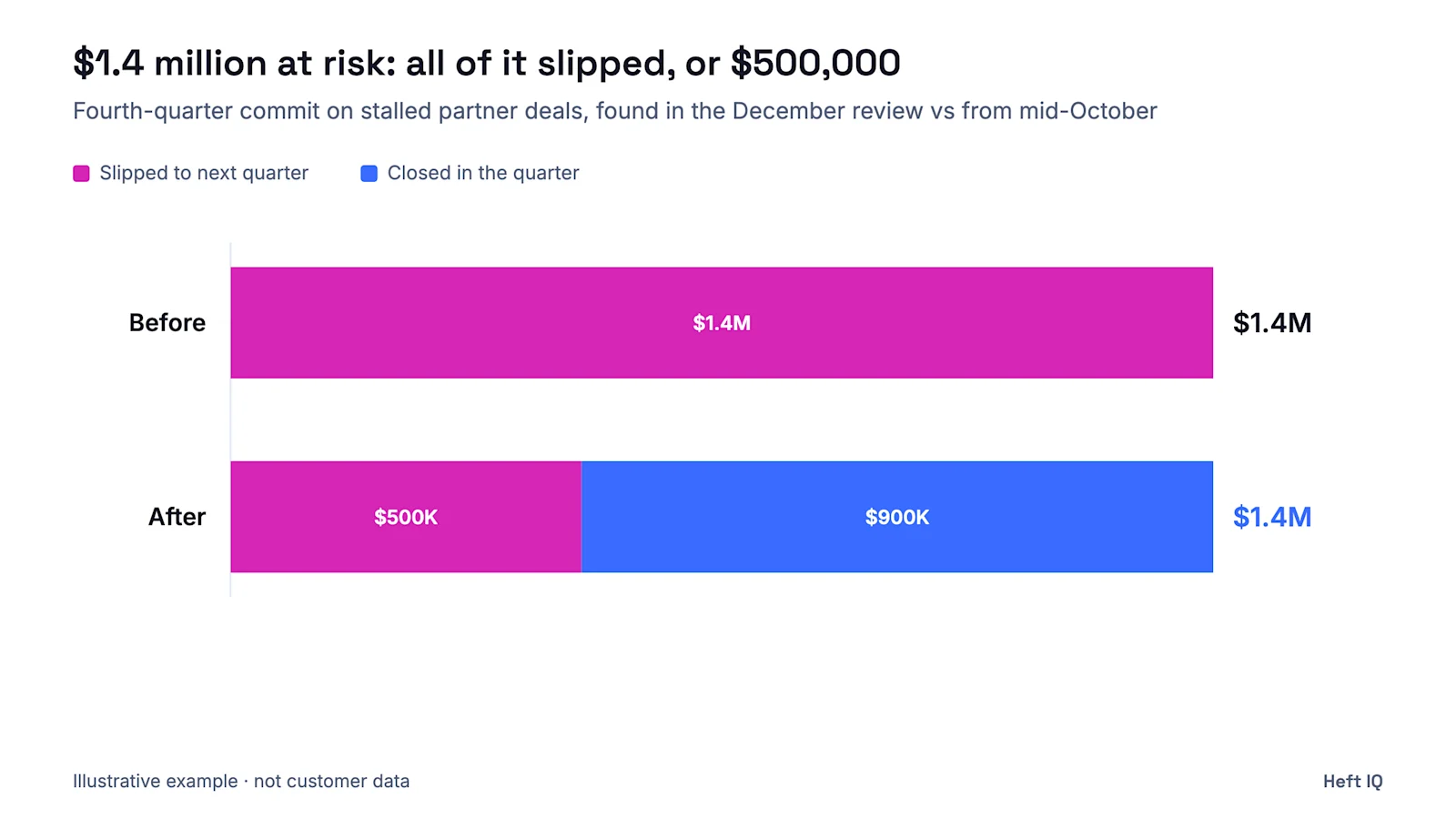
Year-end close rewards the team that sees the stall first. Thread connects deal health, partner health, commitments, and the people on each deal, so the work that keeps pipeline moving is owned and finished before the calendar runs out.