
Illustrative scenario: a brokerage's first 90 days with Margo
A composite freight brokerage traces all-in cost, carrier trust and no-show chains to owned actions, and tracks $219,000 of illustrative margin at stake to results.
On this page
This is an illustrative scenario built on a composite company, not a customer story. It follows a mid-sized freight brokerage through its first 90 days with Margo, heading into peak. Margin looked healthy on the booking screen, but realized margin kept coming in lower, and nobody could say which carrier decisions caused the difference. All figures here are illustrative.
The company
The composite brokerage has about 70 people across two offices and moves roughly 1,400 truckload shipments a week, mostly dry van with a growing reefer book, for a mix of contract and spot shippers. Carrier sales reps cover loads from a base of a few thousand active carriers, and a small settlement team pays carrier invoices.
The owner, the VP of operations and the VP of carrier sales kept asking one question: after accessorials, re-covers and chargebacks, which loads actually made money, and which carrier decisions made the difference? Booking margin answered a different question.
What was connected
Margo read the brokerage's loads, carrier rates, fuel and accessorials, carrier performance history and carrier invoices. From that it builds all-in cost for every load (linehaul plus fuel plus accessorials), carrier trust with confidence bounds, rate against market, and lane coverage depth, now and 30 days out.
At the moment of tender, Margo also captures a decision trace and a snapshot of the carrier, so any choice can be revisited later with the facts as they stood that day.
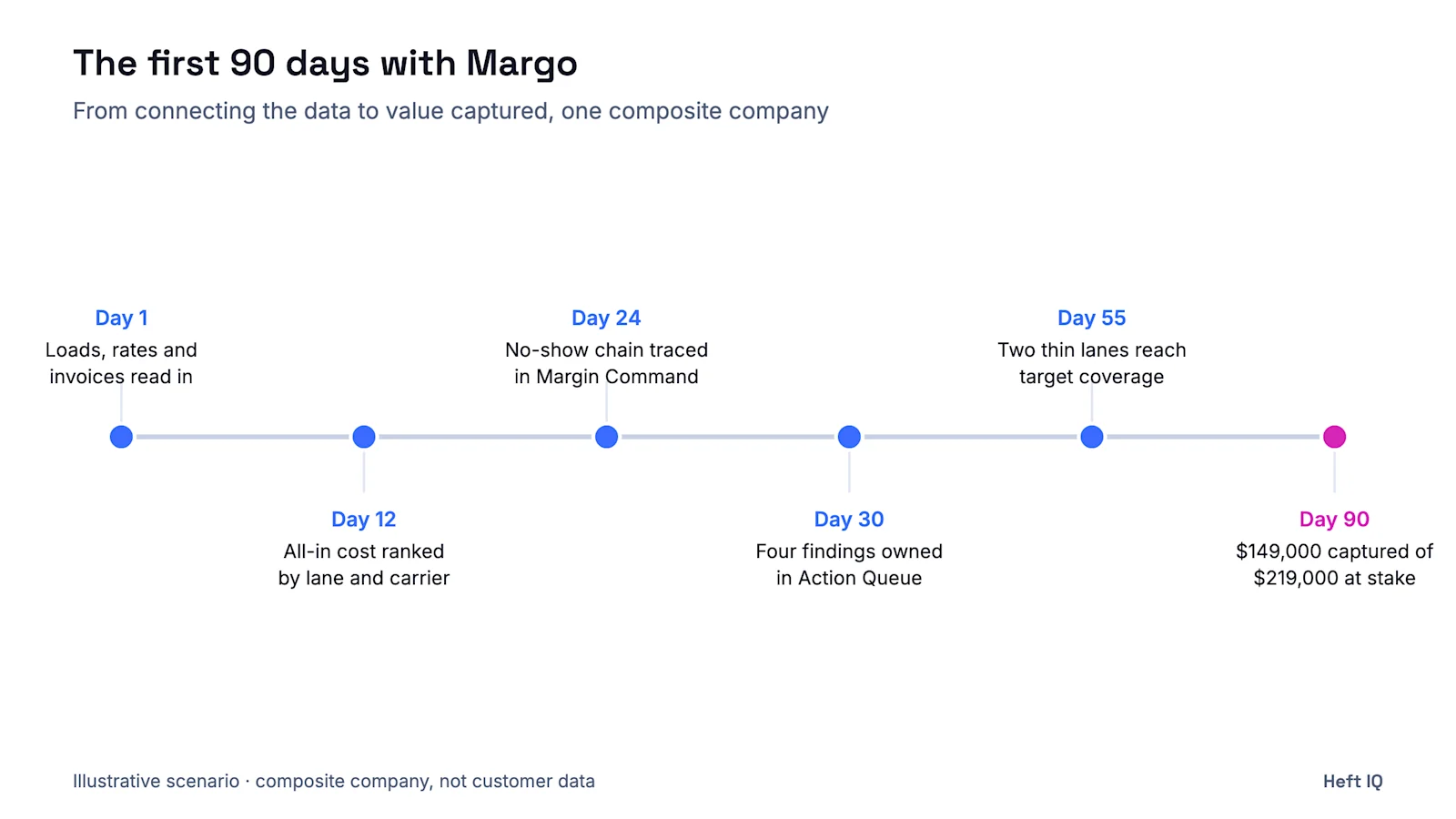
What surfaced in the first 30 days
The cheapest carriers on two reefer lanes cost the most
On two reefer lanes, reps were consistently choosing the lowest linehaul. All-in cost told a different story: those carriers' invoices ran above the agreed rate more often, and they accounted for most of the re-covers on both lanes. Their trust scores sat low with tight confidence bounds, so the pattern was well established rather than a few bad loads. Illustrative value at stake: $72,000 over the quarter. Owner: the VP of carrier procurement.
Accessorials paid that weren't payable
Invoice reconciliation split each carrier invoice's variance by component. Most of it sat in accessorials: detention and TONU paid without meeting the brokerage's payability rules, and accessorial charges never approved on the load. Illustrative value at stake: $38,000. Owner: the settlement manager.
No-shows that ended as unrecovered chargebacks
Margin Command traced a chain the brokerage had only ever seen in pieces. A carrier no-showed on a peak load, the rep re-covered it at a premium, a chargeback was filed against the original carrier, and most of those chargebacks were never collected. In the first month the chain repeated across a cluster of carriers with recent no-shows. Illustrative value at stake: $64,000. Owner: the VP of carrier sales.
Three peak lanes with thin coverage
Coverage depth flagged three outbound lanes where the brokerage had few trusted carriers today and fewer projected 30 days out, right when holiday volume would arrive. Thin coverage on those lanes was where the steepest re-cover premiums came from. Illustrative value at stake: $45,000. Owner: the carrier development lead.
Who owned what
Each finding became an owned, dated action in the governed Action Queue, and the VP of operations reviewed the queue every Monday with the four owners. An action stayed open until the work was done, not until someone said it was handled.
Reefer lanes: the VP of carrier procurement owned moving both lanes to carriers with stronger trust at a slightly higher linehaul, due before the first holiday week.
Payability: the settlement manager owned holding accessorials that failed payability until they were supported, and recovering overpayments from the prior month.
No-show chain: the VP of carrier sales owned a trust gate. Carriers with repeat no-shows needed human approval before tender, and open chargebacks were assigned for collection with due dates.
Coverage: the carrier development lead owned adding trusted carriers to the three thin lanes, with a target depth for each.
On routine loads that met the brokerage's thresholds, Margo was given limited autonomy with undo, so reps spent their approvals on the loads that needed judgment. Every tender, automatic or approved, kept its decision trace.
Days 31 to 90: what changed
Around day 50, the owner asked why procurement was now paying more linehaul on the reefer lanes. The VP of carrier procurement pulled the decision trace from a recent tender: the carrier snapshot, the trust score with its confidence bounds, and the all-in cost comparison as they stood that day. The conversation took minutes instead of a week of reconstructing emails.
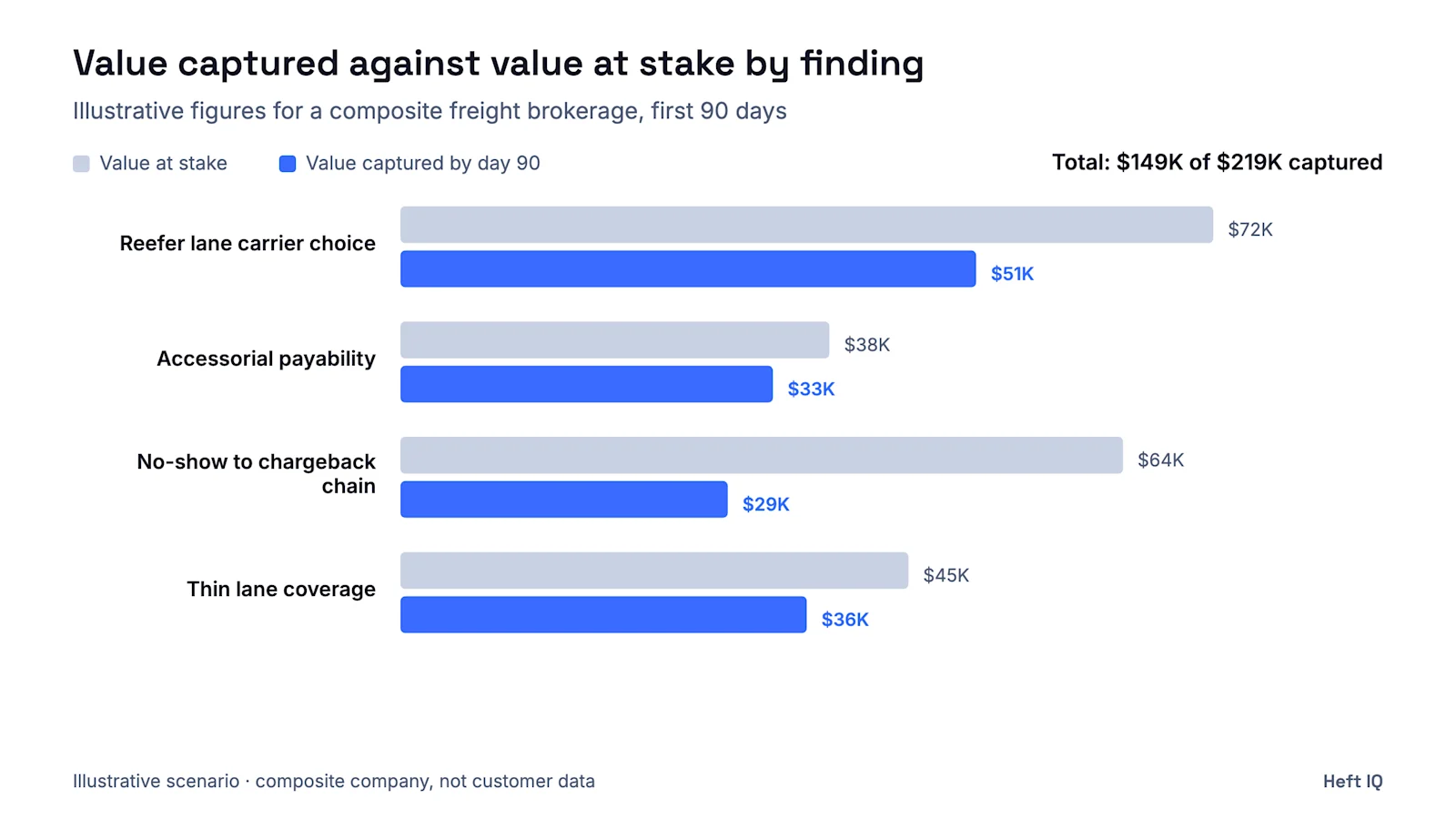
By day 90, the illustrative results looked like this:
Reefer lanes: $51,000 captured of $72,000 at stake. The higher linehaul was more than paid back by fewer re-covers and cleaner invoices.
Payability: $33,000 captured of $38,000 at stake, most of it from holding unsupported accessorials going forward.
Coverage: $36,000 captured of $45,000 at stake. Two of the three lanes reached their target depth before holiday volume arrived.
No-show chain: $29,000 captured of $64,000 at stake. This was the miss.
The trust gate worked: no-shows from the gated carriers dropped sharply. But the chargebacks already open were mostly uncollectible, and two of those carriers stopped hauling for the brokerage rather than pay. The VP of carrier sales kept the action open, re-scoped to preventing the chain rather than recovering it.
In total, $149,000 captured of $219,000 at stake in the first 90 days.
What made the difference
Each finding on its own was familiar. Reps knew some cheap carriers were trouble, settlement knew accessorials crept up, and carrier sales knew no-shows were expensive. What the brokerage lacked was one view connecting them: the cheap carrier on the reefer lane was often the carrier behind the no-show, whose re-cover landed on a thin lane, and whose chargeback never came back. Margin Command put that chain in dollars against realized margin.
The measures were also fair, which is why reps accepted them. Facility dwell was charged to the facility, never to the carrier, so a slow receiver didn't drag down a good carrier's score. Trust came with confidence bounds, so a carrier with three loads wasn't judged like one with three hundred.
And decisions became something the team could learn from. Because Margo scores past decisions against actual outcomes, the Monday review moved from arguing about single loads to asking which kinds of decisions were paying off.
See how Margo connects all-in cost, carrier trust and realized margin for freight brokers. For the broader peak picture, read peak freight decisions you can defend.