
Illustrative scenario: an importer's first 90 days with Atlas One
Four DCs, overseas suppliers, a few trade lanes. How a storm, a flood and a duty proposal became ranked, owned actions, and what they were worth by day 90.
On this page
This is an illustrative scenario built on a composite company, not a customer story, and every figure in it is illustrative. The company imports hardware and home goods from overseas suppliers and moves them through four distribution centers. Its planners learned about storms, floods and trade policy changes the way most teams do: from the news, a supplier email or a delay notice, usually after the decisions that mattered had already been made.
The company
The composite is a mid-sized importer and distributor with about 400 employees. It runs four DCs (Gulf Coast, Southeast, Midwest and West Coast) plus two overflow warehouses, buys from roughly 60 suppliers concentrated in a handful of manufacturing regions in Asia and Mexico, and moves most of its volume over a small number of trade lanes. It sells hand tools, small appliances and home goods to retail and trade buyers.
Leadership kept asking one question nobody could answer quickly: of everything happening in the world this week, what actually touches our sites, our routes, our suppliers and our products, and who is on it? The answer lived in a dozen browser tabs, a trade consultant's monthly memo and the instincts of two senior planners.
What was connected
Nothing was wired into the company's internal systems. Instead, the team confirmed its profile in Atlas One: the four DCs and two overflow warehouses, the main truck routes and corridors between them, supplier locations, the product categories it imports with their HS codes, and the trade lanes those products travel.
Atlas One then matched weather, flood, global hazards, traffic and routing, and trade policy from the Federal Register, Congress, the EU and the WTO against that confirmed profile. It does not see orders, SKUs, customers, carriers, ports or margin. Where this article puts a dollar figure on a situation, that figure is the company's own illustrative estimate, not something Atlas One calculated.
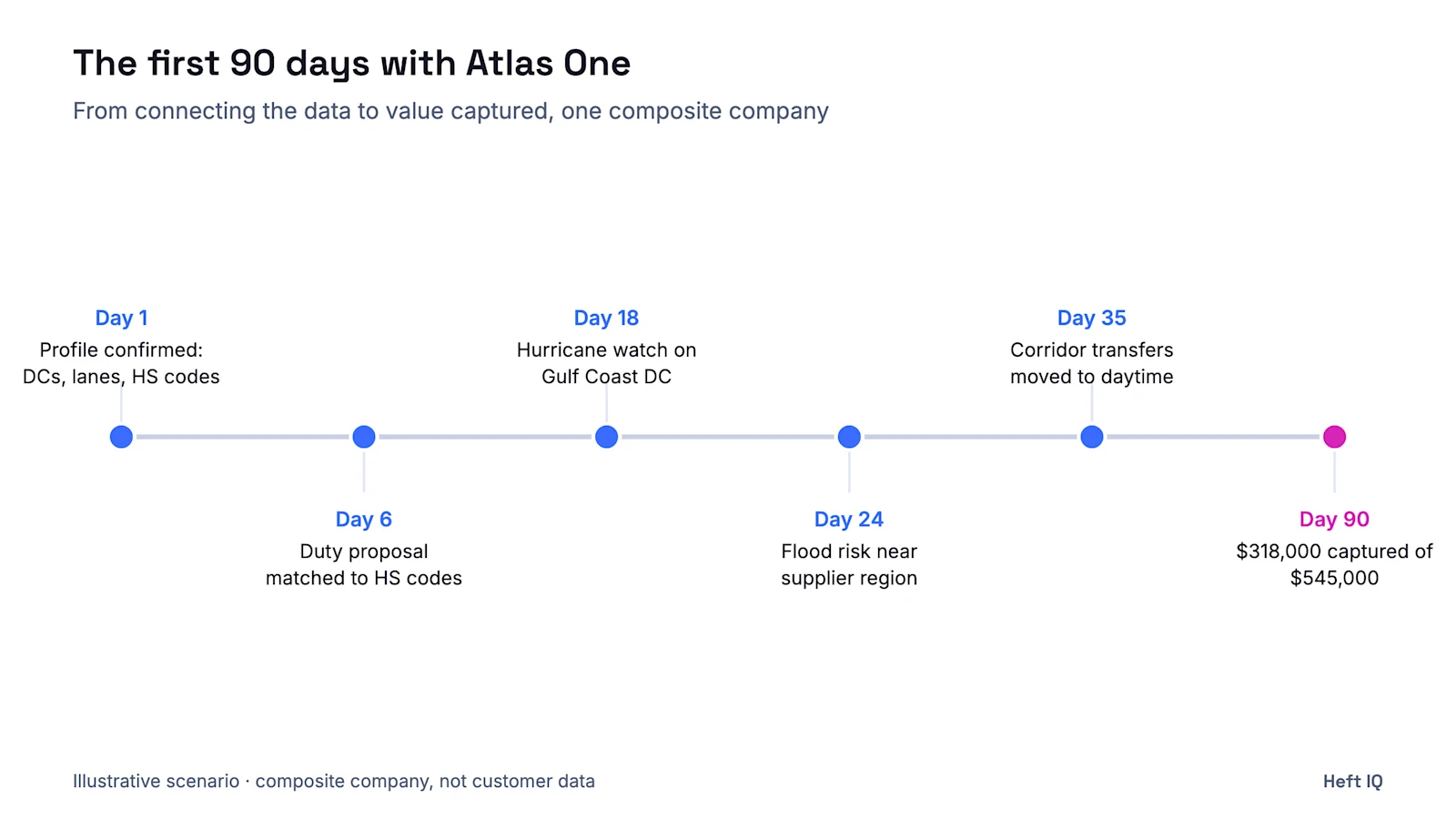
What surfaced in the first 30 days
Atlas One grouped related evidence into ranked situations, each with its sources cited, so the team read one situation instead of fifteen separate alerts. Four stood out.
A proposed duty change on a core product category
In the first week, a proposed rule in the Federal Register raised duties on a category of small electrical goods. Atlas One mapped the notice to the HS codes the company had confirmed and to the trade lane that carries most of that category, and ranked it high because three of the company's largest suppliers sit on that lane. The trade compliance director estimated $240,000 in added duty on the next two quarters of planned purchases if the rule went through as written. Owner: the VP of procurement, with trade compliance supporting.
A late-season hurricane watch over the Gulf Coast DC
On day 18, a hurricane watch was posted for a stretch of coast that included the Gulf Coast DC and the corridor feeding it from the Southeast DC. Atlas One combined the watch, the flood outlook and traffic and routing data for that corridor into one situation, and set a watch on both sites. The distribution team estimated $180,000 at stake in expedited freight, idle labor and late deliveries if the building lost three days. Owner: the VP of distribution.
Flooding near a key supplier region
Heavy rain upstream of an inland manufacturing region raised the flood risk around two supplier locations that make a fast-moving line of hand tools. Nothing in the company's inbox mentioned it yet. Sourcing put $85,000 at stake in stockouts and premium freight if production stopped for two weeks. Owner: the sourcing manager for that region.
Recurring closures on a West Coast corridor
Traffic and routing data showed planned overnight closures and a long construction project on the main corridor between the West Coast DC and the Midwest DC through year end. Each closure was minor on its own. Together they added hours to every transfer. The transportation team estimated $40,000 in overtime and late transfers over the quarter. Owner: the transportation manager.
Who owned what
Each situation became an owned, dated action in the Action Queue instead of a forwarded link. The actions were specific:
Duty change (VP of procurement, due day 21): test the proposed rate against two alternate supplier countries with Atlas One's "what if" questions, then decide whether to pull purchases forward.
Hurricane watch (VP of distribution, due day 19): pre-position fast movers in the Southeast DC, release outbound waves early and confirm an alternate route around the exposed corridor.
Supplier flooding (sourcing manager, due day 30): confirm production status with both suppliers and qualify a backup for the hand tools line.
Corridor closures (transportation manager, due day 35): move transfers to daytime windows and shift them to an alternate route the routing data showed was clear.
Tracked to done meant an action closed only when its owner recorded what was decided and what happened, measured against the estimate at stake. Watches stayed open, so new evidence on the same storm or the same rule updated the existing situation instead of starting a new email thread. Between meetings, planners could ask about any situation in Claude or ChatGPT and get Atlas One's cited answer.
Days 31 to 90: what changed
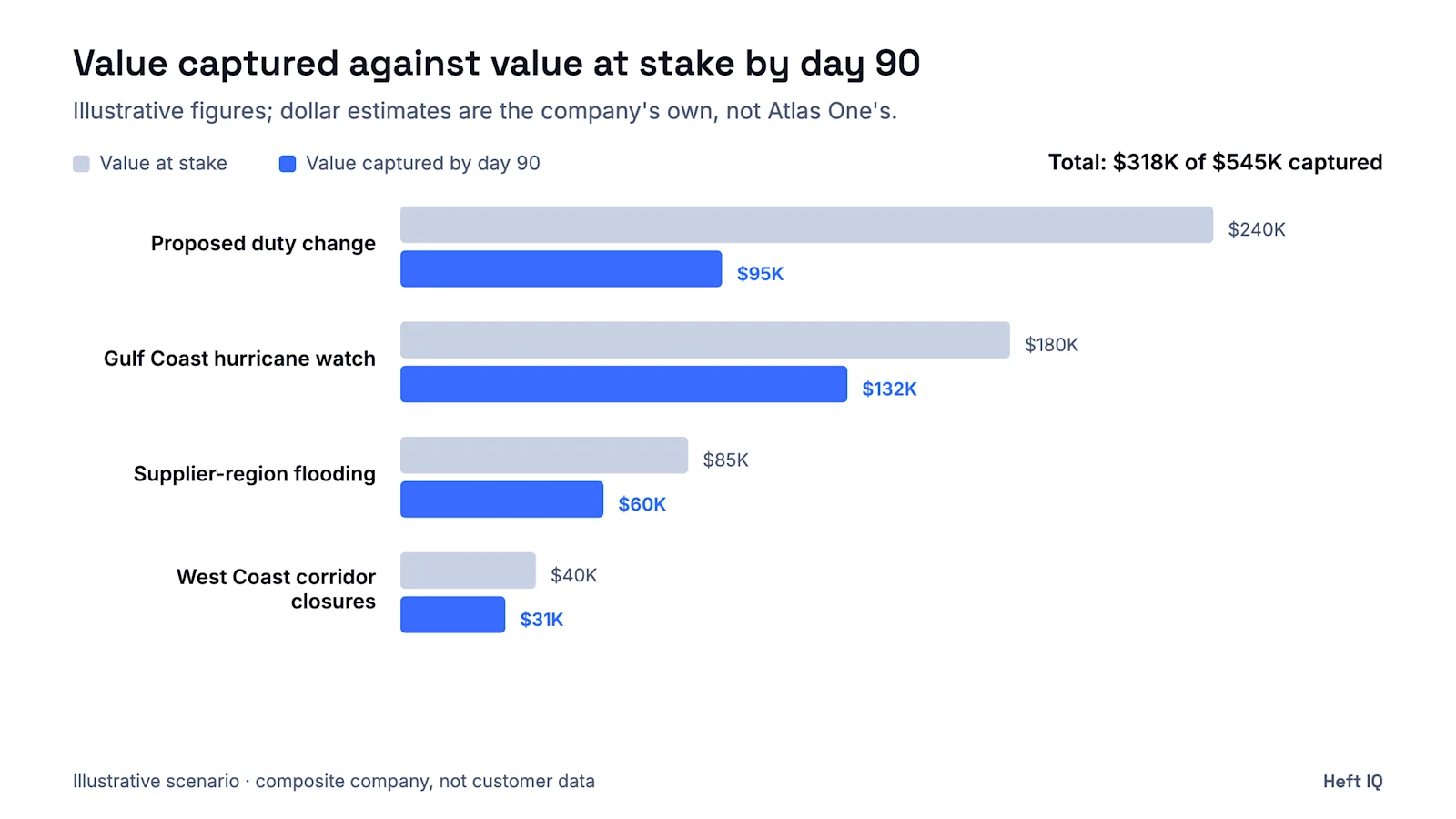
By day 90, the company had captured an illustrative $318,000 of the $545,000 it had put at stake, about 58 percent.
Hurricane watch: the storm turned before landfall but still closed the corridor for a day and a half. Because stock was already in the Southeast DC and waves had gone out early, the company captured $132,000 of the $180,000 at stake.
Supplier flooding: one of the two suppliers lost eight days of production. The backup covered most of the gap, capturing $60,000 of $85,000.
Corridor closures: daytime transfers on the alternate route recovered $31,000 of $40,000.
Duty change: this is the one that didn't fully land. The final rule matched the proposal. Procurement pulled one quarter of purchases forward, but the alternate supplier failed quality checks on two of five products, so the company captured $95,000 of $240,000. The "what if" answer arrived early enough; qualifying a new supplier took longer than the rule did.
The larger change was the weekly rhythm. The Monday review stopped being a tour of headlines and became a short list of ranked situations, each with an owner, a due date and a status. The two senior planners stopped being the company's early warning system and went back to planning.
What made the difference
No single data feed was the story. The hurricane watch mattered because Atlas One knew which DCs and corridors the company had confirmed; the same watch two hundred miles away would have ranked low. The duty notice mattered because it was mapped to HS codes the company actually imports, on a lane it actually uses. Relevance came from the profile, not from the volume of news.
Grouping evidence into one cited situation spared the team from reconciling a weather alert, a flood outlook and a traffic report by hand. Ranking told them which of the four to start with. Citations meant the VP of procurement could take the Federal Register notice straight to the CFO without anyone researching it again.
The Action Queue closed the loop. Every situation ended with a name, a date and a recorded result, which is what finally let leadership answer its question and show what the answer was worth.
To see how Atlas One matches outside events to the sites, routes, suppliers and lanes you confirm, visit the Atlas One product page. For the wider view of how one external change reaches a business, read how to trace global disruption to your business.