
Trace a global disruption to your sites, routes and trade lanes
Storms, road closures and trade notices pile up in peak season. What matters is which of your sites, routes and lanes they touch, and who owns the response.
On this page
It is the second Monday of November. Over the weekend, a winter storm watch went up across two states, a highway into one of your distribution centers was posted for a lane closure, and a trade notice proposed new duties on a product category you import. By 9 a.m., three people have forwarded three links into three different channels, and everyone is asking the same question: does any of this touch us?
For companies that import and distribute physical goods, that question is the expensive one. The news is easy to find. Turning it into "our Southeast DC, the corridor that feeds it, and two of our product families" takes hours of cross-referencing, and in peak season those hours are exactly when the good options disappear.
This guide follows one outside event as it becomes a business problem, explains why most teams find it late, and shows how Atlas One connects outside change to the sites, routes and trade lanes you have confirmed. Two deeper pieces follow the same thread for holiday storms and for tariff changes.
Why peak season makes outside change so costly
Most of the year, a network has slack. From November through January it doesn't. DCs run near capacity, inbound containers are timed to promotions, and outbound routes carry their heaviest volume of the year. A lost day doesn't get absorbed. It rolls forward into the next one.
The events also stack. Winter weather, holiday traffic and year-end trade policy deadlines tend to arrive in the same few weeks, and they come from very different places:
Weather and flood. Storm, ice and flood warnings, drawn by county or region.
Global hazards. Events near supplier locations that can delay goods long before they reach you.
Traffic and routing. Closures, incidents and slowdowns on the corridors between your buildings.
Trade policy. Notices from the Federal Register, Congress, the EU and the WTO, which name products by HS code.
None of these sources speak your company's language. A storm warning is a shaded area on a map. A road closure is a segment of highway. A trade notice is a list of tariff codes. Your business, meanwhile, is buildings, lanes, suppliers and products. Translating one into the other is where the time goes.
The chain of impact
Here is how one outside change travels through a business. The figures in this article are illustrative, built around a composite company: a home-goods importer with four DCs, two overseas supplier regions and a set of regional delivery routes.
An outside event is published. A flood warning covers the county around the importer's Southeast DC, and a state highway into the building is posted for closure. This is the moment with the most options.
Inbound stalls at the site (receiving). Trucks due at the Southeast DC wait or reroute. About 30 inbound loads scheduled for the week slip by two to three days.
Outbound runs late (transportation and fulfillment). Regional routes out of the building run late or skip a day, and replenishment to the other DCs stops. In this scenario, about 6,000 orders that would have shipped from the Southeast DC go out a day or more late.
Other buildings absorb the load (network planning). Planning shifts volume to the Midwest DC, which means weekend overtime and longer transit. Illustrative cost: $45,000 in extra labor and freight for the week.
Holiday commitments slip (sales and service). Promise dates are missed, service contacts climb, and a key retail account asks for credits. Illustrative cost: $60,000 in concessions.
Finance finds it at month end. The cost appears as variance in the December close, weeks after any decision could have changed it.
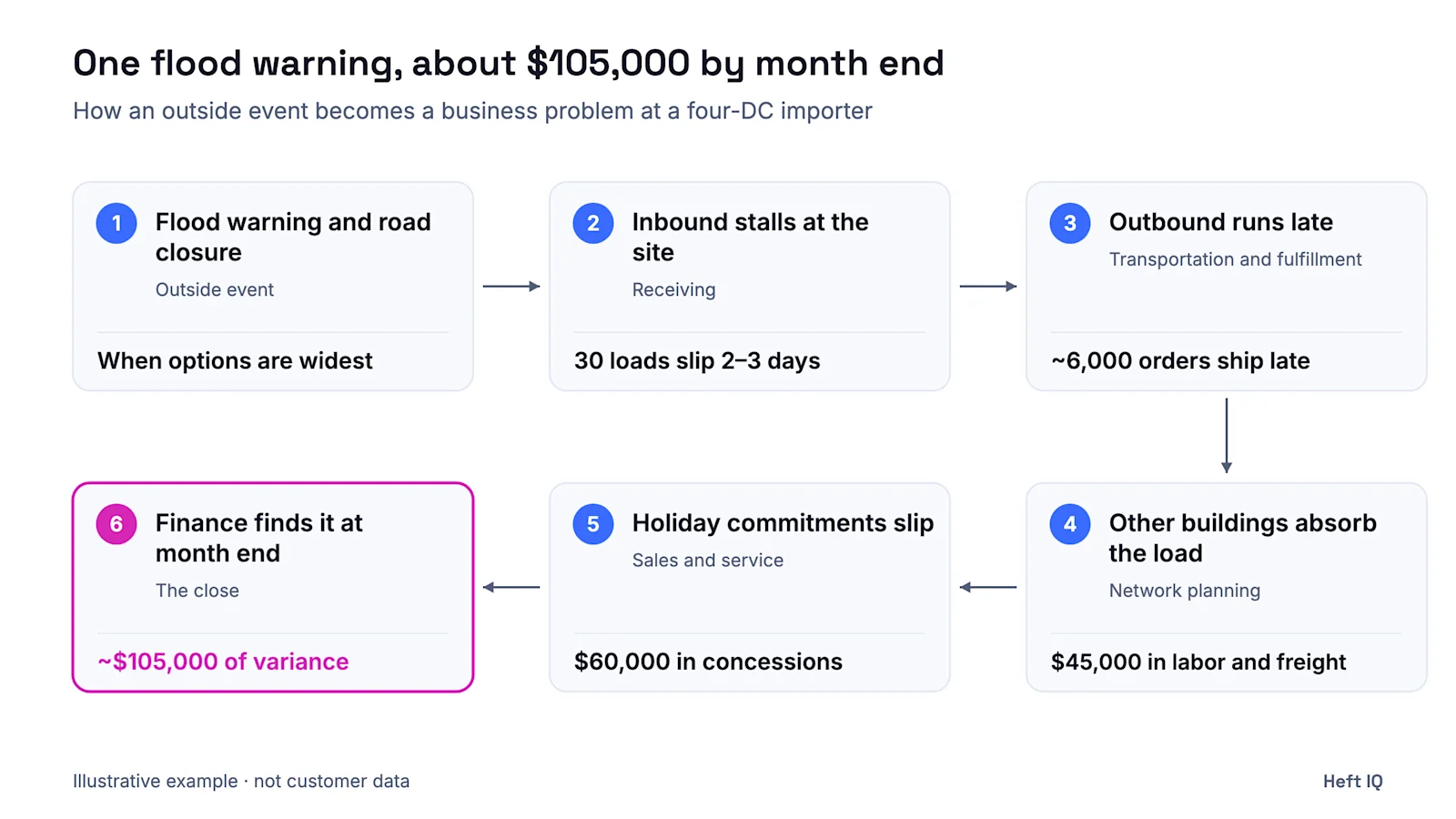
Each step lands with a different team, in a different system, on a different day. So the total rarely gets added up, and step one, where the real choices are, gets the least attention.
The news was never the problem. Knowing which of our buildings and lanes it touched, and who owned the next move, was.
How teams catch it today
In most companies this work falls to a few people who already have full jobs. A logistics manager checks weather sites before the morning call. Someone in trade compliance reads the policy summaries and emails a list of tariff codes to procurement. Transportation hears about a closure from a driver already stuck in it.
Every source is a separate tab. Weather, traffic, hazards and trade policy each have their own feed, format and map.
The translation lives in people's heads. Someone has to know that a county warning covers the Southeast DC, that a closed segment is the main route out of it, or that a listed tariff code covers two of your product families.
Nothing is ranked. A minor advisory and a closure on your busiest corridor arrive with the same weight.
Ownership is informal. A forwarded link isn't a task. Nobody is clearly on the hook, and afterward nobody can show what was done or when.
The result is that the company learns about the problem from its own symptoms: a missed receiving appointment, a late truck, an invoice with a new duty line. By then the chain is three steps along and the cheap options are gone.
How Atlas One catches it
Atlas One starts from your business, not from the news. Your team confirms a profile of what matters: sites, warehouses and DCs, the routes and corridors between them, supplier locations, the products you import, and the trade lanes they travel. Atlas One then watches outside sources against that confirmed profile.
It matches outside events to what you operate. Weather, flood, global hazards, traffic and routing, and trade policy mapped to HS codes are checked against your sites, routes, suppliers, products and lanes. A storm that misses everything you run stays out of your way.
It groups related evidence into one situation. A flood warning, a lane closure and a hazard alert affecting the same DC become a single situation, not three alerts for three people.
It ranks and cites. Situations are ranked so the team starts at the top, and each one cites the sources behind it.
It keeps watch. Watches and alerts follow a developing situation, so the team hears when the evidence changes instead of rechecking five sites every few hours.
It answers "what if" questions. "What if the corridor stays closed through Friday?" or "What if this duty takes effect January 1?" can be asked against the same confirmed sites, routes and lanes.
Leaders who don't live in a new screen can ask about a situation in the assistant your team already uses (Claude or ChatGPT) and get answers drawn from the same situations.
Then the situation becomes work. Each finding goes into the Action Queue as an owned, dated action that is tracked through to done: confirm alternate routing for the Southeast DC, reschedule inbound, brief procurement on the trade notice. When the week is over, there is a record of what was flagged, who acted and when.
Atlas One doesn't replace the systems that run your orders or warehouses. It tells you early, with sources, which of your sites, routes and lanes an outside change touches, so the people who run those systems can act while the options are still open.
Illustrative example
The same composite importer, in a mid-December week. Every figure here is illustrative.
Before
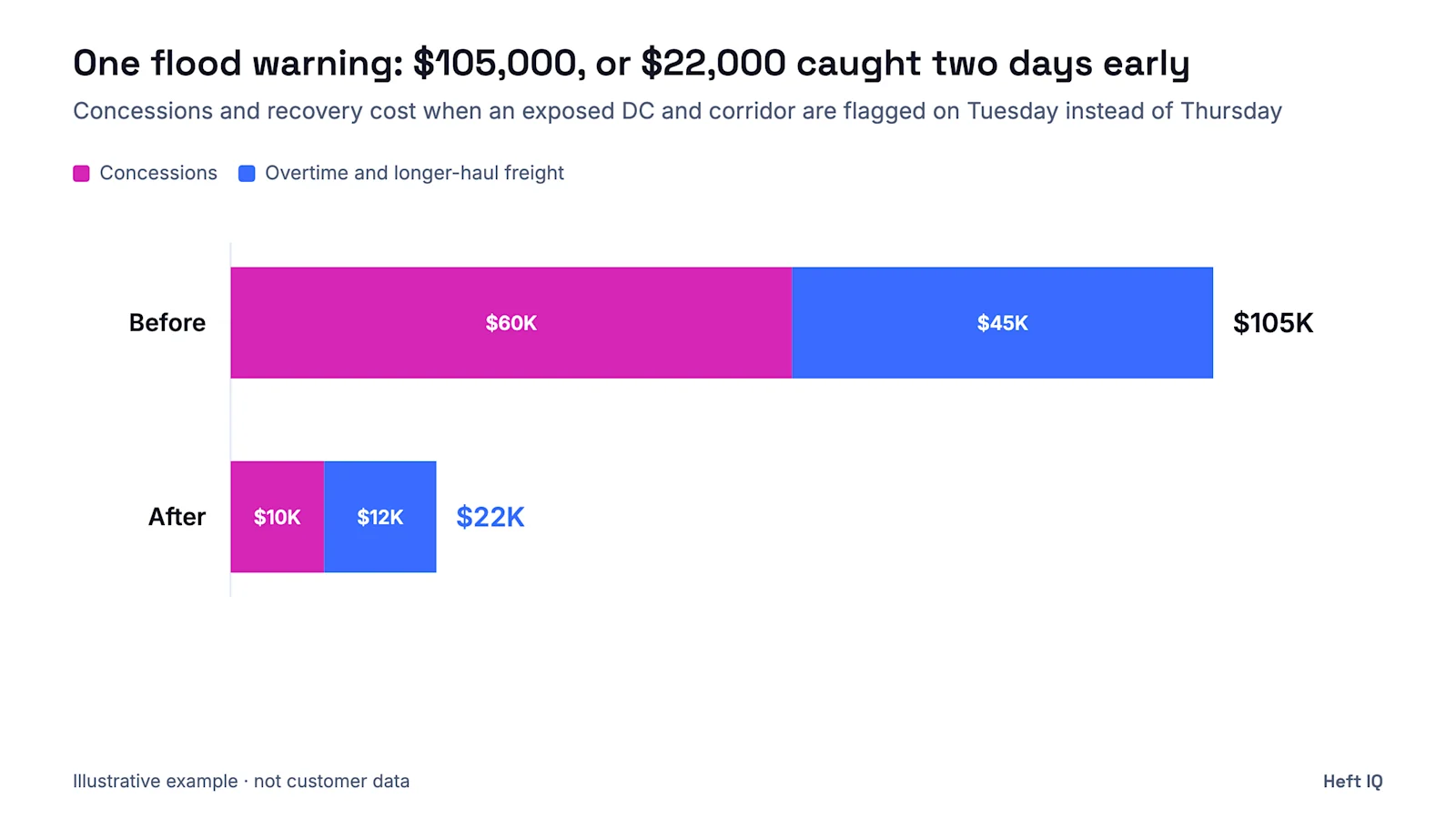
The flood warning was posted on Tuesday. The highway closure went up on Wednesday. The DC manager learned about both on Thursday, when the morning inbound didn't arrive. Planning moved volume to the Midwest DC on Friday. The week ended with about 6,000 late orders, $45,000 in overtime and longer-haul freight, and $60,000 in concessions. Finance added up the roughly $105,000 in January.
After
Atlas One matched the flood warning to the Southeast DC on Tuesday morning and grouped it with the highway closure as one ranked situation, both sources cited. A watch went on the corridor. The Action Queue carried three owned, dated actions: transportation to confirm an alternate route by Tuesday afternoon, the DC manager to reschedule inbound, and planning to pre-position fast-moving products at the Midwest DC by Wednesday.
With two extra days, the shift ran on regular shifts instead of weekend overtime. In this scenario, late orders fell to about 1,200, overtime and freight premiums to $12,000, and concessions to $10,000. Still a hard week, but about $83,000 better, with a record of who did what.
Where to go deeper
Holiday storms: which of your sites and routes are exposed follows a winter storm from forecast to corridor traffic to specific DCs and routes.
Catch a tariff change before it hits landed cost follows a trade notice from HS codes to your products, lanes and supplier options.
To see how Atlas One matches outside change to the sites, routes and lanes you have confirmed, visit the Atlas One product page.