
Illustrative scenario: a partner-led sales team's 90 days with Thread
Resellers, agencies and field reps, one shared pipeline. How stalled deals, forgotten promises and a champion's exit became owned actions, and what they were worth by day 90.
On this page
This is an illustrative scenario built on a composite company, not a customer story, and every figure in it is illustrative. The company sells most of its business through partners rather than its own sales team. Going into the last quarter of the year, its pipeline looked healthy on paper, but nobody could say which partner deals were actually moving, what had been promised to whom, or who was waiting on whom.
The company
The composite sells field-service software and hardware bundles to mid-market operators. It has about 250 employees and roughly 70 active partners: value-added resellers that run their own deals, marketing agencies that fold the product into client retainers, and independent field reps who work regional territories on commission. A channel team of eight partner managers supports them, alongside a small direct sales team.
The question leadership couldn't answer was simple: of the deals our partners are carrying, which ones are stuck, why, and is the blocker on their side or ours? The weekly pipeline call ran on partner self-reporting, and every partner said their deals were on track.
What was connected
Thread read the channel team's email, call recordings and meeting transcripts, alongside the company's deals and partner roster. From that it tracked deal health and partner health, pulled out the commitments people made in conversation, and built the Today feed each partner manager starts the day with.
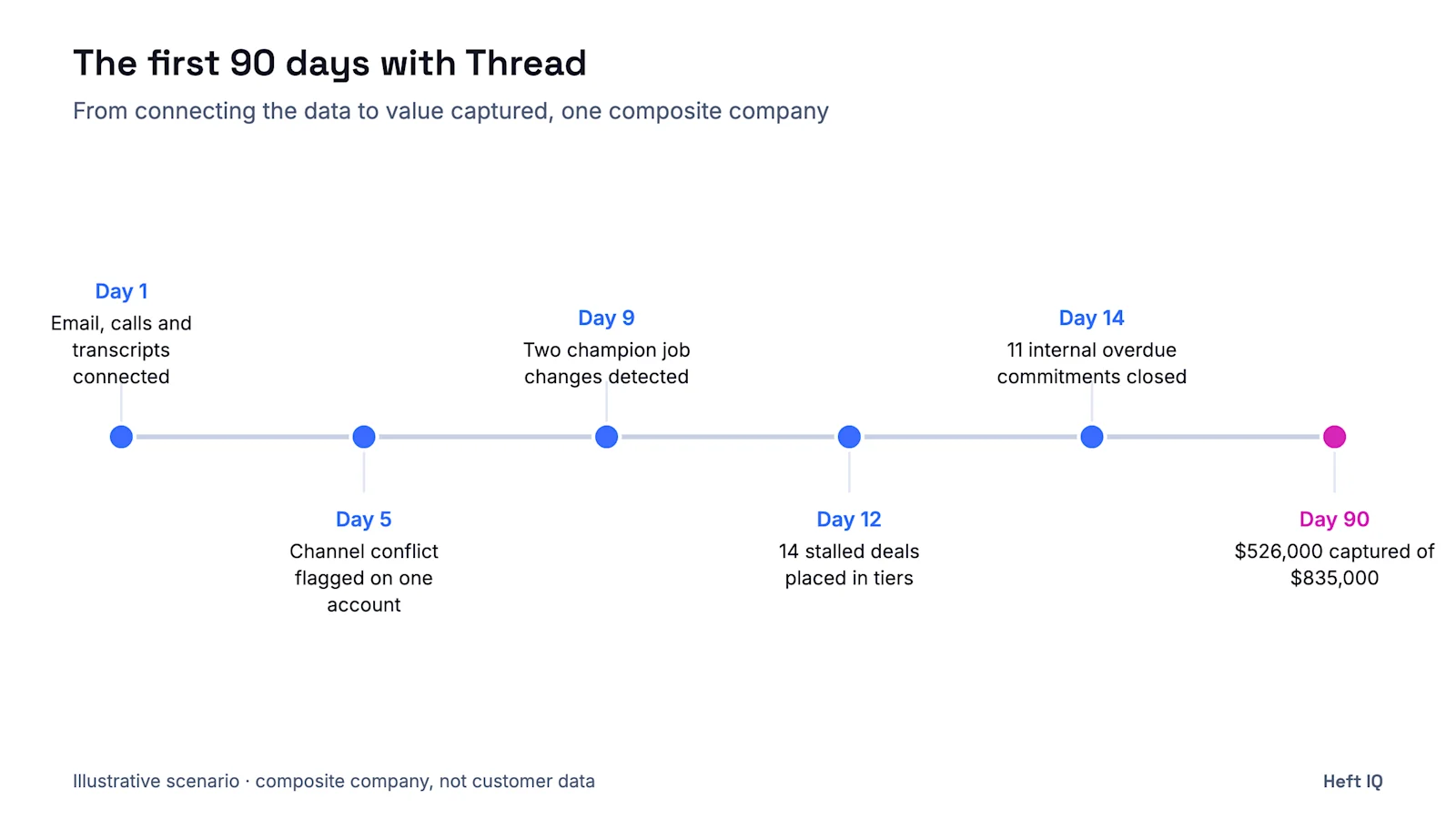
What surfaced in the first 30 days
Fourteen partner deals stalled past their stage
Within the first two weeks, deal health flagged fourteen partner-sourced deals that had sat in the same stage well past its threshold. Most belonged to four resellers whose partner health had dropped at the same time: fewer conversations, fewer updates, and open items aging on both sides. Thread placed each deal in a stalled-deal escalation tier, so the oldest went to a manager instead of staying with a rep who had already followed up twice. Value at stake: $410,000 in pipeline. Owner: the VP of channel sales.
Thirty-seven overdue commitments, eleven of them ours
Thread pulled commitments out of emails, calls and meeting transcripts: a pricing sheet promised to an agency, a pilot plan promised to a reseller's buyer, a security answer promised on a call. Thirty-seven were overdue. The surprise was that eleven were the company's own, and they showed up in partner managers' "Blocked on you" view in the Today feed. Value at stake on the deals those commitments were holding up: $180,000. Owner: the regional sales directors, one list each.
Champions changed jobs at two accounts
Champion job-change detection caught that the internal sponsors on two late-stage deals had moved to new companies. One deal came through a field rep, the other through an agency, and neither partner had mentioned it. Value at stake: $150,000. Owner: the partner manager on each deal.
Two partners working the same account
The channel-conflict guard flagged a reseller and a field rep pursuing the same multi-site operator with different pricing. Left alone, it would have ended in a discount fight or a lost deal. Value at stake: $95,000. Owner: the channel operations lead.
Who owned what
Every finding became an owned, dated action in the Action Queue, and every action showed up in the owner's Today feed until it was done.
Stalled deals (VP of channel sales, due day 21): Smart Nudge drafted a specific message for each reseller contact, tied to the deal's last open item. For the six oldest deals, partner managers built a business case for the reseller to put in front of its buyer.
Overdue commitments (regional sales directors, due day 14): close the company's eleven first, then nudge partners on the rest. Each commitment closed only when it was sent or delivered, not when someone said it would be.
Champion moves (partner managers, due day 10): use the buyer map to find the next most engaged stakeholder, then run a meeting prep brief before the first call with that person.
Channel conflict (channel operations lead, due day 7): decide which partner owns the account under the existing rules of engagement and tell both partners in writing.
Tracked to done meant the queue showed each action's owner, due date and status, and each owner recorded the result against the value at stake. Partner managers stopped keeping private spreadsheets of who owed what. The weekly pipeline call opened with the queue instead of partner self-reports.
Days 31 to 90: what changed
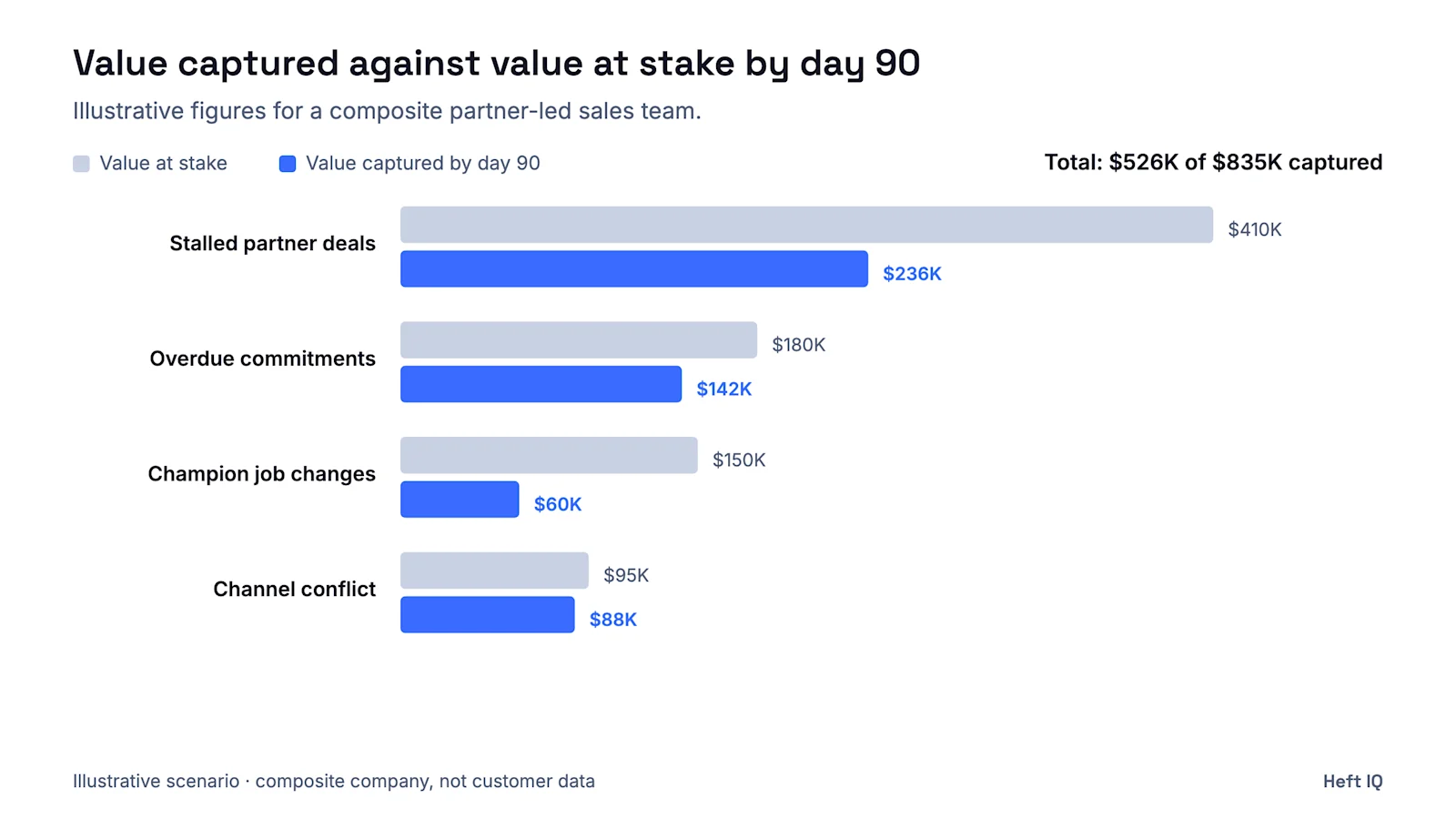
By day 90, the company had captured an illustrative $526,000 of the $835,000 at stake, about 63 percent.
Stalled deals: nine of the fourteen moved forward and five of those closed. Captured: $236,000 of $410,000. The business cases did the most work; two resellers forwarded them to their buyers unchanged.
Overdue commitments: the company cleared its eleven within a week, and partners closed most of theirs once the nudges named the specific item. Captured: $142,000 of $180,000.
Channel conflict: the reseller kept the account, the field rep was credited on a related site, and the deal closed near list price. Captured: $88,000 of $95,000.
Champion moves: this is the one that didn't fully land. The agency deal recovered after a meeting with the new stakeholder the buyer map surfaced. The field rep's deal had no second relationship to fall back on, and the buyer paused the project. Captured: $60,000 of $150,000.
The champion miss changed a habit. Partner managers now check the buyer map on every late-stage deal for at least two engaged stakeholders, and a deal with only one gets its own action in the queue.
What made the difference
The findings were connected. The four resellers with stalled deals were also the partners holding the most overdue commitments, and several of those commitments were the company's own. Deal health alone would have blamed the partners. With commitments and partner health in the same view, it was clear that some stalls started on the company's side, and the "Blocked on you" view made that impossible to miss.
Each finding also came with the next step attached. A stalled deal came with a drafted nudge and, where it helped, a business case. A champion's exit came with a buyer map and a meeting prep brief. A conflict came with a decision owner. Partner managers spent their time acting, not assembling context.
The Action Queue held it together. Every finding ended with a name, a due date and a recorded result, so leadership could see what the quarter's pipeline work was actually worth.
To see how Thread tracks partner deals, commitments and next steps in one place, visit the Thread product page. For more on keeping a pipeline moving into the last weeks of the year, read what stalls pipeline before year-end close.