
How one late inbound turns into SLA credits and overtime
A slow receive on Wednesday becomes missed cutoffs Thursday, a cascade Friday and SLA credits at month end. Here is the chain, and how CargoCore flags it while it is still a receiving problem.
On this page
Wednesday, 2:40 p.m., the second week of December. A trailer from a footwear brand's supplier finally backs in, two days after the date on its ASN. It holds 22 pallets of mixed SKUs, including the boots the brand is promoting in an email that goes out at 6 a.m. tomorrow. The receiving lead does the math: at the current pace, the last pallet will not be put away until Friday. Upstairs, nobody in outbound planning knows yet.
A late inbound looks like a receiving problem. During peak it is the first link in a chain that ends in missed cutoffs, overtime and SLA credits. It is one of the leaks covered in our guide to where peak season drains 3PL margin. The figures are illustrative.
The chain of impact
The inbound misses its window (receiving and the ASN). The trailer was due Monday. Orders kept dropping against the ASN for two days. Monday's planned receiving labor was used elsewhere, and Wednesday's crew is committed to three other brands.
Receiving runs behind the ASN (the receiving floor). Mixed pallets need breakdown, scanning and putaway. The team moves at about 45% of the pace the ASN volume requires. By end of shift, 9,000 of 14,000 units are still sitting in staging, physically in the building but not available to pick.
Orders cannot release (WMS allocation and wave planning). The promo email lands. About 3,400 orders for the boots allocate against stock that is still on pallets. Wave planners hold them or release partial waves, and pickers walk to empty locations.
Cutoff risk becomes a missed cutoff (outbound and the carrier pickup). When units finally reach pick faces at 3 p.m. Thursday, the orders drop into waves that cannot finish before the 5 p.m. parcel pickup. About 2,100 orders miss the day's cutoff.
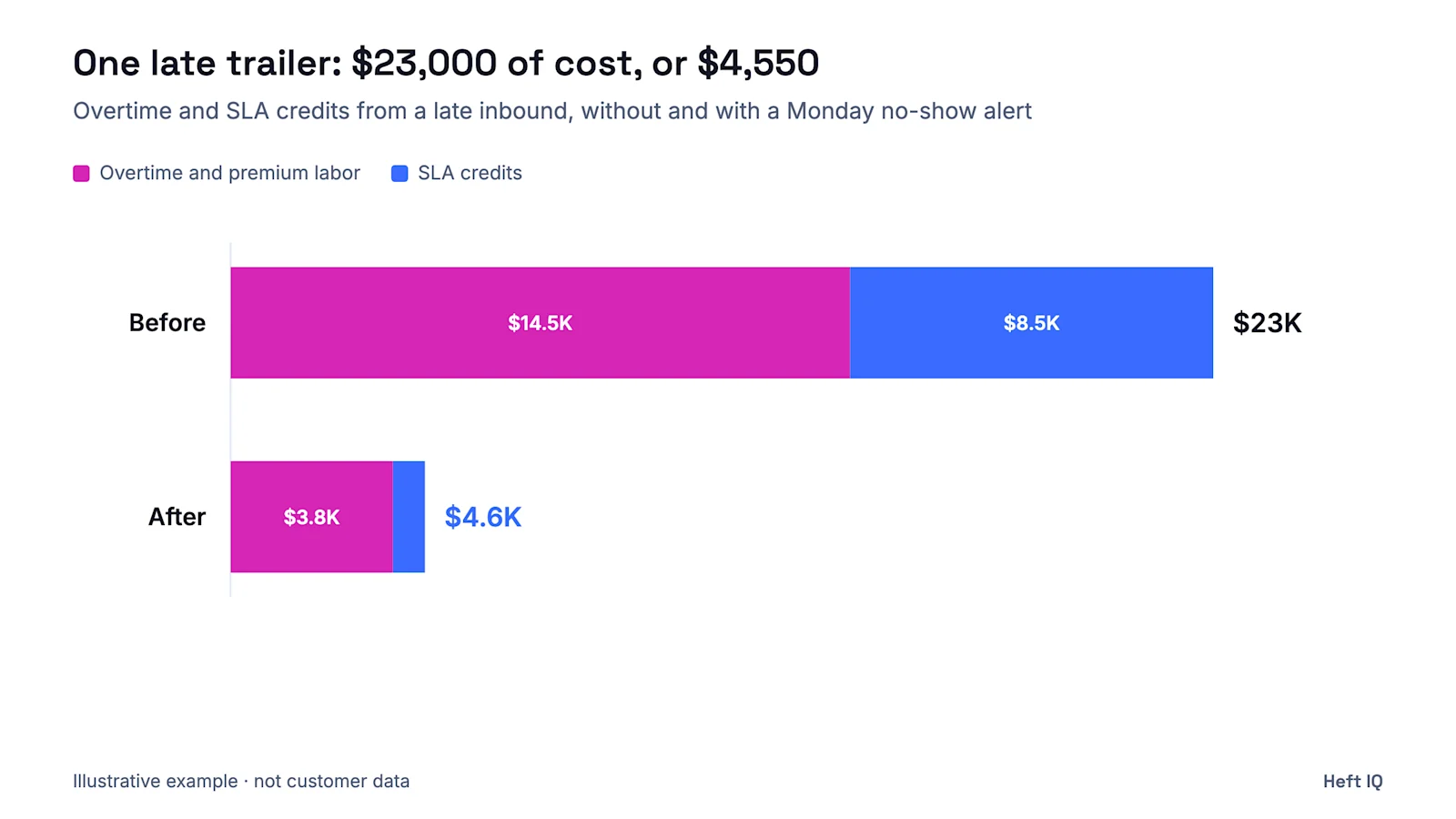
The miss cascades (the next day's waves and labor). Friday starts with Thursday's backlog on top of its own volume, and another 1,300 of the brand's orders slip. Two other brands in the building now face cutoff risk too. The site manager adds a second overtime shift and calls the temp agency at a premium rate. Overtime and premium labor run about $14,500 across the three days.
SLAs breach and credits follow (account management and finance). The contract promises 99% of orders shipped within one business day. The brand finishes the week at 91%. Under its SLA terms the 3PL owes a credit of $2.50 per late order, about $8,500 on 3,400 orders, plus a hard conversation at the next business review.
One trailer, two days late: roughly $23,000, spread across four departments, none of which owns the whole chain.
How teams catch it today
Each team sees its own slice. The receiving lead knows the trailer was late and that the receive is slow, and tracks it on a whiteboard or a shared sheet. Wave planners see orders that will not allocate, but not why, or when the stock will arrive. The site manager sees the overtime request on Friday. Finance sees the SLA miss when the month closes and the brand's operations team sends its own report, often with a credit already calculated.
Connecting those slices takes someone walking between receiving, the planning desk and the account manager's inbox, in the weeks when nobody has time. So the late trailer is treated as a receiving problem on Wednesday, a planning problem on Thursday, a labor problem on Friday and a finance problem in January. The cheapest moment to act, Monday afternoon when the trailer was a no-show, passes without a dollar figure attached.
How CargoCore catches it
CargoCore follows the same chain in order, with a dollar value and an owner at each step.
Inbound no-show. On Monday, when the expected trailer has not arrived, the Ops Command Center raises an inbound no-show alert, while orders are still dropping against stock that is not in the building.
Receiving pace vs ASN. On Wednesday, the receiving pace alert compares units received against the ASN and shows how far behind the receive is running.
Cutoff risk and past cutoff. Orders that depend on that stock are flagged as cutoff risk before the parcel pickup, and as past cutoff once it passes.
Cutoff cascade. When Thursday's misses roll into Friday and threaten other brands' cutoffs, CargoCore raises a cutoff cascade alert for the building.
Labor gap and SLA breach. A labor gap alert shows the shortfall against the work in the building, and an SLA breach alert shows which brand's SLA is being missed.
Stale WMS sync. If the WMS feed goes quiet, CargoCore says so, so a quiet screen is not mistaken for a calm floor.
Alerts are ranked by urgency times dollars, so the boots promo outranks a low-value delay in another aisle, and each alert carries an owner role: receiving lead, site manager, account manager. Dollar-valued alerts flow into the Action Queue, where they become owned, dated actions tracked to done. Site managers work those actions in Mobile Ops, and dismissing one requires approval. The Executive Advisor morning brief puts the at-risk brand in front of leadership before the day starts.
When the brand has submitted a campaign forecast for the promotion, the SLA at risk detector estimates overtime and SLA credit dollars in advance.
Illustrative example
Take a composite 3PL running five buildings, with the footwear brand in its Midwest site. These figures are illustrative.
Before. The trailer no-show on Monday was noted on the receiving whiteboard. The slow receive surfaced Wednesday night, the missed cutoff Thursday, the cascade Friday. Overtime and premium labor came to $14,500. The brand's on-time rate for the week fell to 91%, and the $8,500 SLA credit was found when the brand sent its scorecard in January.
After. With CargoCore, the inbound no-show alert reaches the receiving lead and the account manager Monday at 4 p.m. as a dollar-valued action. The account manager confirms the new arrival date and flags the promo with the brand. The site manager schedules a dedicated receiving crew for Wednesday's arrival, and the receiving pace alert confirms the receive is on track by mid-shift. Orders release Thursday morning. In this illustration, overtime falls to $3,800, about 300 orders miss cutoff instead of 3,400, and the SLA credit drops to $750.
To see how CargoCore connects receiving, cutoffs, labor and SLAs with an owner at each step, visit the CargoCore product page.