
Why partner deals slip quietly before year-end
When a reseller or agency stops updating its deals, nothing alerts you. Deals age, partner health falls, and the forecast is wrong by the QBR. Here's the chain, and where Thread breaks it.
On this page
Your top agency partner registered eleven deals in September. It's now the week before Thanksgiving, and the last update on any of them was October 28. The partner manager assumes the agency is working them. The deals still say commit. Nobody has called, because nothing has told anyone to.
Partner deals rarely die loudly. The partner gets busy with its own year-end, a key rep at the agency goes on leave, or a producer shifts attention to a competing line. The deals don't get marked lost. They just stop moving, and because the partner is the only source of updates, your view of them freezes on the last good day. This piece follows that chain end to end. For the full year-end picture, see what stalls pipeline before year-end close.
The chain of impact
One trigger: a reseller stops logging activity on its open deals in late October. The numbers below are illustrative, based on a composite company.
The partner goes quiet (partner channel). A reseller with eleven open deals worth $820,000 stops updating them. Its own team is closing its fiscal year, and your deals drop to second priority.
Deals age past their stage thresholds (pipeline). Four deals in proposal pass the expected week in that stage, then two weeks. In the CRM they look the same as deals moving on schedule.
Partner health drops, unseen (channel management). With no recent activity and a growing count of idle deals, the partner is effectively stalling. But partner scorecards are reviewed quarterly, so the drop shows up in January.
Buyers cool on the other side (customer). Without the partner following up, two buyers sign with a competitor whose rep stayed in front of them in November. A third pushes its decision into the new budget year.
The forecast is wrong in the QBR (revenue leadership). $820,000 sits in commit right up to the forecast call. When the partner manager finally reaches the partner, $510,000 of it is gone or pushed to Q1.
The partner relationship takes the hit (channel program). The partner misses its program target, its incentives shrink, and the next quarter starts with a less motivated partner and a thinner pipeline.
How teams catch it today
Partner managers carry dozens of partners each. Keeping up means a rotating set of check-in calls, a spreadsheet of last-contact dates, and a weekly pipeline export sorted by close date. It works in a quiet month. It breaks in November.
Silence looks like stability. A deal with no updates doesn't trigger anything. It keeps its last stage and close date, and it looks fine.
Health checks are periodic. Partner reviews happen monthly or quarterly, long after a quiet month has done its damage.
Escalation is personal. Whether a stalled deal reaches a manager depends on someone noticing and deciding to raise it. That's the step that gets skipped in December.
Conflict hides in the gap. When one partner goes quiet on an account, another partner may start working it, and nobody finds out until the buyer is confused.
By the time the pattern is clear, the buyers have already decided.
How Thread catches it
Thread treats a partner's silence as a signal, not as the absence of one.
Partner health that moves with the partner's deals. Each partner's health reflects recent deal activity, open pipeline, and deals that have gone idle. When a reseller stops updating its deals, its health falls from healthy to at risk to stalling in plain view, instead of waiting for a quarterly review.
Deal health and stalled-deal escalation tiers. Each stage has an expected duration. A deal that passes it is flagged for a nudge. At twice the expected time it becomes a warning, and at three times it turns critical and is marked for a manager to step in. Escalation runs on a schedule, not on someone's memory.
Smart Nudge. For each stalled deal, Smart Nudge drafts a follow-up grounded in the deal's history, ready to review and send. Restarting the conversation takes a minute instead of a blank page.
Channel-conflict guard. Only one partner can hold an open deal on a company at a time. If a second partner tries to open a deal on an account the quiet partner still holds, Thread blocks it and shows who holds the account, so the partner manager decides who works it.
Today feed with "Blocked on you." Stalled deals and at-risk partners land in the Today feed of the person who owns them. When a deal is waiting on the partner manager, it shows up under "Blocked on you."
Each escalation becomes an owned, dated action in Thread's Action Queue and is tracked until it's done: the partner called, the deal re-dated or advanced, the account reassigned if the partner can't work it before year-end. Leaders see what was done about every stalled deal, not just which ones stalled.
A partner that stops updating its deals is telling you something. The cost is in hearing it in January.
Illustrative example
A composite company sells through 30 regional agencies and field reps, with $4.5 million of fourth-quarter commit. All figures are illustrative.
Before
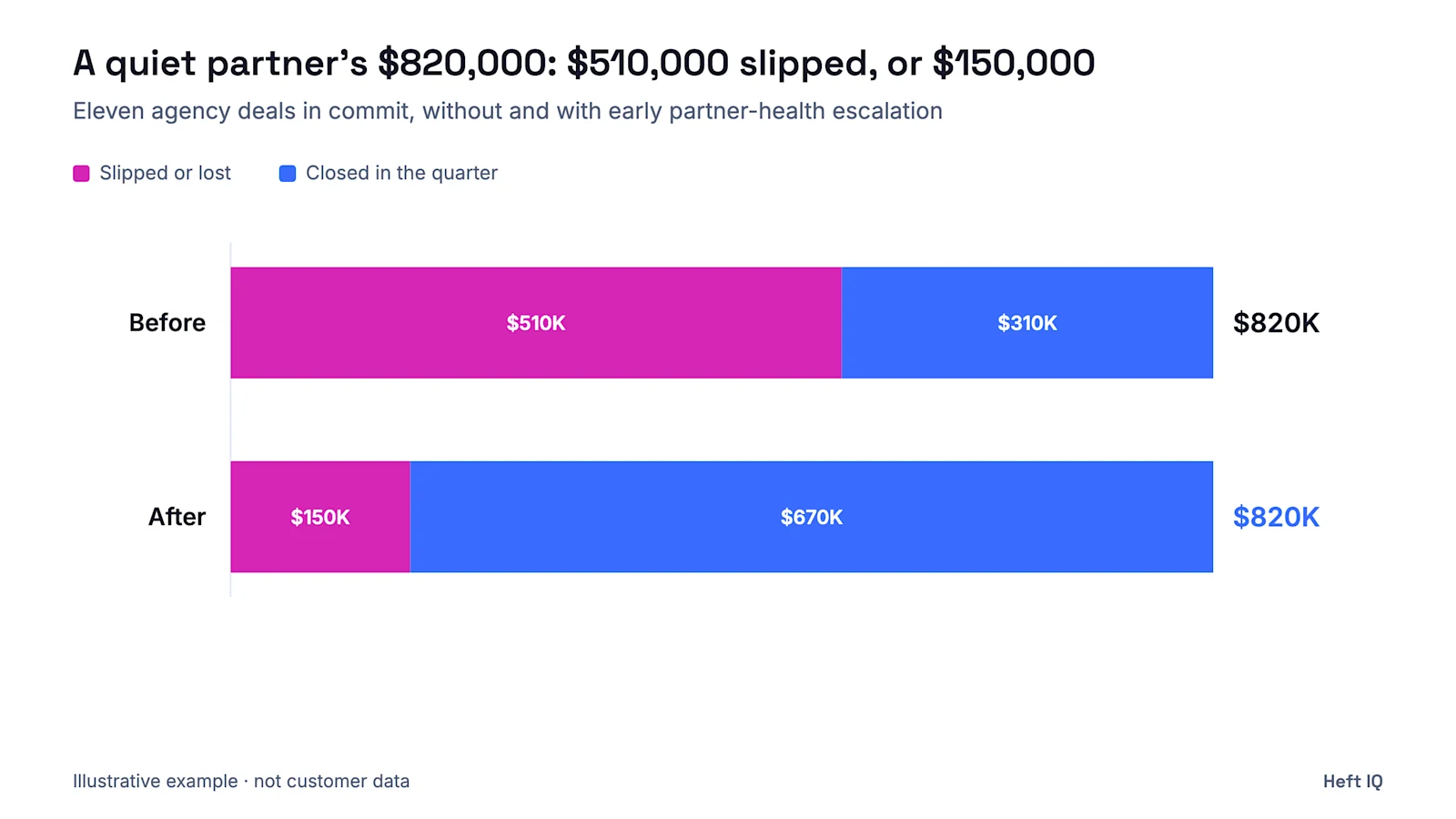
One agency holding eleven deals worth $820,000 goes quiet in late October. Nothing flags it. The partner manager notices in the December 3 pipeline review, reaches the agency on December 6, and learns two deals were lost to a competitor and three have moved to next year. $510,000 slips out of the quarter, and the QBR forecast misses by the same amount.
After
Thread flags the first proposal-stage deal for a nudge in early November, when it passes its stage threshold. The agency's partner health drops to at risk that week and to stalling a week later. Smart Nudge drafts the follow-ups, and the escalation lands in the partner manager's "Blocked on you" view as an owned action. The partner manager reaches the agency on November 10, re-engages four buyers through the agency's principal, and reassigns one account the agency can't work before year-end. In this scenario, $360,000 of the $510,000 closes in the quarter, and the remaining $150,000 moves to Q1 in the forecast a month before the QBR, not during it.
Quiet partners are among the easiest risks to miss and the cheapest to fix early. Thread turns a partner's silence into an escalation, a drafted follow-up, and an owned action while the deal can still close.