
Question fatigue: why chat won't fix what dashboards couldn't
Dashboards look back. Chat waits to be asked, so teams end up asking the same questions every week. What we learned building chat on warehouse data in 2024.
Learie Hercules on LinkedIn (opens in a new tab), CEO, Heft IQ
4 min read
On this page
Most AI budgets are going to plumbing: connecting the ERP, the WMS and the CRM to a data platform, then putting a dashboard or a chat window on top. The plumbing matters. But the problems that cost you revenue are the ones nobody thought to ask about: the order about to ship late, the customer quietly moving volume elsewhere, the supplier about to miss a ship date.
That's the gap this piece is about. Dashboards look back. Chat waits to be asked. Neither one tells you what changed this morning, what it's worth, or who should act on it.
We've built this before
Around 2016, companies spent heavily on pipes so that data analysts could build dashboards. Around 2026, they're spending on pipes so that agents can build dashboards. The tools are better and the demos are faster, but the shape of the project is the same: connect the systems, model the data, and hope the answer to "what does this actually mean?" appears at the end.
It usually doesn't, because the hard part was never the connection. It's the judgment about what matters in your business, which lives in people's heads and not in the schema.
Dashboards look back
A dashboard shows what already happened, to whoever opens it, when they open it. It's only as good as the person looking and the time they have to look. By the time a problem shows up in the weekly report, it has usually already cost money.
Chat waits to be asked
Chat interfaces looked like the fix. Instead of building a report, you ask a question in plain language. We thought so too. In May 2024 we rolled out a chat assistant on a customer's warehouse management system, and their team used it to ask about late orders.
It answered in seconds, in plain language. The problems were everything around the answers:
You have to know what to ask. It took four questions to get from "how many orders were late?" to one warehouse's numbers. Nobody asks the fifth question if they don't know it exists.
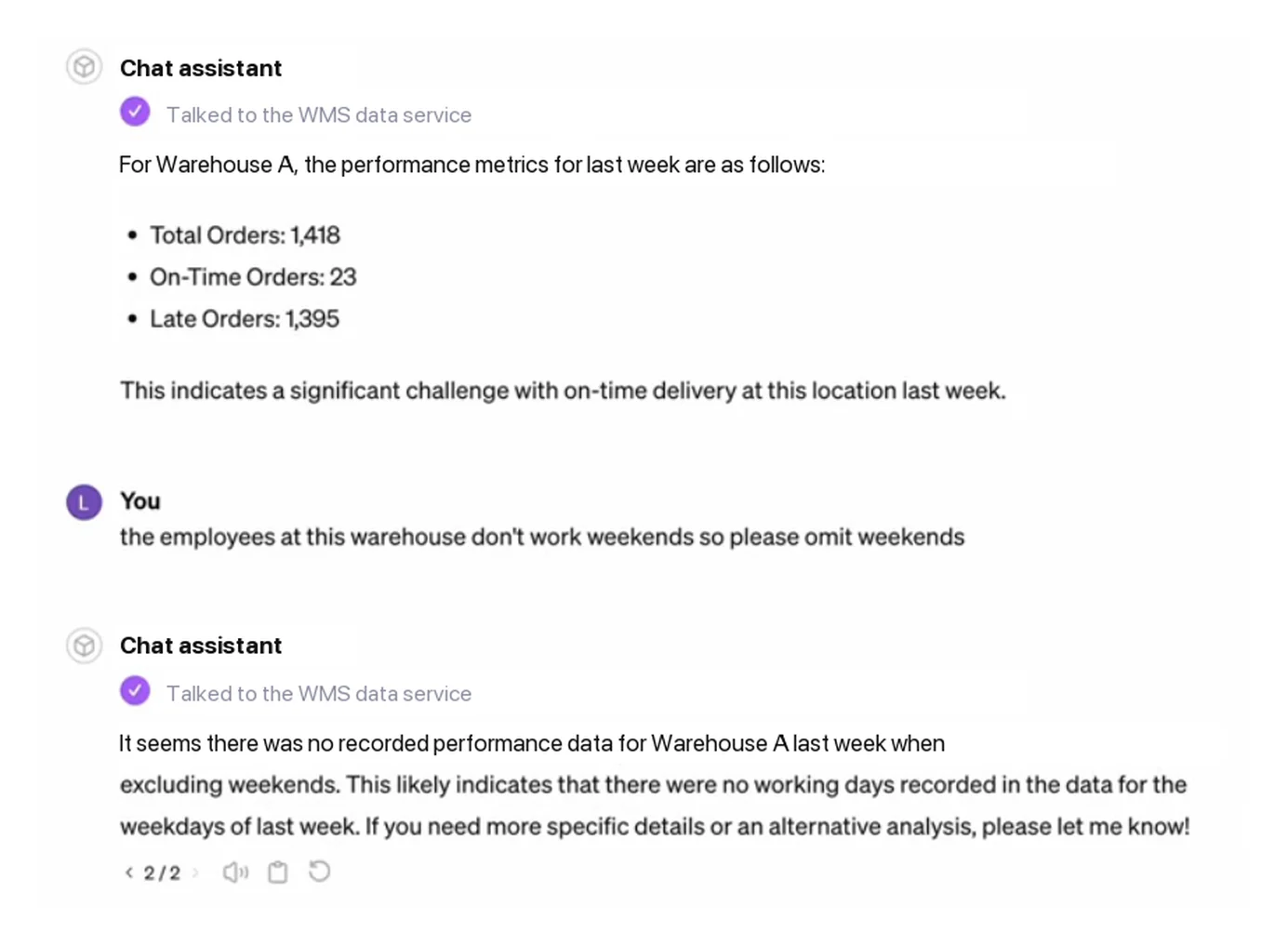
It reports, but it doesn't decide. It told us 1,395 of 1,418 orders at one warehouse were late last week and called that "a significant challenge." No cause, no dollar value, no owner, no next step.
It doesn't know your business. When we told it that warehouse doesn't work weekends, it concluded there was no data at all. Every piece of operating context has to be typed in again, every time.
It still looks back. Every question was about last week.
Here's that exchange from May 2024, with the customer and warehouse names replaced:
What question fatigue costs
Teams that live with chat end up asking the same questions every Monday: which orders are late, which SKUs are short, which accounts went quiet. Then the questions get shorter, then they stop. That's question fatigue, and it's where revenue leaks: not in the questions people ask, but in the ones they stopped asking or never thought of.
Meanwhile the ground keeps moving. Tariffs reshuffle trade lanes. Drewry put Asia–Europe container rates roughly 40% higher than a year earlier in May 2026. A key supplier misses a ship date. Demand swings week to week. The questions that matter change faster than anyone can keep asking them:
Which demand signals matter this week?
Which inventory risks need action, and which can wait?
Which decisions can run on their own, and which need a person?
The contractor trap
The usual answer is to bring in forward-deployed engineers to encode that judgment. They're often excellent, and the first version works. Then the engagement ends, and the logic leaves with them: undocumented rules, one-off prompts and scripts nobody on the team can maintain. Six months later, the business has changed and the system hasn't.
The layer that comes to you
There are three layers in a working stack. Plumbing connects systems. Ontology connects objects: orders, SKUs, suppliers, customers. Domain knowledge connects decisions to outcomes. Most budgets stop after the second.
Heft IQ is built as that third layer. It reads Snowflake, Databricks, Palantir and 256 ERP systems, and for teams without a data platform it consolidates their systems itself, so it works with or without your plumbing. On top, Ambient Agents watch around the clock and bring each finding to email, Slack or Teams, with what it's worth, the evidence behind it and an owner. The domain knowledge is managed like a product: versioned, tested and improved, not left in a contractor's head.
Chat still has its place. We still use it for ad hoc exploration, when you know what you're looking for and want to dig in. But the watching can't depend on someone remembering to ask. Ambient Agents run on autopilot: they check every site, order, customer and deal on their own schedule, and act only where you've said they can.
A dashboard waits for you to look. A chat window waits for you to ask. The layer that matters comes to you.
Five questions to ask before your next AI budget
What will it tell us that we didn't think to ask? If the answer is "anything you ask it," you're buying a better search box.
Does every answer come with a dollar value, the evidence and an owner? If not, someone still has to turn it into a decision.
Where does our operating knowledge live, and who maintains it after go-live? Weekends, cutoffs, SLAs and exceptions have to be built in once, not retyped every time.
Does it look forward? Last week's numbers are a report. Today's risk to next week's revenue is a decision.
Does it need a finished data platform first? If it only works once the plumbing is done, the budget will go to plumbing.
For more on how this works in practice, read What are Ambient Agents? A guide for operations teams. Or see what Heft IQ finds in your own systems: your first finding in 48 hours.