
What are Ambient Agents? A guide for operations teams
Ambient Agents watch your systems around the clock and bring you what matters, so you don't have to go looking. What they are, how they differ from dashboards and chatbots, and how to judge them.
Learie Hercules on LinkedIn (opens in a new tab), CEO, Heft IQ
4 min read
On this page
Ambient Agents watch your systems around the clock and bring you what matters, priced and explained, so you don't have to go looking. They act only where you've said they can.
Most operations teams already have more data than they can read. The ERP, the WMS, the TMS and the CRM each hold part of the picture, and dashboards show it to whoever opens them. The problem isn't seeing the data. It's that someone has to go looking, every day, across every site, customer and lane, and the thing that mattered is usually found after it has already cost money. Ambient Agents turn that around: instead of you going to the data, what matters comes to you.
Where the term comes from
The term was introduced by the software company LangChain in January 2025 to describe agents that "listen to an event stream and act on it accordingly", rather than waiting for someone to type a question. Its founder, Harrison Chase, has been clear on one point that matters to operations leaders: "ambient does not mean fully autonomous." An ambient agent can notify you, ask you a question, or ask you to review something before it acts.
It's worth separating the term from "ambient AI" in healthcare, which usually means tools that listen to doctor-patient conversations and write clinical notes. That's a different idea. Ambient Agents in operations watch business systems, not conversations.
Ambient Agents, dashboards and chatbots
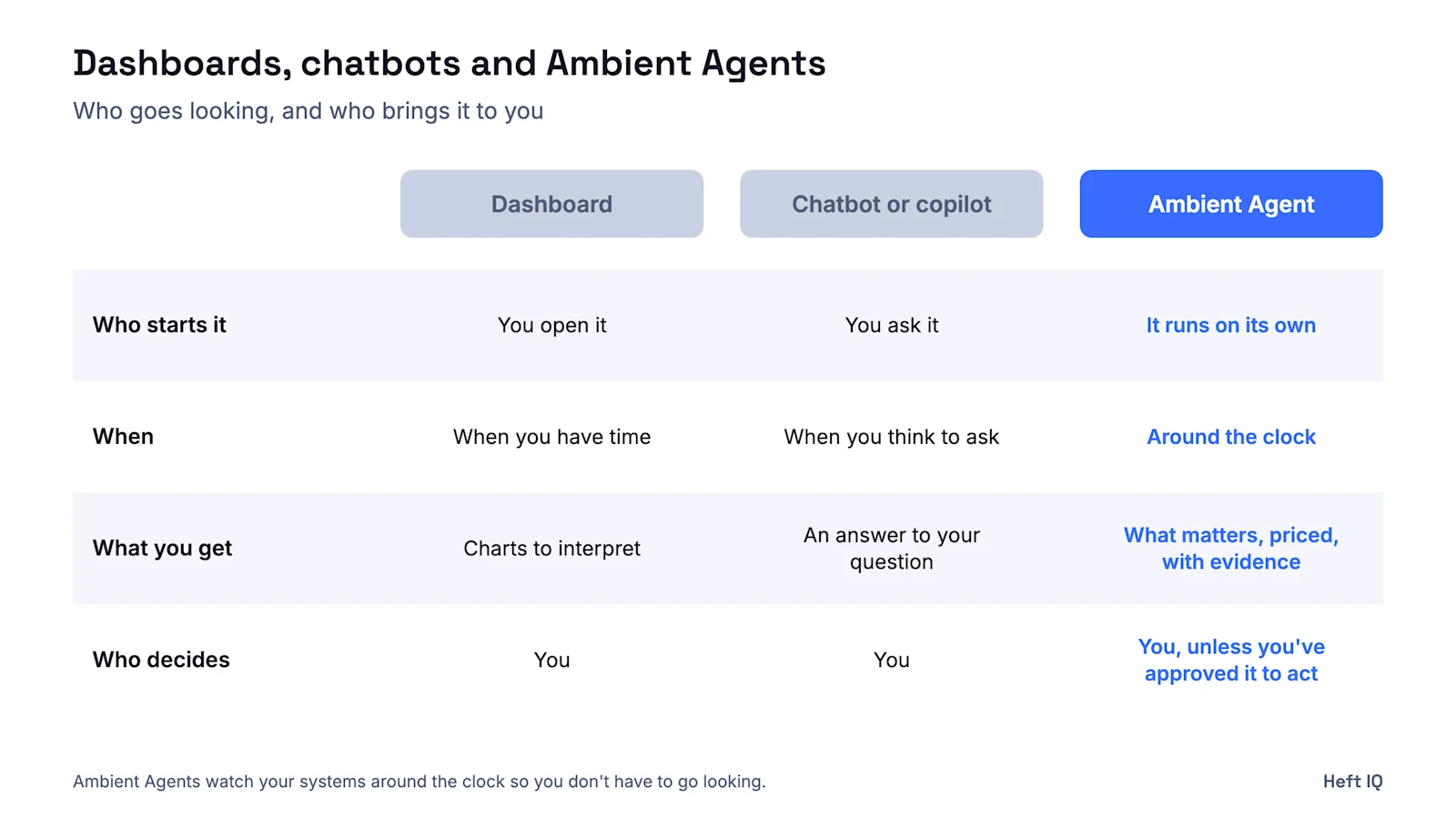
Dashboards show you the data when you open them. They're only as good as the person looking, and the time they have to look.
Chatbots and copilots answer when you ask. They're useful, but you still have to know what to ask and when.
Ambient Agents run on their own schedule, watch for the patterns that matter to your business, and come to you with what they found, its value and the evidence behind it. You decide what happens next, unless you've told them they can act.
What an Ambient Agent does
Watches. It reads the systems you already run, continuously or on a schedule, across every site, customer, lane or deal, not just the ones someone remembered to check.
Judges what's worth your time. It ignores what falls below a threshold that matters, so the list stays short enough to trust.
Brings it to you, priced. Each finding arrives with what it's worth in dollars, the evidence behind it and a recommended next move.
Acts only where you've approved. Where you've allowed it, it takes the next step itself, and that step can be undone. Everywhere else, a person decides.
Shows its work. What it saw, what it did and why are recorded, so you can check it later.
A dashboard waits for you to look. An Ambient Agent looks for you, and tells you what it found and what it's worth.
Why "ambient" doesn't mean "autonomous"
Operations leaders are rightly cautious about software that acts on its own. In RELEX's 2026 survey of 514 supply chain leaders, only 10% said they would trust AI to make fully independent supply chain decisions, while 54% wanted it to recommend and let people decide. Capgemini found trust in fully autonomous agents fell from 43% to 27% in a single year. Ambient Agents are built for that reality: they do the watching, and people keep control of the decisions that matter.
What they catch, by role
3PLs. Orders projected to miss today's carrier cutoff, receiving running behind the ASN, work performed but not billed, and brands whose order profile has drifted from the deal.
Freight brokers. A carrier whose identity or insurance changed since approval, a truck that hasn't checked in for pickup, and lanes that will be thin next month.
Manufacturers. Customer orders that a material shortage will hold up, ranked by how short and how soon, and backlog stuck at a work center.
Importers and supply chain teams. A tariff notice that touches your HS codes, or a storm heading for a site and the corridor that feeds it.
Partner-led sales teams. A partner deal that has gone quiet, a commitment that's overdue, or a champion who has changed jobs.
How to judge Ambient Agents
What exactly do they watch, and how often?
How do they decide what's worth bringing to you, and can you see why?
Does every finding come with a dollar value and the evidence behind it?
What can they do on their own, who decides that, and can it be undone?
Can you see a record of what they saw and did?
How long until they're watching your own systems?
Ambient Agents at Heft IQ
Each Heft IQ product runs Ambient Agents on the systems its users already have, so the work of watching is done for them.
CargoCore checks every site, order and billable activity against your SLAs and rate cards, so nothing ships late or goes unbilled without you knowing.
Margo vets every carrier at tender, watches for no-shows and recovers loads with vetted capacity, acting on its own only inside a window where any automatic action can be undone.
Atlas One watches trade policy, weather and disruption and alerts your team the day a change touches your products, suppliers, sites or lanes.
Thread watches your deals and partners and surfaces the deals going quiet, the commitments overdue and the next step to take.
For how this works in practice, read Where peak season quietly drains 3PL margin or A carrier vetting checklist for freight brokers.