
Catch a tariff change before it hits landed cost
Trade notices list HS codes, not your suppliers. See how a duty change maps to your products and lanes early enough to test supplier options and assign the response.
On this page
Late on a Friday in mid-November, a tariff notice on a product category is published. It proposes higher duties starting January 1 and lists a handful of HS codes. Procurement is finalizing first-quarter purchase commitments the following week. Nobody on the team reads the notice until a customs broker's newsletter mentions it ten days later.
This piece goes deep on one chain from our guide to tracing a global disruption to your business: how a policy notice moves through HS codes and trade lanes into landed cost, and how Atlas One surfaces the exposure while there is still time to choose.
Why trade policy is hard to read in time
Trade policy comes from several places at once: the Federal Register, Congress, the EU and the WTO. Each notice speaks in tariff codes and countries of origin. Your business speaks in product families, suppliers and lanes. The same product bought from two suppliers in two regions can land on opposite sides of a notice. Working out which side yours is on takes someone who knows both the codes and the catalog, and in peak season that person is busy.
The chain of impact
The figures below are illustrative, built around a composite company: a kitchenware importer buying from three supplier regions and distributing through two DCs.
A notice is published (trade compliance). It proposes a 15-point duty increase on six HS codes, effective in about six weeks. It sits unread over the weekend.
The codes map to your products (product and catalog). Four of the importer's product families fall under two of the listed codes. Nobody has made that connection yet.
The products travel one exposed lane (procurement). All four families come from suppliers in a single region on a single trade lane, about $4 million a year in imports and roughly $1 million in the first quarter.
Landed cost rises (finance). At 15 points, the added duty is about $600,000 a year, or roughly $150,000 on first-quarter volume.
Commitments lock in the old assumption (procurement and sales). First-quarter purchase commitments go out at pre-notice cost, and spring pricing is already set.
Margin absorbs the gap (finance). With no time to resource or reprice, the $150,000 shows up as first-quarter margin erosion, explained after the fact.
How teams catch it today
In many importers, trade policy monitoring is a side task for one person in compliance or logistics, on top of a peak-season workload.
Reading every source is slow. Notices are long and arrive from several bodies on their own schedules. Most get skimmed, if they are read at all.
Matching codes to products is manual. Someone exports the catalog, filters by tariff code and checks each match by hand.
Lanes and suppliers are a separate step. Knowing a product is affected is not the same as knowing which supplier and lane carry it, or whether an alternate supplier is any safer.
Findings travel by email. Procurement and finance hear second-hand, often after commitments are placed, and nobody owns the follow-up.
By the time the exposure is clear, the cheapest responses, such as shifting volume or pulling shipments ahead of the effective date, are already off the table.
How Atlas One catches it
Atlas One watches trade policy from the Federal Register, Congress, the EU and the WTO, mapped to HS codes, and checks it against the profile your team has confirmed: the products you import, your supplier locations and the trade lanes between them.
The notice is matched to your products and lanes. Instead of a list of codes, the team sees which confirmed products and which lanes the notice touches.
It becomes a ranked, cited situation. The exposure appears as a situation, ranked alongside everything else, with the notice cited so compliance can confirm it at the source.
Watches follow it forward. A watch on the notice and the affected codes alerts the team when new evidence appears, without anyone rereading the feeds.
"What if" questions test the options. Landed-cost and supplier-substitution ideas become questions: "What if we move these families to our supplier in the second region?" The answer shows whether that lane faces the same notice, or a different one, with sources.
Atlas One doesn't hold your purchase prices or margin. What it gives finance and procurement is the specific products, codes and lanes affected on the day the notice appears, so the landed-cost math starts weeks earlier.
Then the response becomes owned work in the Action Queue. Each action has an owner and a date and is tracked through to done: compliance confirms the classification, procurement requests quotes from the alternate supplier, finance re-costs first-quarter commitments.
Illustrative example
Same composite kitchenware importer, same notice. All numbers are illustrative.
Before
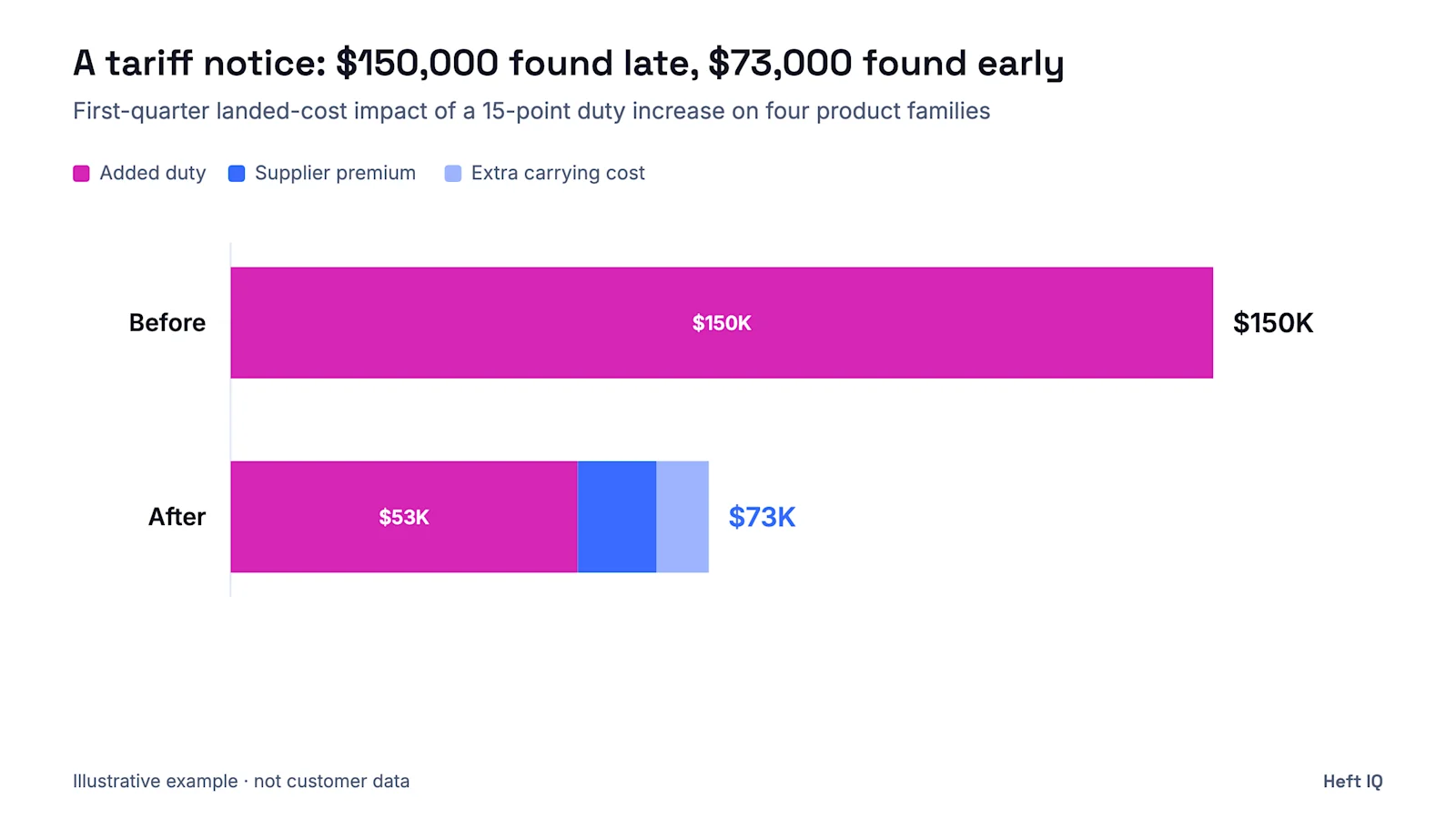
The notice was found ten days late. First-quarter commitments had gone out at the old cost, and switching suppliers would take a full quarter. The added duty on first-quarter volume came to about $150,000, absorbed as margin erosion.
After
On Monday morning, Atlas One showed the notice matched to four product families and one trade lane, with the source cited. A "what if" on the second supplier region showed that lane was not named in the notice. By Tuesday, the Action Queue held three owned, dated actions, and procurement held back part of the first-quarter commitment.
In this scenario, the importer pulled about 25% of first-quarter volume ahead of January 1 and moved about 40% to the second region. Only 35% landed under the new duty, about $53,000. Adding a $12,000 supplier premium and $8,000 in extra carrying cost, the quarter's hit was about $73,000 instead of $150,000.
For the wider view of how outside events reach your business, read the pillar guide. To see how Atlas One maps trade policy to the products and lanes you have confirmed, visit the Atlas One product page.