
Why the cheapest rate is often your most expensive decision
A lower linehaul from an unproven carrier can cost more once detention, TONU claims, invoice variance and fall-off risk land. Here's that chain, and how Margo shows it before you tender.
On this page
Three weeks before Christmas, a reefer load out of the Central Valley needs a truck by 6 a.m. tomorrow. The rep posts it and gets four callbacks. Three carriers the team has run before quote $3,050 to $3,200. A fourth, with two loads of history and a clean authority check, quotes $2,700. The customer rate is $3,600. Taking the $2,700 truck nearly doubles the margin on the load, and the board is full of loads just like it. The rep books it in under a minute.
Sometimes that's the right call. At peak, it's often the most expensive decision on the board, and the cost doesn't arrive until the invoice does. This piece goes deep on one chain from our overview of peak freight decisions you can defend.
The chain of impact
Carrier sales books on linehaul. The rate confirmation shows $2,700 against a $3,600 customer rate: $900 of gross margin, $400 more than the next-best option. That's the number the rep's scorecard sees.
Operations absorbs a weaker carrier's habits. The driver misses the pickup appointment by three hours, the shipper reworks the slot, and the truck waits. Because the carrier was late, the detention isn't billable to the customer. The carrier bills $250 anyway. Track and trace loses an hour to check-calls a reliable carrier wouldn't have needed.
Carrier settlement gets an invoice that doesn't match. Detention, a $185 lumper at the grocery DC and a TONU claim from an earlier load that canceled two hours before pickup arrive together. The invoice is $610 over the rate confirmation. AP has to decide which lines are payable, usually without the facts to decide.
The fall-off risk travels with every future load. A carrier with thin history is a guess. When it rolls a load at peak, the re-cover runs $500 to $800 over the original rate, and the customer's delivery appointment is at risk. That's the subject of our deep dive on no-show recovery cost.
Account management takes the customer's call. Any accessorial passed through needs a reason; any written off is margin gone. Either way, the account manager can't show why this carrier was chosen or what the market was paying.
Realized margin lands far from the booked number. The $400 of extra margin on paper becomes $150 or less after accessorials the brokerage can't pass through, AP time and dispute write-offs. On a load that falls off, it becomes a loss.
The rate wasn't wrong. It was incomplete: linehaul is one line of what a load costs.
How teams catch it today
In most brokerages, the cost of a cheap carrier is found in pieces, by different people, weeks apart.
Carrier vetting checks authority, insurance and safety at onboarding. It says whether a carrier may haul the load, not how it will perform on this lane at peak.
Margin is booked at tender and reported on linehaul, so rep scorecards reward the cheap truck before the accessorials arrive.
Accessorial review happens in AP, invoice by invoice, usually after the customer has been billed. Telling carrier lateness from a slow dock means digging through check-call notes.
TONU claims are judged case by case, often by whoever has time, against terms nobody has in front of them.
The pattern only appears at month end, when someone builds a report on realized margin by carrier. By then the carrier has a dozen more loads in December.
How Margo catches it
Margo prices the decision the way the load will actually be paid, and keeps the evidence attached.
All-in cost at the point of decision. Every carrier option is shown as linehaul plus fuel plus accessorials, with its rate compared with the market. The $2,700 truck and the $3,050 truck are compared on all-in cost, not on linehaul alone.
Carrier trust with confidence bounds. A carrier with two loads on file gets a score that says how little is known. The rep sees a low price with wide uncertainty, not a low price alone.
Human approval where it matters. Your team decides when Margo can act on its own and when a person signs off, such as a low-trust carrier on a high-value load. Autonomous actions can be undone within an undo window.
A decision trace at the moment of tender. Margo records the options, the all-in cost of each, a snapshot of the chosen carrier, and why it won.
Payability and reconciliation. Detention, accessorial and TONU charges are checked for whether they're payable. Facility dwell is charged to the facility, never the carrier, so a good carrier isn't blamed for a slow dock. Invoice variance is split by component, so AP sees $250 of detention, $185 of lumper and a $175 TONU claim instead of one unexplained total.
Each finding becomes an owned, dated action in Margo's Action Queue: a TONU claim to resolve for carrier settlement, a carrier review for the carrier sales lead, a pass-through question for the account manager. The queue tracks each one to done. Past decisions are scored against actual outcomes, so the team learns where cheap linehaul paid off.
Illustrative example
These figures are illustrative, based on a composite brokerage moving about 700 loads a week at peak, heavy in temperature-controlled and retail freight.
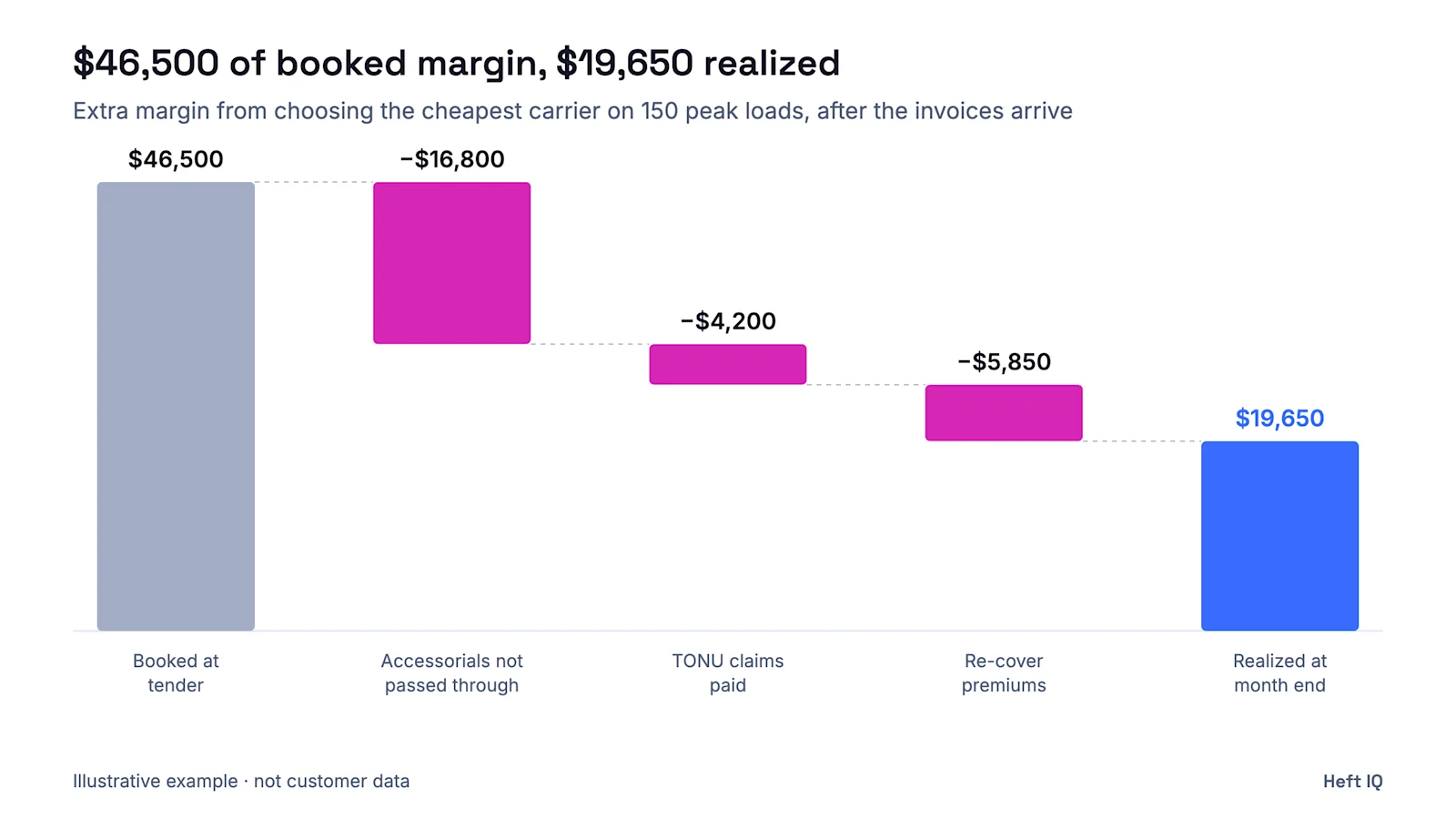
Before. Over December, reps book 150 loads with the lowest-quoting carrier when a known carrier was available, booking about $310 of extra margin per load, roughly $46,500. Then the invoices arrive. Sixty loads carry accessorials the brokerage can't pass through, about $280 each, or $16,800. AP pays $4,200 in TONU claims it can't assess in time. Nine loads fall off and are re-covered at an average $650 premium, $5,850. Realized extra margin: under $20,000, less than half of what the scorecards showed.
After. Reps see all-in cost and carrier confidence before booking. About 50 of the 150 loads go to known carriers at a higher linehaul but a lower all-in cost. Loads routed to thin-history carriers above a set value go to a lead for approval. Unpayable TONU and detention claims are caught at reconciliation, and each is assigned to an owner. The extra margin booked is smaller, and much more of it is still there at month end.
The cheapest rate isn't the problem. Choosing it without the rest of the cost is. See how Margo puts all-in cost and carrier trust in front of every tender.