
Double brokering: how brokers catch carrier identity fraud before tender
What double brokering and carrier identity theft are, the red flags FMCSA and TIA point to, and the checks that belong at every tender, not just onboarding.
Learie Hercules on LinkedIn (opens in a new tab), CEO, Heft IQ
4 min read
On this page
Freight fraud has become a cost of doing business for many brokerages. In TIA's April 2025 survey of its members, 22% reported losing more than $200,000 to fraud in the previous six months, and unlawful brokerage was the tactic named most often. Verisk CargoNet estimated 2025 cargo theft losses at nearly $725 million, up 60% from the year before.
Most of these schemes have one thing in common: someone isn't who they say they are. A carrier's identity is borrowed, a load is quietly passed to another truck, or payment goes somewhere it shouldn't. This guide covers what the law says, the warning signs regulators and the industry point to, and the checks that catch fraud before a load is tendered. It is general information, not legal advice.
What double brokering and identity theft are
"Double brokering" isn't defined in statute or regulation. FMCSA describes the common use of the term as a motor carrier accepting a load from a broker and then passing it, without the shipper's or original broker's knowledge, to another carrier that actually hauls it. It's closely tied to unauthorized brokering: under 49 U.S.C. 14916, only registered brokers with the required financial security may provide brokerage services, and anyone who knowingly allows a violation can be liable for a civil penalty of up to $10,000 per violation and for the injured party's valid claims.
FMCSA defines carrier identity theft as using another motor carrier's USDOT number without authorization, or acting as a broker without registering, and calls both criminal acts. In practice, the two often go together: a fraudster takes over or imitates a legitimate carrier's identity, books loads, and re-brokers or steals them.
What's changing in 2026
FMCSA launched its new registration system, Motus, in May 2026, with identity verification for registrants using government-issued IDs and facial scans plus third-party business validation. The agency said the old system let fraudsters register with just an email, a name and an address. Motus should make new fraudulent registrations harder. It doesn't remove identities already in circulation, and it doesn't stop someone impersonating a real, well-established carrier.
Red flags FMCSA and TIA point to
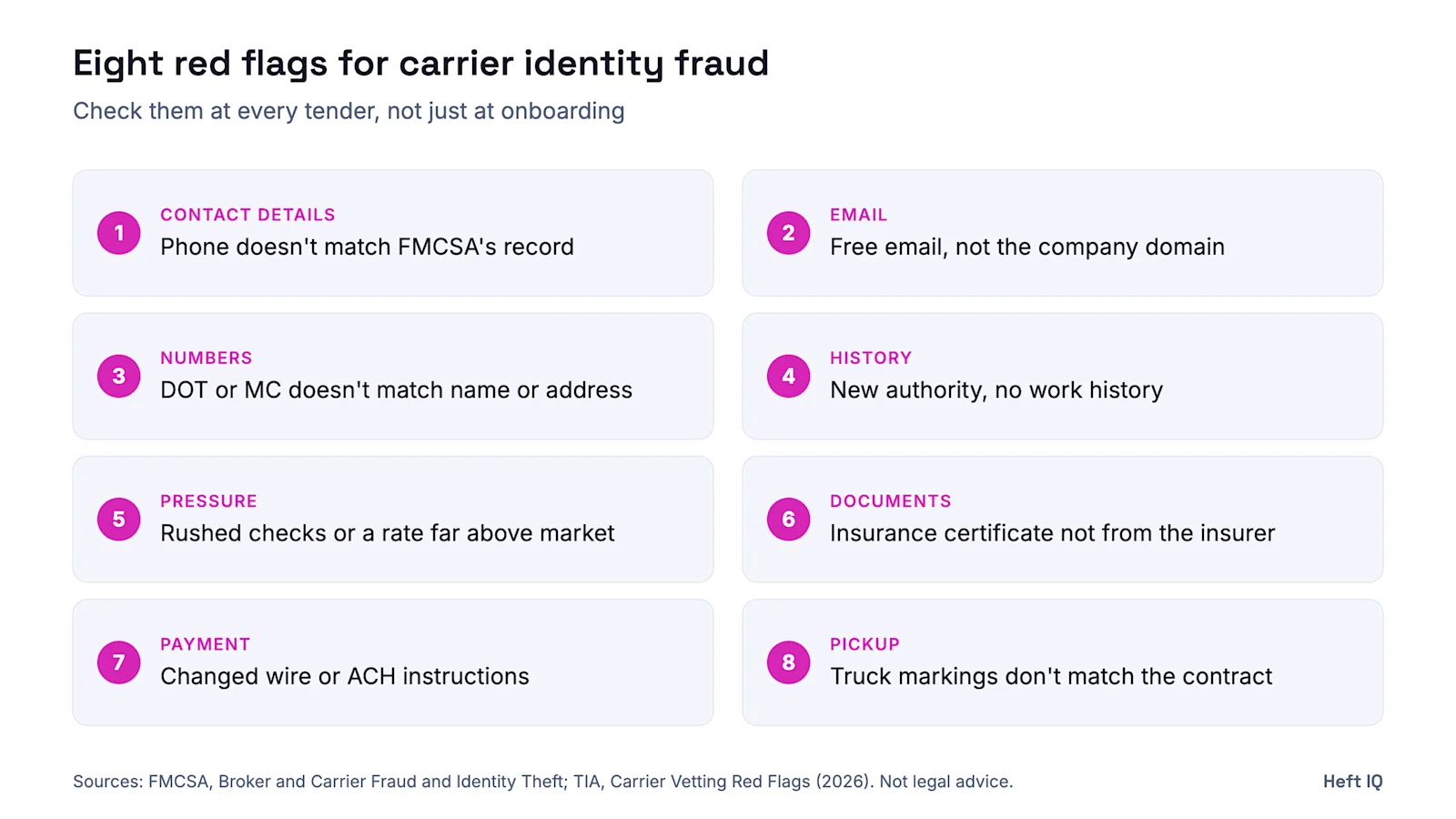
Contact details that don't match FMCSA. If the phone number you were given doesn't match the one in SAFER, call the SAFER number. FMCSA suggests considering not contracting with a carrier whose listing has no phone number.
Free email addresses. TIA notes carrier emails should match the company's domain, not a Gmail or Yahoo account.
Numbers that don't match the company. A DOT or MC number that doesn't match the company name or address.
New authority with no history. Newly issued authority and zero work history deserve extra checks and a lower load-value limit.
Pressure and shortcuts. Rushed verification, or a rate far above the market. FMCSA says to stop the transaction.
Documents that can be faked. FMCSA warns that even insurance certificates can be fraudulent. Get them from the insurer.
Changed payment instructions. TIA lists altered wire or ACH instructions among common payment schemes.
The wrong truck at pickup. Confirm the name and numbers on the truck that arrives match the carrier you contracted.
Checks that belong at every tender
Onboarding checks matter, but identities and authority change between loads. These belong at the moment of each tender:
Re-check authority and insurance. Active for-hire authority, and an insurance filing that's in force, not cancelled or pending.
Look at authority history. A carrier whose authority was revoked and re-granted, sometimes called a chameleon carrier, deserves a closer look.
Confirm identity against your approved record. Legal name, DBA and insurer should match what you approved. Contact through the details in FMCSA's record, not the ones in the email.
Weigh history on your own freight. Repeat no-shows and short histories should lower trust and limit what a carrier can be offered.
Stop, don't just warn. A carrier that fails a hard check shouldn't be bookable, and a borderline one should need a named approver.
Pay the right party. Keep a dated history of remit-to and factoring details, and require a notice of assignment before paying a factor.
Fraud gets in through the checks that only run at onboarding. Run them again at every tender, and keep a record that you did.
How Margo helps
Margo runs vetting at the moment of each tender and keeps the evidence.
Vetting at every tender. Authority, insurance filing status and safety are checked for each carrier option, and a cancelled or missing insurance filing blocks the carrier.
Authority history and age. Carriers whose authority was re-granted are flagged, and new authority lowers a carrier's trust score.
Identity checked at tender. Each carrier’s DOT and MC numbers, legal name, DBA and insurer are compared with the record saved when it was approved, and a carrier whose identity has changed is flagged or blocked.
Your carriers, plus new capacity. Bring in the carriers you already use from your rate sheets and carrier workbooks, and find vetted capacity you don’t know yet from FMCSA and QCMobile data, including Canadian carriers.
Blocks and approvals. A blocked carrier can't be booked, and a flagged one goes to a person for approval, with the reasons saved.
A decision record at tender. Which carriers were considered, what each check returned and why the chosen carrier won, kept unchanged.
Location checked at pickup. The driver’s device location is compared with the expected pickup location, so the truck that arrives is the one you booked.
Payment identity. A dated history of remit-to and factoring details, with a notice of assignment required before a factor is paid.
For the full vetting list, read A carrier vetting checklist for freight brokers. For why the record matters, read What Montgomery v. Caribe means for how brokers vet carriers.
Sources: 49 U.S.C. 14916; FMCSA, Broker and Carrier Fraud and Identity Theft (updated April 2025); 88 Fed. Reg. (June 16, 2023, FR Doc. 2023-13080) and 88 Fed. Reg. 78665 (Nov. 16, 2023); FMCSA, Motus launch announcement (May 19, 2026); TIA, State of Fraud in the Industry (April 2025) and Carrier Vetting Red Flags (Feb. 2026); Verisk CargoNet, 2025 cargo theft analysis (Jan. 2026).