
How to run a tariff impact analysis
A six-step method to find which products, suppliers and lanes a tariff change hits, what it does to landed cost, and what to do about refunds you may be owed.
Learie Hercules on LinkedIn (opens in a new tab), CEO, Heft IQ
6 min read
On this page
In 2026, the legal basis for U.S. tariffs changed three times in five months. Tariffs imposed under one statute were struck down, a temporary replacement was ruled unlawful and then expired, and a new set took effect under a different statute with different rates and exemptions. Each change landed on specific products from specific countries, and companies that could answer "what does this hit?" the same day made better decisions than those that waited for the next monthly close.
This guide sets out a repeatable tariff impact analysis: what changed, which of your products and suppliers it touches, what it does to landed cost, and what to do next, including money you may be owed. It is general guidance, not legal or customs advice. Confirm classifications and filings with your customs broker or trade counsel.
What changed in 2026
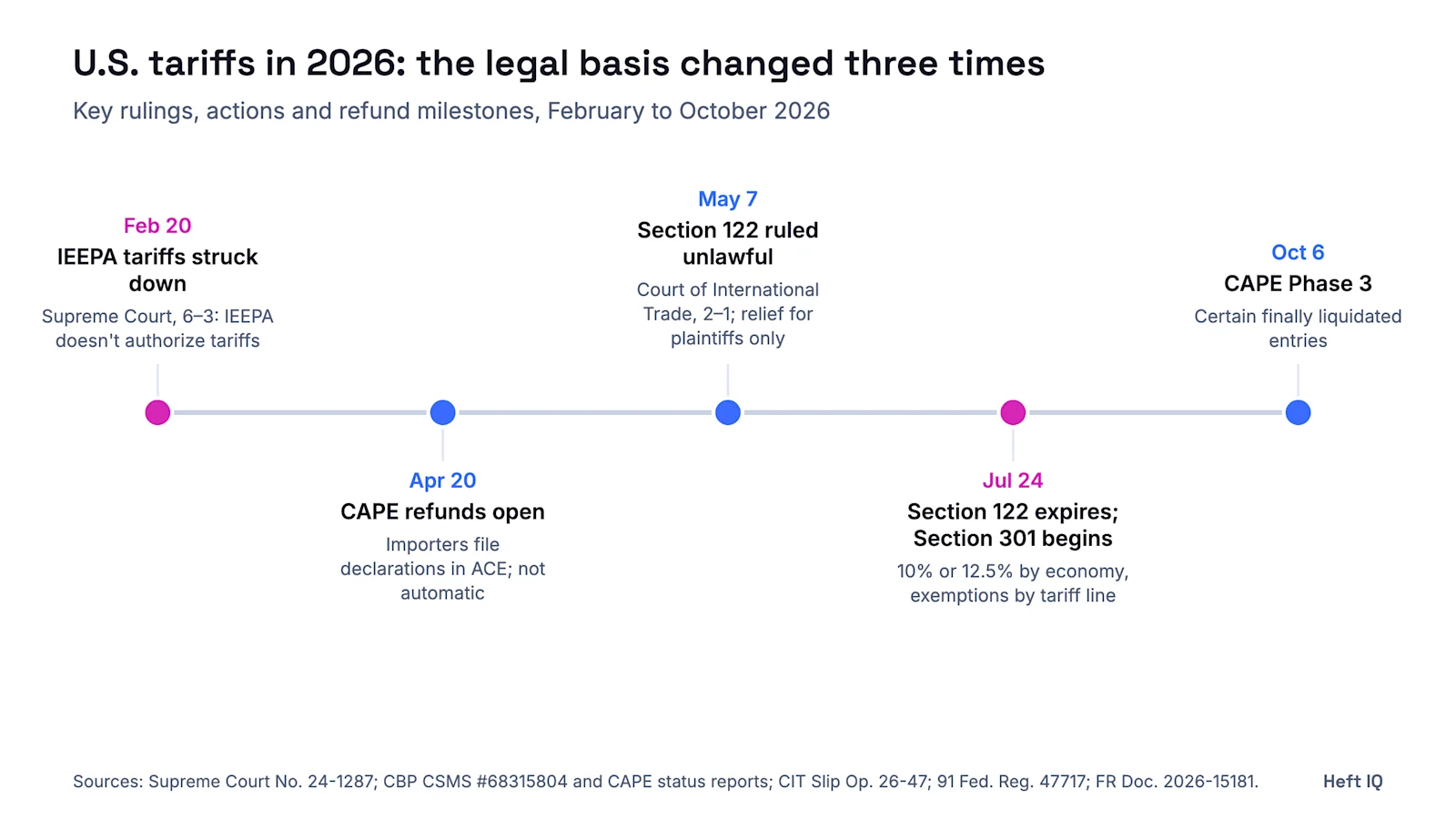
February 20: IEEPA tariffs struck down. In Learning Resources, Inc. v. Trump, the Supreme Court held 6–3 that "IEEPA does not authorize the President to impose tariffs." That covered the drug-trafficking tariffs on Canada, Mexico and China and the "reciprocal" tariffs on most trading partners. The Court did not decide how refunds would work.
April 20: refunds open, but not automatically. U.S. Customs and Border Protection launched CAPE in the ACE Portal. Importers or their brokers must file a CAPE declaration listing the entries to be refunded. CBP had collected about $166 billion in IEEPA duties. By September 11, it had accepted about $134.7 billion into CAPE and certified about $122 billion for payment. A third phase, for certain finally liquidated entries, opened October 6.
May 7: Section 122 tariff ruled unlawful. The Court of International Trade held 2–1 that the 10% global tariff imposed under Section 122 of the Trade Act of 1974 was unlawful, with relief limited to the plaintiffs. The government appealed, and the tariff expired on July 24 at the end of its 150-day limit.
July 24: Section 301 tariffs take effect. After investigating 60 economies' enforcement of forced-labor import bans, the U.S. imposed additional tariffs of 10% or 12.5% depending on the economy, with exemptions listed by tariff line in an annex. They apply to goods entered on or after 12:01 a.m. Eastern on July 24, with a narrow exception for goods already in transit.
The lesson for analysis isn't any one rate. It's that the answer depends on three things at once: the statute, the country of origin, and the exact tariff classification. An analysis that works at the level of "our China spend" will be wrong.
Step 1: Build the exposure base
Start with what you actually import, not what you buy. Pull twelve months of entry data, from ACE reports or your customs broker, at the line level:
HTS code (10-digit) and description
Country of origin, which is not always the country you ship from
Supplier and the products or SKUs each line feeds
Customs value, quantity and the duties paid, by type
Port of entry and the trade lane
Link each line to the products it goes into. A tariff on one component can matter more than a tariff on a finished good if that component sits in your top sellers.
Step 2: Map the change to your tariff lines
Read the notice itself, usually in the Federal Register, rather than a summary. For each action, note which countries are covered and at what rate, which HTS lines are exempt, how it interacts with duties you already pay, and the effective date, including any in-transit exception. Then join it to your exposure base. Every line comes out as hit, exempt or not covered.
Watch for the edges. Exemption annexes are written at the tariff-line level, so two products from the same supplier can land on opposite sides. Country of origin follows the goods, so a supplier that ships from one country may be making goods that originate in another.
Step 3: Size the landed cost effect
For each line that's hit, the additional duty is the new rate times the customs value. Add it to the existing landed cost (product, freight, insurance, existing duties and fees) and roll it up to the products each line feeds. Express it per unit and as a percentage, because the percentage is what tells you whether to absorb it, reprice or move volume.
Step 4: Decide what to do
Absorb when the increase is small relative to margin, or the change looks temporary. The 2026 rulings show how quickly a tariff's legal basis can move.
Reprice when the increase is material and the market will bear it. Price the specific products affected, not the whole catalog.
Re-source or shift origin when a qualified supplier in a lower-rate or exempt position exists. Factor in qualification time, minimums and freight.
Check the classification when a product sits on the edge of an exempt line. Get a ruling or your broker's view before relying on it.
Step 5: Recover what you're owed
If you paid IEEPA tariffs in 2025 or early 2026, check that every eligible entry has been claimed. Refunds through CAPE require a declaration from the importer or its broker. Entries in different liquidation states follow different paths and deadlines, so match each one to the right path with your broker. CBP also needs bank details on file to pay refunds by ACH.
Step 6: Watch for the next change
Tariff policy now moves through investigations, proposed actions, comment periods, final actions and court challenges, each with its own date. Set watches on the HTS lines, countries and suppliers in your exposure base, so the next notice is mapped to your business the day it's published, not after the first invoice arrives.
Illustrative example
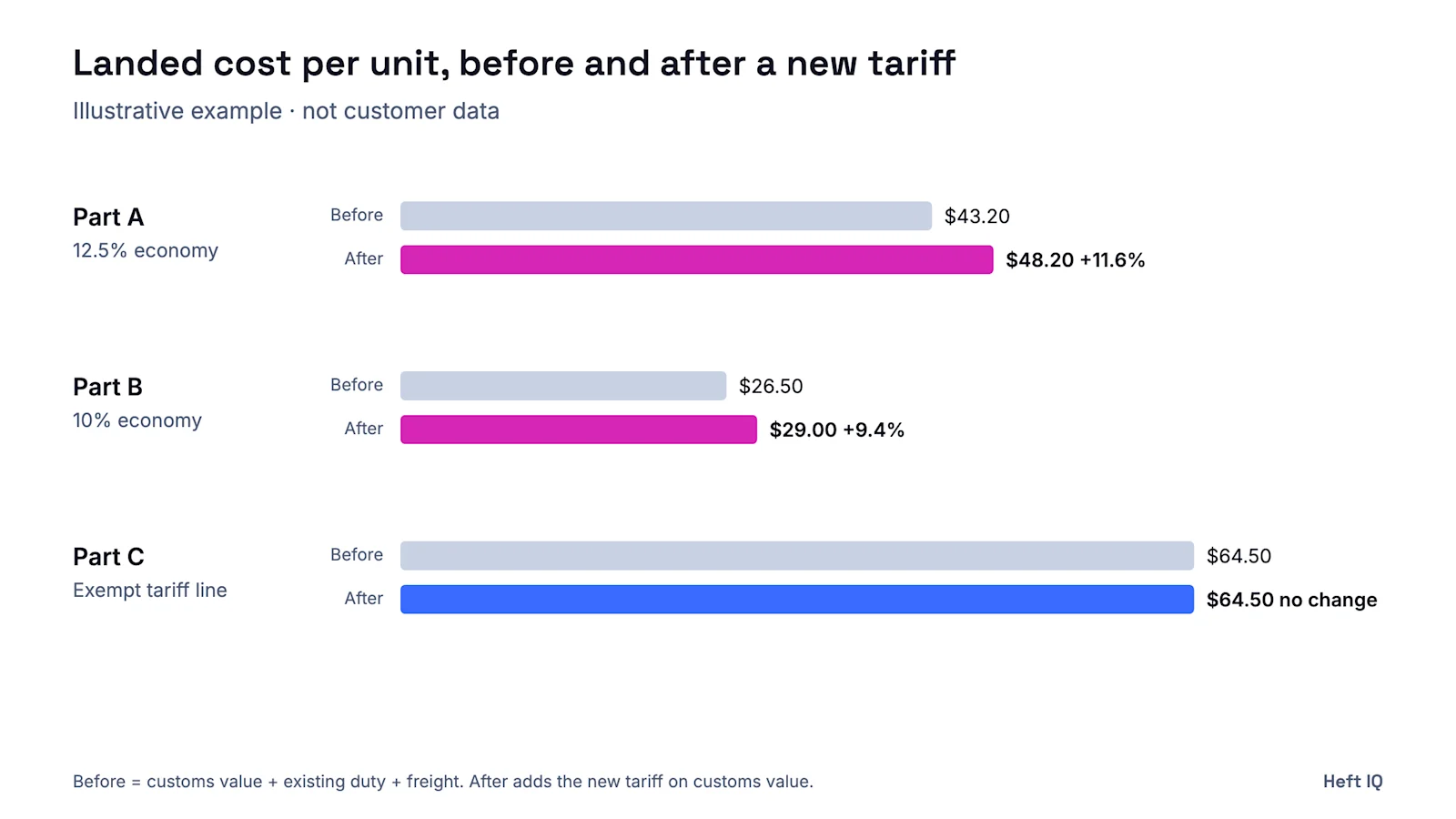
Illustrative example, not customer data. A manufacturer imports three components. Part A comes from a supplier in an economy at the 12.5% rate: customs value $40.00, existing duty $1.20 and freight $2.00, so the landed cost was $43.20. The new tariff adds $5.00, to $48.20, an increase of 11.6%. Part B comes from an economy at the 10% rate: value $25.00, no existing duty and $1.50 freight, so landed cost was $26.50. It goes up by $2.50 to $29.00, an increase of 9.4%. Part C is on an exempt tariff line: $64.50 before and after.
Part A feeds the company's two best-selling products, so the team reprices those and opens qualification with a second supplier. Part B's increase is absorbed for one quarter while the team watches the legal challenges. Part C needs no action, but its classification is checked to confirm the exemption holds.
How Atlas One helps
Atlas One watches the sources tariff changes come from and maps each change to your business on the day it's published.
Trade policy, mapped to HS codes. Federal Register notices, Congress, the EU and the WTO, matched to the HS codes, products, supplier locations and trade lanes in your confirmed profile.
Ranked, cited situations. Related evidence is grouped into one situation, ranked by how much of your business it touches, with links to the source documents.
What-if questions. Ask what a proposed action would hit before it's final, and compare scenarios such as shifting a component to another supplier.
Watches and owned follow-up. Set watches on your lines and countries, and turn each finding into an owned, dated item in the Action Queue, tracked until it's done.
Atlas One tells you what changed and where it touches your business. The landed cost math uses your own entry and cost data, and refund filings go through your customs broker. For the wider view, read How to trace a global disruption to your business and Catch a tariff change before it hits landed cost.
Sources: Supreme Court of the United States, Learning Resources, Inc. v. Trump, No. 24-1287 (Feb. 20, 2026); U.S. Customs and Border Protection, CSMS #68315804 (Apr. 10, 2026) and status reports to the Court of International Trade (2026); U.S. Court of International Trade, Slip Op. 26-47 (May 7, 2026); Presidential Memorandum of July 23, 2026, 91 Fed. Reg. 47717, and USTR notice, FR Doc. 2026-15181 (July 28, 2026).