
What sales tools a distributed team actually needs, before you renew for next year
Renewals and next year's budget land between Thanksgiving and January. Start from the six jobs every seller does, then decide what to keep, cut or consolidate.
Learie Hercules on LinkedIn (opens in a new tab), CEO, Heft IQ
4 min read
On this page
The weeks between Thanksgiving and January decide a sales team's next year. Software renewals come due, next year's budget gets set, kickoff plans get written, and buyers go quiet for the holidays. It's the one time of year when changing the stack is easy, and the time when it most often gets renewed on autopilot.
That matters more for distributed teams. When your sellers are agents, brokers, producers, field reps, resellers or franchise owners, they don't sit in one office or use one set of tools. Each extra tool is another place where buyer context goes missing between a call in the car and a follow-up three days later.
Why the stack keeps growing
Most sales stacks were bought one problem at a time: a prospecting database, then a sequencing tool, then something for call notes, then a content hub. Each one solved its problem. Together they create a new one. According to Salesforce's 2026 State of Sales research, sellers spend only about 40% of their time actually selling. Gartner found that sellers overwhelmed by their tools were 45% less likely to hit quota, and that about half of sellers said they were overwhelmed.
Distributed teams feel this first. A producer at an insurance agency or a rep in the field can't flip between nine tabs between meetings. What isn't easy on a phone doesn't get done.
Start from the jobs, not the tools
Before you look at renewal quotes, list the work every seller has to do to win a deal. For most distributed teams it's six jobs:
Find the right accounts. Not more leads, but accounts that look like the ones you've already won, with a reason to call now.
Prepare for the conversation. Know what the account cares about, who's in the room and what changed since the last call.
Follow up with the right message. Outreach and follow-ups grounded in the account, not a template with the name swapped in.
Practice the hard conversation. Rehearse the objections a CFO or a technical evaluator will raise, before the real meeting.
Know what needs attention. Deals going quiet, promises overdue, champions who have changed jobs, ranked so each seller knows where to start.
Learn from every deal. What worked and what didn't, captured in a minute and surfaced to the next seller facing a similar account.
Then map each job to what your team actually uses today, and to who uses it. The gaps and the overlaps show up quickly.
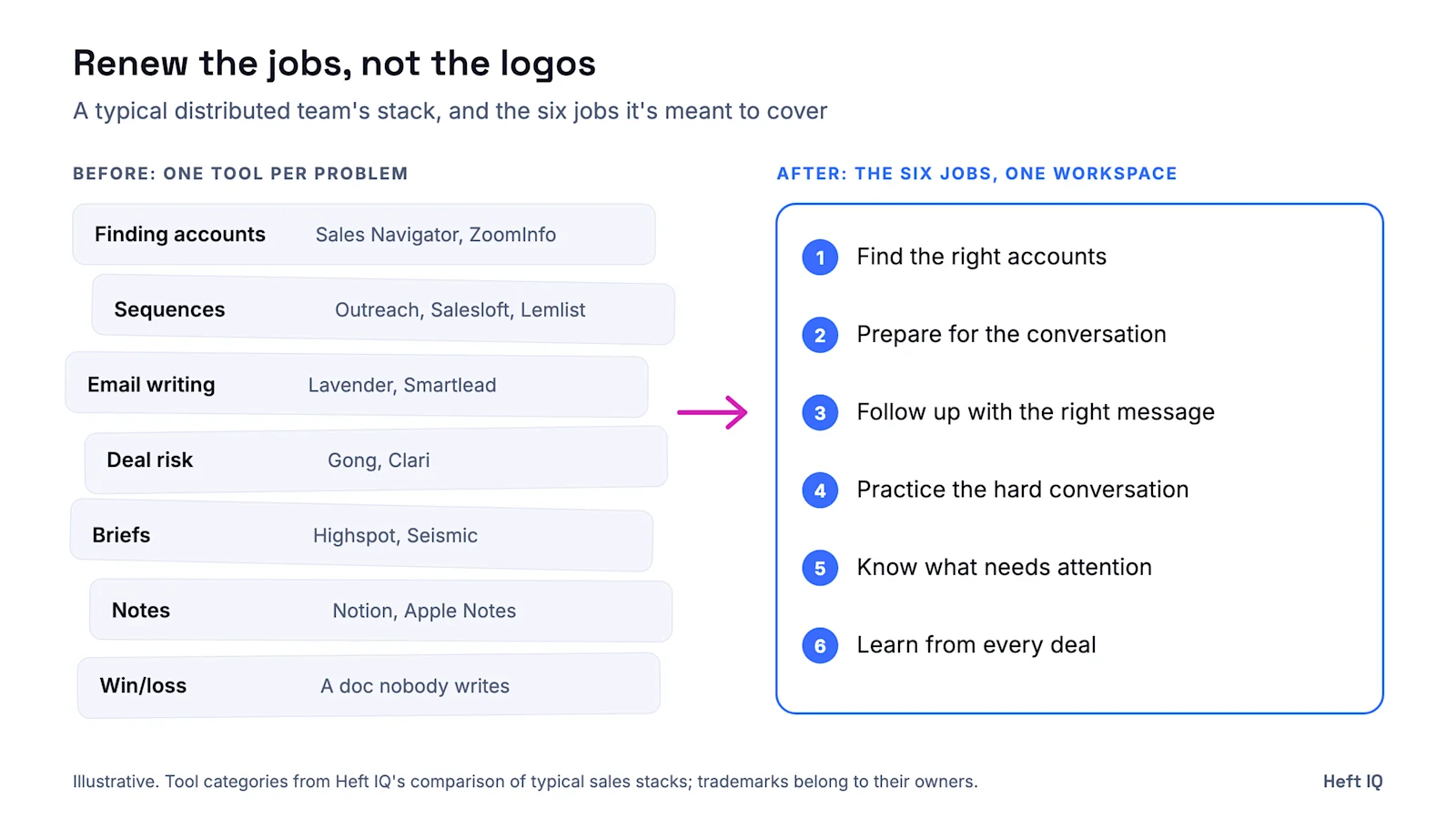
What the stack usually looks like
Finding accounts: LinkedIn Sales Navigator, ZoomInfo
Sequences and email: Outreach, Salesloft, Lemlist, plus a writing assistant such as Lavender or Smartlead
Deal risk and forecasting: Gong, Clari
Briefs and documents: Highspot, Seismic
Notes: Notion, Apple Notes, or whatever is on the seller's phone
Win/loss: a post-mortem document nobody writes
Across a team, these tools typically run $8,000 to $32,000 a year in list price, based on Heft IQ's tally of published pricing. The bigger cost is the context lost between them. A promise made on a call lives in one app, the prospect research in another, and the follow-up in a third. None of them knows the deal has gone quiet.
Questions to ask before you renew
Which of the six jobs does this tool do, and who on the team actually uses it each week?
Can a seller use it from a phone, between meetings or on the road?
Does it know about the deal, or does someone have to copy context in by hand?
Does it tell sellers what needs them today, or wait for someone to open a dashboard?
Does anything from it make the next seller better, or does the lesson leave with the person who closed the deal?
If we cut it, what breaks, and could another tool we already pay for cover it?
Renew the jobs, not the logos. The holiday weeks are when a stack can change without disrupting anyone.
Illustrative example
Illustrative example, not customer data. A 20-producer insurance agency lists its tools before renewal season. It pays for a prospecting database three producers use, a sequencing tool most producers never set up, a call recorder used by managers, and a content library nobody can find things in. Notes live in personal apps. The agency maps all of it to the six jobs and finds two jobs with no real coverage: knowing which deals need attention, and learning from closed deals. It also finds three tools doing overlapping work. It consolidates before January, and the money saved pays for the two jobs it was missing.
How Thread helps
Thread is deal intelligence for distributed sales teams. It covers all six jobs in one workspace and keeps your CRM as the system of record.
Find: lookalike prospects that resemble your wins, flagged when they're in the news.
Prepare: an account brief at the top of every deal, a buyer map, and meeting prep before each call.
Follow up: three-step sequences and follow-ups written from the research, which you review before anything sends.
Practice: Practice Run, which rehearses the call against the persona you'll meet.
Focus: a ranked list of what needs each seller today, including deals going quiet, overdue promises and champion moves.
Learn: a 60-second debrief after every close that surfaces in the next similar deal.
On the road: Ask Thread by voice. "Remind me to ask Sally for an intro." "Email me a close plan for this deal."
Teams can try Thread free for 7 days, with no credit card, and run a real deal through it before renewal season ends. For more on keeping pipeline moving through the holidays, read Why partner deals slip quietly before year-end and What stalls pipeline before year-end close.