
Carrier no-shows during Thanksgiving week: a recovery playbook for brokers
Thanksgiving week compresses capacity into fewer working days. Here's how to plan backup carriers, catch a no-show early, and recover the load without giving away the margin.
Learie Hercules on LinkedIn (opens in a new tab), CEO, Heft IQ
4 min read
On this page
Thanksgiving falls on November 26 this year, and the week before it is one of the hardest of the year to cover freight. In 2024, DAT reported that loads moved in the shortened pre-Thanksgiving week fell 18%, yet there was still a shortage of capacity, because truck postings on its load board fell 31%. Last year, with the holiday late in the month, DAT said freight crowded into the final week of November, and once the holiday passed, dry van load posts more than doubled.
A no-show in a normal week is a bad morning. In Thanksgiving week it can be a lost customer: many shippers and receivers keep holiday hours, capacity thins out, and the window to re-cover a load is measured in hours. This playbook covers what to do before the week, how to catch a no-show while there's still time, and what to do after. For what a no-show actually costs, read What a peak-season carrier no-show really costs to recover.
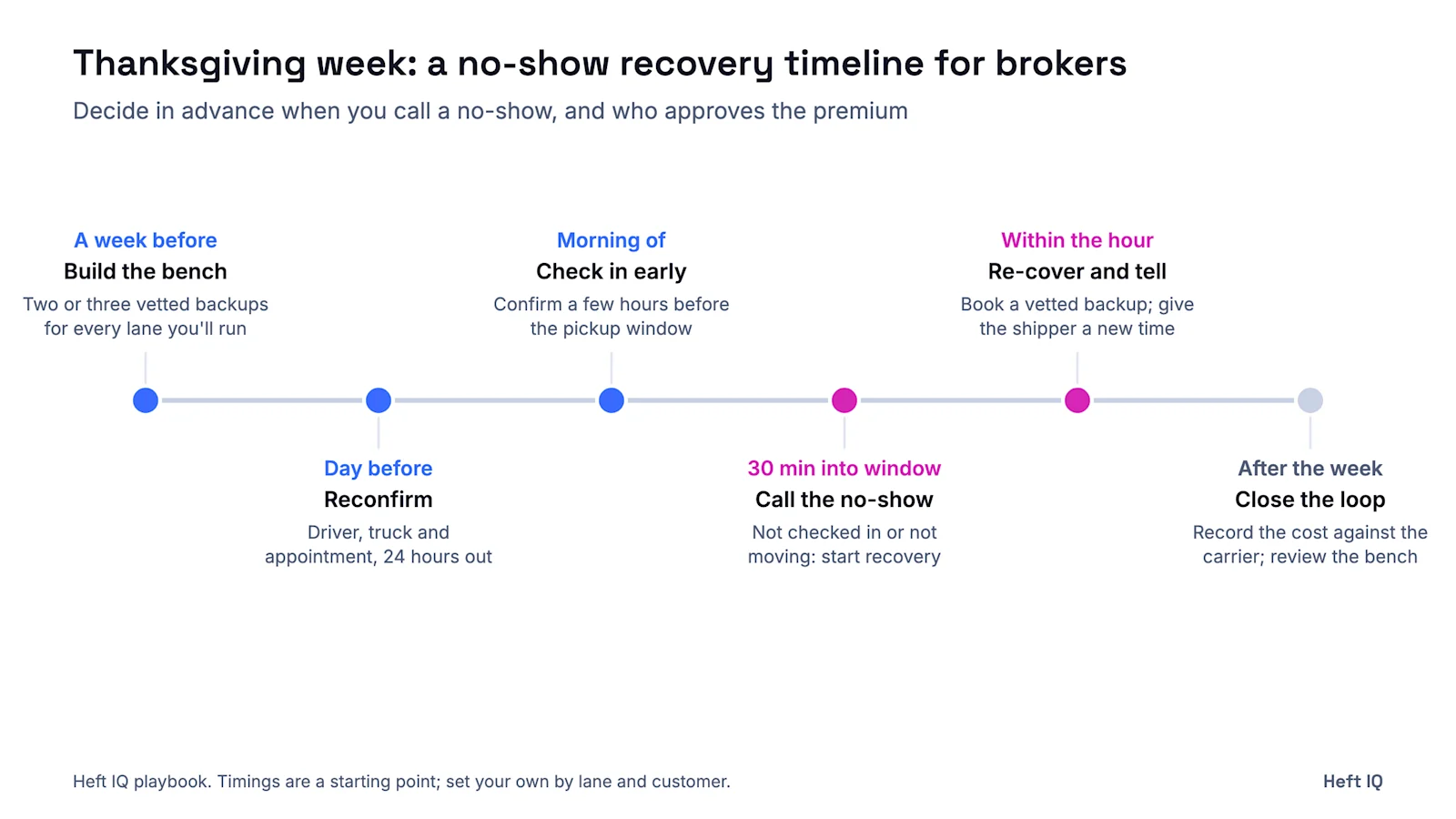
Before the week: plan for the no-show you'll get
Know which loads matter most. List the loads that deliver into tight receiving windows, carry penalties, or serve your largest customers. Those get your most reliable carriers and a named backup.
Build a backup bench by lane. For every lane you'll run that week, have two or three carriers vetted and ready, not just a list of names. Check authority, insurance and their history on your freight now, not at 6 a.m. on the day.
Tender early and confirm in writing. Holiday capacity goes quickly. Tender as early as the customer allows and get confirmed rate confirmations back.
Agree on the approval line. Decide in advance how much of a re-cover premium a rep can approve alone and when a manager signs off, so nobody waits for a decision mid-crisis.
Tell customers the plan. For critical loads, agree with the shipper how you'll communicate if a truck falls through.
During the week: catch it early
Confirm the day before. Reconfirm driver, truck and appointment 24 hours out. A carrier that can't name the driver is a warning.
Confirm again the morning of. A check-in a few hours before pickup catches most problems while backup capacity is still available.
Watch the pickup window, not the end of it. If the truck isn't checked in or moving toward the shipper by a set point, such as 30 minutes into the window, treat it as a no-show and start recovery. Waiting to be sure costs the hours you need.
Re-cover from the vetted bench first. Go to the backup carriers you already checked for that lane before the open market, and make sure the replacement passes the same checks.
Keep the customer informed. Tell the shipper and receiver what happened, the new pickup time and the new ETA, before they have to ask.
The difference between a recovered load and a lost customer is usually the first hour. Decide in advance when you'll call it a no-show.
After the week: close the loop
Record the cost. The re-cover premium, any detention or penalties, and the time spent, recorded against the carrier that didn't show.
Recover what you can. Pursue chargebacks your carrier agreement allows, and keep the evidence.
Update how you use the carrier. A repeat no-show should lower a carrier's standing and limit which loads it's offered.
Review the bench. Which backups answered, which didn't, and which lanes need deeper coverage before Christmas?
Illustrative example
Illustrative example, not customer data. On the Tuesday before Thanksgiving, a truck booked for a 7 a.m. pickup hasn't checked in by 7:30. The rep calls it a no-show, offers the load to two pre-vetted backups on that lane, and books one at a $350 premium, within the rep's pre-agreed approval limit. The shipper is told the new pickup time by 7:50, and the load delivers before the receiver closes Wednesday. Afterward, the premium is recorded against the original carrier, which had a second no-show in October, and that carrier comes off the bench for December's critical loads.
How Margo helps
Margo is built for brokers, and it treats a no-show as something to catch and recover, not just log.
Lane coverage depth, now and in 30 days. See how deep your vetted capacity is on each lane before the week starts, including carriers from FMCSA and QCMobile data and your own carriers from rate sheets and workbooks.
Vetting at every tender. Authority, insurance, safety, trust and identity are checked for the original carrier and the replacement alike.
Location checked at pickup. The driver's device location is compared with the expected pickup location.
No-show detection and recovery. No-shows are detected and escalated, and Margo can rank and book vetted replacements automatically inside a window where any automatic action can be undone, or wait for a person to approve.
The cost on the record. The re-cover premium and chargeback land against the carrier in Margin Command, repeat no-shows lower its trust, and the follow-up is an owned, dated item in the Action Queue.
For the vetting side, read A carrier vetting checklist for freight brokers.
Sources: DAT, Dry Van Report (Dec. 3, 2024) and Dry Van Report (Dec. 9, 2025); DAT, November truckload volumes release (Dec. 19, 2025).